Rangers v St Johnstone red card gets universal verdict as pundit insists referee was ‘conflicted’

The best sendings-off are the ones nobody argues about, and the worst are the ones that take several minutes and leave the stadium unsure what has just happened. The red card shown to Kai Fotheringham in Rangers’ 4-0 win over St Johnstone on Saturday belongs firmly in the second category. It arrived after a delay long enough to prompt questions, it was confirmed by a referee who had initially seen nothing worth a dismissal, and it has since divided the experts. A Daily Record headline described the reaction as a universal verdict, while also noting that one pundit insisted the referee was conflicted. Those two claims do not sit comfortably together, and the gap between them is where the story really lies.
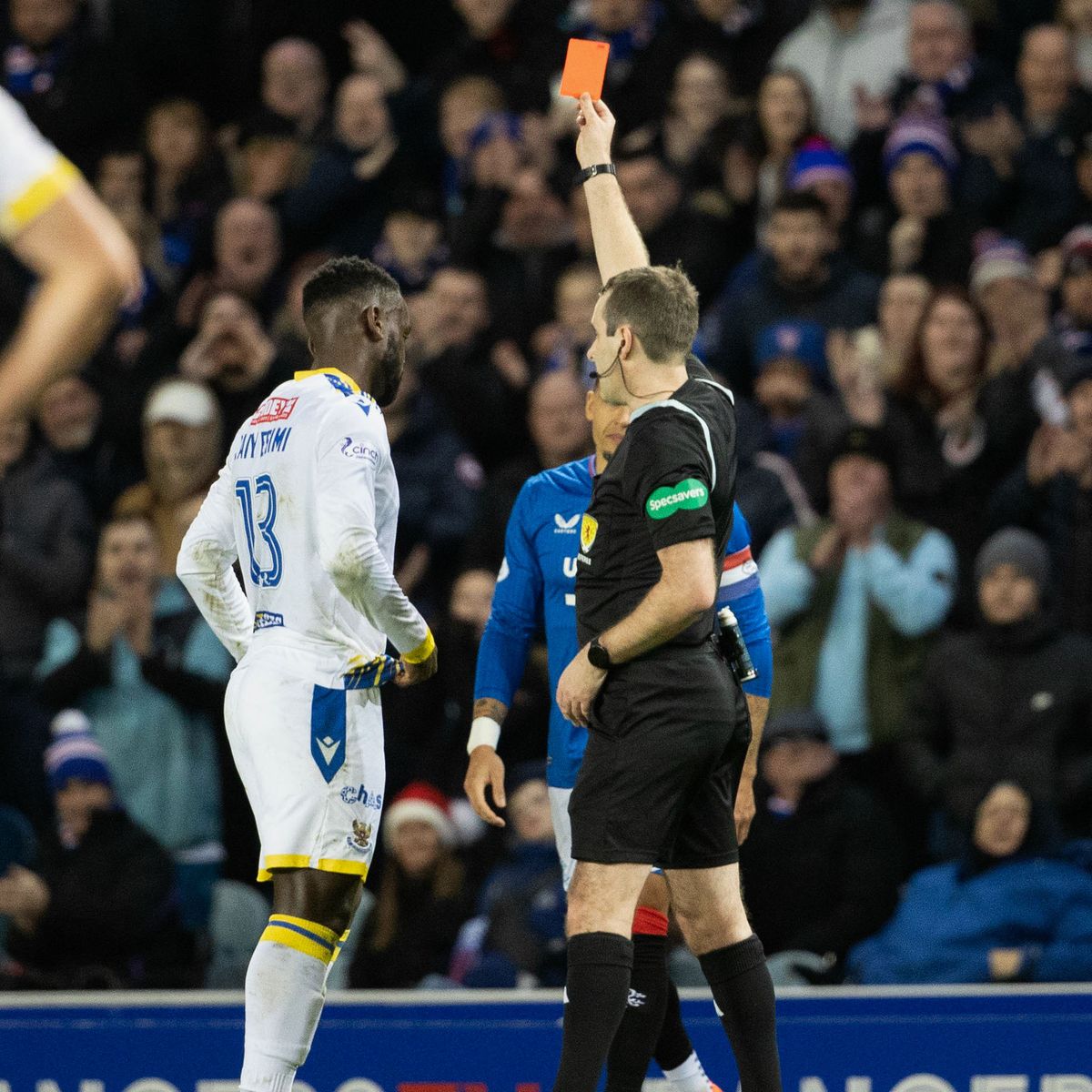
The facts of the incident are not in dispute. In the 74th minute, with Rangers 3-0 ahead after Kevin Kelsy’s second goal and rain pouring down at Ibrox, Fotheringham lunged into Nicolas Raskin, and the contact came above the ankle on the follow-through. On-field referee Chris Graham initially allowed play to continue, but after a VAR review he was advised to consult the pitchside monitor, and following a lengthy delay he issued a straight red card. The video assistant was Andrew Dallas, and it was his intervention that brought the incident back to the referee’s attention. The player was seen pleading his innocence before and after the decision, and St Johnstone were reduced to ten men for the final quarter of an hour.
The sequence matters, because it shows how the process is meant to work. Graham, who was close to the action, did not consider the challenge serious enough to warrant a red card, and he allowed the game to continue. That is a reasonable first reaction in real time, because tackles on a wet pitch happen quickly and the referee has to judge speed, contact and intent in a split second. Dallas, with access to multiple replays, saw something different, and he recommended that Graham look again. This is exactly what VAR is for. It exists to catch situations in which the referee’s initial view may have missed a clear and obvious error, and it gives him the chance to reconsider with better information.
What happened next has been the subject of debate. Graham walked to the monitor, watched the footage and eventually reached a decision, and the length of the delay was noticeable. James McFadden, speaking on BBC Sportscene, said that he did not understand why the referee was taking so long and that it told him the official was conflicted. He added that he felt for the player, and he was careful to describe the challenge fairly. He said that Fotheringham went to ground, won the ball and caught Raskin on the follow-through above the ankle, which he would normally describe as an easy red card, but that he did not think there was an enormous amount of force in it. That is a more balanced position than some of the headlines suggest. McFadden recognised that the challenge fitted the standard pattern for a red card and still argued that the circumstances made it harsh.
His fellow pundit Steven Thompson was more direct. He said that, for him, there was no endangering of a player and no malice in the tackle. McFadden went further in applying the language of the law, asking whether the challenge was one that endangered an opponent or used excessive force or brutality, and concluding that he did not think it was. He also observed that the freeze-frame, the still image that tends to dominate social media, made the tackle look worse than it did in motion. That is a fair point, and it is one that referees themselves often make. A single frame can make a challenge look reckless in a way that the full sequence does not, and viewers should be wary of drawing conclusions from images alone.
On the other side of the argument stood Keith Hackett, the former FIFA referee, who was asked about the decision by Ibrox News. His view was that the referee had judged the action to be serious foul play and that, despite the player’s protests, he was left with no option but to show a red card. That is a very different reading from the one given by McFadden and Thompson, and it reflects the way that experienced referees tend to approach these incidents. Where the former players focus on what the tackler intended and on how much force was involved, the former official focuses on what the law requires. The question is not whether the player meant any harm, but whether the challenge met the threshold for serious foul play.
That threshold is worth spelling out, because it explains why the red card was defensible even if it felt harsh. Under the laws of the game, serious foul play includes any tackle or challenge that endangers the safety of an opponent or uses excessive force or brutality. A lunging challenge with studs showing, making contact above the ankle, is a textbook example of the first category, because it exposes the opponent’s leg to the risk of serious injury. Intent is not part of the test. A player can win the ball, intend no harm and still be sent off if the manner of the challenge puts an opponent at risk. The lawmakers made that choice deliberately, because they decided that player safety should outweigh sympathy for the tackler.
That is the heart of the disagreement. McFadden and Thompson are measuring the challenge against a traditional sense of fairness, in which winning the ball and lacking malice should count heavily in a player’s favour. Hackett and the referees are measuring it against the current law, in which the risk created by a challenge is what matters. Both approaches have a long history in football, and the tension between them is not new. What has changed is that the modern game has moved decisively towards the safety-first interpretation, and that shift is one of the reasons that so many tackles that would once have been tolerated now attract a red card. It is a change that many supporters, particularly older ones, still find hard to accept.
The weather deserves a mention too. Ibrox was subjected to torrential rain and strong winds from Storm Boelo, and a wet pitch makes slide tackles travel further and faster than on a dry surface. Defenders and midfielders are expected to adjust their challenges to the conditions, and a player who goes in with the same commitment as he would on a dry pitch is taking an extra risk. That cuts both ways in the debate. On one hand, the conditions might explain why Fotheringham lost control of his slide, which supports the argument that there was no malice. On the other, it reinforces the point that he should have allowed for the surface, and that the extra speed made the challenge more dangerous. It is not a mitigating factor under the law, although it may help to explain what happened.
Then there is the question of the delay, which is where the word conflicted comes from. It is tempting to read a long review as evidence of doubt, and many viewers will have done exactly that. But the length of a review depends on several factors, including the number of camera angles, the speed of the replays and the need to communicate with the video assistant. A decision that seems obvious to a spectator can take several minutes to confirm properly, and the referee has a responsibility to be thorough. If anything, a careful review is a sign that the official is taking the decision seriously. The alternative, a rushed decision that turns out to be wrong, would draw far more criticism.
It is also worth noting the lesson that Scottish football’s head of referees, Willie Collum, drew earlier this week when he admitted that VAR officials had been too hasty in dealing with incidents involving Rangers and Celtic. His message was that significant decisions deserve a longer, more careful check. The review at Ibrox was precisely that, a longer and more careful look at a serious incident. It would be inconsistent to criticise officials for moving too quickly one week and for moving too slowly the next. The better conclusion is that the system is being asked to find a balance, and that the process in this case appeared to be the one that the authorities want.
None of this means that McFadden’s comment should be dismissed. A referee who changes his mind after a review is inevitably showing that the decision was not obvious, and that is a legitimate observation. Graham did not think the challenge deserved a red card in the first instance, and he had a good view of it. If a referee with a clear sight of the incident concluded that it was not serious enough, there is a reasonable argument that the decision was a close one, and that the threshold for overturning it should be high. VAR protocols are supposed to respect that principle, intervening only when the original decision was a clear and obvious error. The fact that Dallas intervened suggests that he considered it just that, but the debate is a fair one to have.
What about the claim of a universal verdict? The evidence does not support it. The reports show that McFadden and Thompson disagreed with the red card, that Hackett agreed with it, and that St Johnstone’s manager, Simo Valakari, said he had no complaints. That is a split verdict, not a unanimous one, and headlines that suggest otherwise are probably referring to the fact that most commentators accepted that the decision had been made correctly under the law, even if some felt it was unlucky. The distinction between a decision being technically right and being fair is one that football discussions often blur. It is perfectly possible to think that a red card was justified by the rules and that it still felt like a harsh punishment.
For Fotheringham, the consequences are real if not dramatic. A red card for serious foul play carries an automatic suspension, the length of which is set by the Scottish FA’s disciplinary rules, and he will miss matches that his team might have wanted him for. He is a 23-year-old attacker who had come on as a substitute, and the incident will be a lesson in the dangers of committing to a challenge in wet conditions. His protests suggest that he believed he had won the ball cleanly, which is a natural reaction, but the law judges the challenge by its manner as well as its outcome. If he learns from it, the experience may prove useful, and there is no reason to think that his career will be affected.
For Rangers, the incident was largely irrelevant to the result. They were three goals ahead, they had the match under control and they added a fourth in the closing minutes through Tochi Chukwuani. Raskin, the victim of the challenge, continued to play, and the reports do not suggest that he was injured. The main significance for the home side is that they moved to within a point of Celtic and extended their unbeaten run, with a fixture against Hearts on Wednesday to come. A red card in a 3-0 win is a footnote for the winners, and McInnes was more interested in discussing the performance of his team than in debating a decision that did not affect the outcome.
The wider lesson is about communication. A great deal of the confusion around incidents like this comes from the fact that viewers and listeners do not hear what the referee and the video assistant are saying to each other. When the audio is released, as it is on the weekly VAR Review Show, the reasoning is often much clearer than the television coverage suggested, and the controversy tends to fade. If more of that information were available in real time, through a stadium announcement or a broadcast explanation, a lot of the speculation about whether a referee was conflicted could be avoided. Scottish football has taken steps in that direction, and the case for going further is a strong one.
It is also a reminder that referees are not machines. They are human beings who make judgements under pressure, and who sometimes change their minds when they see new evidence. That should be regarded as a strength rather than a weakness. An official who sticks rigidly to his first impression, regardless of what the replays show, is no better than one who makes a rash decision. The ability to look again, to reconsider and to reach a different conclusion is the whole point of video review, and it deserves to be respected. The alternative, a system in which referees are afraid to reverse themselves, would be much worse.
In the end, the red card for Fotheringham was a decision that could be argued either way, but that fitted comfortably within the law as it is currently written. The tackle was a lunge, it made contact above the ankle, and it was made on a slippery pitch where the risk of injury was elevated. Those are the ingredients of serious foul play, whatever the player’s intentions. McFadden and Thompson raised fair points about the lack of malice and the modest amount of force, and their view will appeal to many supporters. But the referee and the video assistant applied the standard that the lawmakers have set, and the process was thorough. That is not a universal verdict, but it is a defensible one.
For supporters and pundits, the most constructive response may be to accept that a decision can be both correct and unlucky. Football is full of moments in which the letter of the law produces an outcome that feels harsh, and the sport has to decide how much weight to give to fairness and how much to safety. At present the scales are tilted towards safety, and there are good reasons for that. If it means that a few more challenges are punished with red cards, including some that look innocent in the moment, that may be a price worth paying. The incident at Ibrox will be forgotten soon enough, but the principle behind it will remai