‘Without question’ – Willie Collum admits Rangers and Celtic VAR errors as Hearts gripes addressed

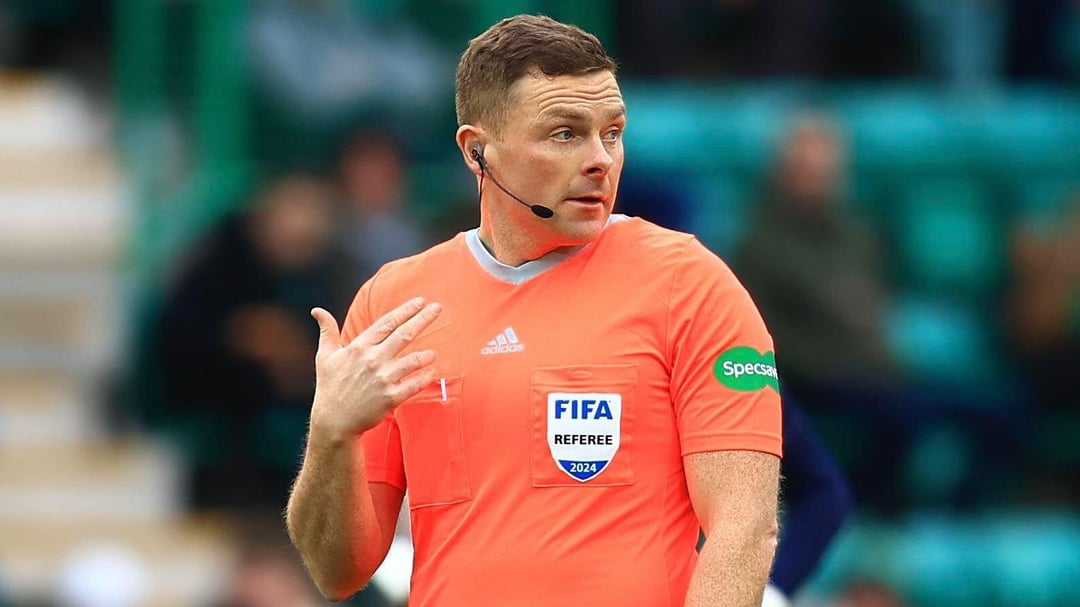
Scottish football has a weekly ritual that few other leagues can match. After every round of Premiership matches, the head of refereeing sits down in front of the cameras, plays the audio from the VAR room and explains, in public, what his officials got right and what they got wrong. It is an unusual act of transparency, and this week it produced an unusually frank result. Willie Collum, the Scottish FA’s head of referees, admitted that Rangers should have conceded a penalty against St Mirren, that Celtic should have been awarded one at Motherwell and that his officials took too little time over both. He also used the same programme to defend a disallowed Hearts goal that has been the subject of angry debate for weeks. Taken together, the three incidents say a good deal about how VAR is working in Scotland, and about where it is not.
Begin with the Ibrox decision, because it carries the most weight. Rangers beat St Mirren 1-0 in the Premiership last month, thanks to a stoppage-time goal from substitute Bojan Miovski, and it was the kind of late winner that supporters remember. What they may have forgotten is a moment in the first half, when the match was still goalless. Rangers defender Emmanuel Fernandez stepped on the foot of St Mirren attacker Ismael Kabia inside the box, and the incident was missed by referee Don Robertson. The video assistant, Steven McLean, checked it briefly and decided that no review was needed. His verdict, as relayed on the programme, was that the St Mirren player had effectively run into the defender, and the match carried on.
Collum disagreed, and he did so in language that left little room for doubt. He said that it should have been a longer check without a doubt, and that for the referees’ department this was a penalty kick, without question. He went further, saying that the challenge fell into the category of reckless, which means that a yellow card for Fernandez would have been expected as well. That is a significant admission. It means that the officials did not simply miss a marginal decision. They missed a clear offence, and then failed to take the time to look at it properly, which is the specific thing the VAR process exists to prevent. A penalty at 0-0 would have changed the shape of the match, and it1 might have changed the result.
The consequences are easy to state and impossible to repair. St Mirren, a club with limited resources and little margin for error, lost a game that they might have drawn or even won if the penalty had been awarded and converted. They received no compensation, and none is possible, because the decision stands and the three points belong to Rangers. One commentary on the story put it bluntly, describing Rangers as one incorrect decision up and two points better off. That is a fair summary of the situation, although it is worth noting that the same phrase applies to the way the result was reached, not to anything the Rangers players did. A defender is not expected to point out a missed foul, and the blame lies with the officials rather than the team.
The second incident involved Celtic, and it has an almost perfect symmetry with the first. In the 2-0 win at Fir Park a fortnight ago, a second-half, goal-bound shot from Callum McGregor struck the arm of Motherwell’s Lukas Fadinger, but despite a VAR check no offence was found. The match referee, Steven McLean, allowed play to continue and awarded only a corner. The video assistant on that occasion was Don Robertson, who did not recommend an on-field review. Refereeing pundits were united in the aftermath that Celtic should have had a penalty, and Collum has now confirmed it. He conceded that the arm was in a position that made it a spot-kick, and that VAR was wrong not to ask the referee to look at the pitchside monitor.
It is worth pausing on the fact that the same two officials were involved in both errors, swapping roles between the two matches. Robertson was the referee at Ibrox and McLean was the video assistant, while at Fir Park McLean was the referee and Robertson the video assistant. In each case, the officials working in the VAR room failed to recommend a review of an incident that the head of refereeing now says was a clear penalty. That is not necessarily evidence of a systemic problem, because mistakes happen to every official, and two incidents in a month do not make a pattern. But it does raise a question about whether the way VAR teams are assembled is producing the best results, and whether the small pool of top-flight officials in Scotland makes it hard to avoid repetition.
For Celtic, the error had no effect on the result, since they won 2-0 anyway, which makes it less consequential than the Ibrox decision. But it matters for another reason, which is that it undermines the argument that mistakes tend to favour one of the two big clubs over the other. In this case, one went in Rangers’ favour and one went against Celtic, and neither was the result of any kind of bias. They were simply errors, made by officials who were working under pressure in a fast-moving environment. Supporters of both clubs will no doubt draw their own conclusions, but the facts suggest that the officials are fallible rather than partisan. That is not an excuse, but it is a more accurate description of what is happening.
The third strand of the story concerns Hearts, and it is the one that has generated the most heat. Last month, in their 1-1 draw at Kilmarnock, Hearts thought they had taken the lead when a shot from Laurent Mendy, with the game still goalless, appeared to be heading wide before it was deflected into his own net by Kilmarnock defender Cathal McCarthy. After a VAR review, officials decided that Mendy had brought the ball down with his hand earlier in the move, and the goal was disallowed. Hearts were furious, because the midfielder was not, in their view, the scorer of the goal. It was an own goal, and under the handball law as many understand it, a handball by someone other than the scorer does not necessarily invalidate the goal.
That is the heart of the dispute. Under the law, a goal is disallowed if the player who scores it has handled the ball in the build-up. If the goal is an own goal, the situation is less clear, because the person who put the ball into the net did so by accident and was not the attacker. Hearts, and a number of pundits, argued that the shot was heading wide, which would make McCarthy the scorer and Mendy merely the player who started the move. Former Hearts midfielder Andy Halliday said that a behind-the-goal angle appeared to show the ball bending outside the post, which would mean that the goal should have stood. The club sought clarification from the Scottish FA, and the matter has been simmering ever since.
Collum’s answer, delivered on the show, was that the decision was fully correct. He argued that the actions of the Kilmarnock defender were not controlled, and that in law the goal needed to be disallowed. He offered an analogy to make the point, suggesting that if the defender were replaced with a goalkeeper who got a fingertip to the ball, people would still say the goal should be ruled out. He added that if the defender were a Hearts attacker, he would be in an offside position, which meant that the same logic applied. It is a technical argument, and it is not hard to see why it has not convinced everyone. But it is consistent with the way the law is interpreted in Scotland, where the focus is on whether the handball had a direct impact on the goal, not on who put the ball in the net.
The debate also has an English dimension. Supporters pointed to a Premier League match in which Harry Maguire’s accidental handball led to a goal that was allowed to stand, because he was not deemed to be the immediate scorer. That decision was explained by the Premier League as a correct application of the law, and Hearts fans naturally asked why a similar principle did not apply at Rugby Park. Collum’s answer, as far as it can be gathered from the reports, is that the circumstances were different, and that the Scottish officials applied the law as it is written. It is a reasonable position, but it also highlights the confusion that can arise when different leagues interpret the same rule in different ways.
What links these three incidents, apart from the fact that they were all discussed on the same show, is the question of how long VAR should take to reach a decision. Collum’s verdict on the Rangers and Celtic errors was that the check should have been longer, and that is a recurring theme in criticism of the system. When a VAR official clears an incident quickly, the supporters at the ground see the match restart and assume that nothing was wrong. If the quick check turns out to be mistaken, the damage has been done before anyone can intervene. A slower, more thorough process might produce more accurate decisions, but it would also delay play, and fans have never been fond of lengthy reviews.
There is a balance to be struck, and Collum’s comments suggest that the officials have not yet found it. The VAR protocol is designed to correct clear and obvious errors, which means that the video assistant should not intervene in marginal cases but should be thorough in looking at significant incidents. A challenge on a player’s foot inside the penalty area is a significant incident, and a goal-bound shot hitting an arm is another. Both deserved a longer look, and both would probably have been given as penalties if the officials had taken it. The failure to do so is a lapse in process rather than a difference of opinion, and it is the kind of lapse that Collum has now acknowledged publicly.
The public acknowledgement itself deserves some credit. Many leagues around the world do not hold their officials to account in this way, and supporters in those countries often have to guess at the reasons for controversial decisions. Scottish football, by contrast, has a weekly programme in which the head of refereeing explains the thinking, plays the audio and admits mistakes when they occur. It is not a perfect system, and the explanations do not always satisfy those who feel aggrieved, but it is a step towards the transparency that supporters have demanded for years. The willingness to say that a decision was wrong, without hedging, builds trust over time, and it deserves to be recognised.
At the same time, transparency alone is not enough. When a mistake is admitted but nothing changes, the admission can start to feel hollow. St Mirren will not get their points back, and Celtic’s missed penalty will not be retaken. What matters is whether the lessons are learned, and whether the same errors are avoided in future. That requires training, feedback and, where necessary, changes to the way officials are appointed. The Scottish FA’s independent reviews of VAR decisions, which have in the past identified a number of incorrect calls each quarter, are one way of tracking that, and the results will be worth watching in the months ahead.
It is also worth thinking about the human side. The officials involved are not faceless figures but professionals who care about their performance and who will be uncomfortable with the public criticism. Don Robertson and Steven McLean have both had difficult moments in their careers, and both will be aware that their errors have been highlighted on national television. That is part of the job, and it comes with the territory, but it should not become a personal attack. The most constructive response is to focus on the process, not the individuals, and to ask what can be done to help them do better. Collum has done that in his comments, which have been critical without being cruel.
For Rangers supporters, the story is a mixed one. On the one hand, their team benefited from an incorrect decision that may have affected the outcome of a match, and some will feel uncomfortable about that. On the other hand, they cannot be blamed for a mistake that was made by the officials, and the three points were earned by a stoppage-time winner that was entirely legitimate. It is also true that decisions have gone against them at other times, including the penalty appeal at Dens Park, where the officials decided not to award a spot-kick after the ball struck Ryan Astley’s arm. Over the course of a season, the breaks tend to even out, and a club that dwells on individual calls will rarely find peace.
For St Mirren and Hearts, the story is more frustrating. Both clubs have good reason to feel that they have been treated unfairly, one because a clear penalty was not given and the other because a goal was ruled out on a debatable interpretation. Neither will be consoled by the knowledge that the head of refereeing has acknowledged the first error or defended the second. But their complaints are legitimate, and they are entitled to expect that the system will improve. That is the real test of the weekly show, which is whether it leads to better decisions or merely to better explanations.
In the end, the Collum interview is a reminder that VAR is a tool, not a solution. It can catch some errors and miss others, and it depends on the judgement of the people operating it. The Scottish system, with its public accountability and its willingness to admit mistakes, is better than many, but it is far from perfect. The incidents at Ibrox, Fir Park and Rugby Park show that the process still has flaws, and that the people who run it know it. If that knowledge leads to a more careful, more consistent approach, the weekly confessions will have served a purpose. If not, they will remain a source of frustration for supporters who want a fairer game.