Rangers beat St Mirren 2-0 in Paisley on 7 November, but much of the discussion afterwards had little to do with the football. It was about a few seconds in the first half, a challenge in the box, a referee’s whistle and a video assistant who decided not to intervene. By Sunday the Daily Record had run the headline “Rangers land new St Mirren penalty VAR verdict as Ibrox Treble winner ‘not having’ James Penrice’s reaction.” The headline asks two questions at once: was the penalty right, and was the reaction that won it acceptable? This piece takes both, along with the larger question underneath them, which is what we want VAR to do. I rely on the Daily Record’s reporting for what happened and who said what. The background on how the laws and the video system are meant to work is my own explanation and isn’t drawn from the match coverage
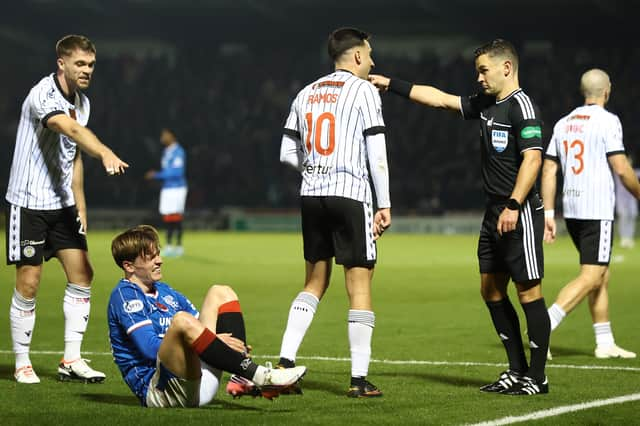
The basic facts are not in dispute. Rangers were awarded a penalty when Penrice, playing as a wing-back, went down in the box under pressure from St Mirren defender Samuel Ramos. The referee, Nick Walsh, gave the spot kick, and the VAR official, Greg Aitken, backed him up. Ryan Naderi took the penalty and broke the deadlock. Rangers went on to win 2-0, which moved them within a point of Premiership leaders Celtic.
That last detail matters for how much weight the incident carries. A win that closes the gap on the league leaders is the kind of result that turns a refereeing decision into a talking point about the title race. Nobody was suggesting the match was irrelevant, and that raised the stakes of an early goal arriving from a contested call.
The reports describe Ramos as having fouled Penrice, but the way the Daily Record frames the incident tells you where opinion landed. The article’s central claim is that Penrice was “called out” for the tumble that earned what it called a soft penalty. The facts of the foul were secondary to the question of how much it really was one
The article is built mostly around three sources of opinion, and it helps to separate them, because they make different arguments.
Steven Thompson is the headline figure. A former Rangers and St Mirren striker, he spoke on BBC Sportscene and put the incident firmly in the category of the extraordinarily soft. He said he didn’t think there was enough to justify a penalty. He then went further and objected to Penrice’s reaction, saying there was very little contact, that it wouldn’t have hurt, and that the player went down right in front of the referee, which can sway an official. That is a double criticism: the contact was insufficient, and the response to it was theatrical.Andy Halliday, another former Ibrox midfielder, made a more structural argument, which I come back to below. He said he didn’t blame Walsh for giving the penalty at first, because his own initial impression at full speed was that it looked like one. His complaint was with the process. He wanted VAR to bring the referee to the pitchside monitor for a second look, and he thought the contact was nowhere near enough. The Ref’s View podcast, run by former referees Steve Conroy and Des Roache, posted on X that it was a very soft penalty with little contact, and that VAR should have overturned it.
Three different kinds of voice reached largely the same conclusion. Thompson is a former player with ties to both clubs, Halliday is a former player who has since spent time analysing games, and Conroy and Roache are former officials who know the protocols from the inside. When that range of people converges, the view is hard to wave away as
Halliday’s argument deserves the most attention, because it goes beyond this one penalty. He said he has long been uneasy with the “clear and obvious” principle, which he sees as a hindrance to referees. His contention is that for contact of this type, the threshold for awarding a penalty needs to be much higher than the system currently demands.
To see why that is interesting, it helps to explain what “clear and obvious” is meant to do. VAR was introduced on the principle that the video official should only step in when the referee has made a decision that is clearly wrong, not merely one the video official would have made differently. The aim was to protect the referee’s authority and keep matches flowing. If every marginal call were reopened, games would be constantly interrupted and officials would effectively be reduced to bystanders.
The difficulty is that this principle produces a particular kind of outcome in cases like the Penrice penalty. A referee who sees contact in real time and gives a foul has made a decision within a reasonable range. The video official, looking at a replay, may agree that the contact is slight but conclude that the referee’s call isn’t beyond defence. Under that logic, the decision stands, even if the video official personally thinks it is soft.
Halliday’s point is that this logic produces the wrong result in a specific category of incident. For slight contact on a moving attacker, a decision that is merely defensible is not good enough, because that is the category where players have an incentive to exaggerate and where fans feel most cheated by penalties that seem to come from nothing. He is arguing that the bar for giving a penalty in those cases should be set higher, so that a referee’s instinctive call is more readily reviewed.
There is a trade-off in that proposal, and it’s worth saying so. Raising the review threshold for one kind of decision means more interventions, more time at the monitor and more situations where the video official’s judgement replaces the referee’s. Supporters of the current approach would say the cure is worse than the disease. Halliday’s response, implicit in his comments, is that a referee who goes to the monitor and watches the replay is still the one making the final decision, so his authority is intact. Which of those views is correct depends on how much you value the speed of the game against the accuracy of individual calls
One of the more revealing parts of Halliday’s analysis is how he described the contact itself. He was candid that he couldn’t be sure what it was, speculating that it might have been a slight glance on the thigh or boot touching boot. He concluded that neither would be enough to constitute a penalised offence.
That uncertainty is telling. If a former professional, with the benefit of replays, cannot say definitively what kind of contact occurred, it suggests the touch was genuinely marginal. And that matters for what a referee can reasonably be expected to see. A touch that is hard to identify on slow-motion replay is nearly impossible to judge at running speed from several yards away.
This is where it’s useful to separate two standards. The first is whether contact occurred. The second is whether the contact was sufficient to warrant a foul. The laws of the game don’t set a minimum force for an offence. A player can be fouled by a light touch if it impedes him, trips him or unbalances him. But they do ask the referee to judge whether the contact genuinely affected the player’s movement, and that is where the Penrice incident becomes arguable. The critics’ position is that a glancing touch of that kind doesn’t materially affect a professional athlete’s balance, so the fall owes more to the player’s reaction than to the contact.
Rangers supporters could respond that a defender who makes any contact in the area takes a risk, and that attackers shouldn’t be required to stay on their feet to prove they were fouled. That is a respectable argument, and it is the reason the incident can’t be dismissed as an obvious error. The question is one of degree, and degree is exactly what people disagree about.ll
Thompson’s second charge, that he wasn’t having Penrice’s reaction, raises a separate issue that is often tangled up with the first. Whether a player exaggerates is distinct from whether he was fouled. A player can be fouled and still go down more dramatically than necessary, and a player can go down theatrically without having been touched at all.
The laws treat the second case as simulation, an offence that carries a caution for attempting to deceive the referee. The first case isn’t an offence at all. A player who has been genuinely impeded is entitled to go down, even if he does so with some flourish. The difficulty is that referees and pundits can’t see inside a player’s head, so they judge intent from behaviour, and that is how a fall can become evidence against the player who took it.
Thompson’s complaint is that the fall happened in front of the referee, which he says can influence the official. That is a claim about how decisions get made. Referees are human, and a clear, visible fall in their line of sight can shape their perception in a way that the same contact, with the player staying on his feet, would not. Players know this, and some use it deliberately. That, more than the contact itself, is the practice critics want to discourage.
It’s worth being careful here. Nothing in the article claims Penrice set out to deceive anyone, and the reaction criticised is described by pundits from a distance, through television replays. Players who go down in the box often react instinctively, and what looks like gamesmanship in slow motion may feel like a stumble at pace. The fair way to put it is that Thompson thinks the reaction was out of proportion to the contact, which is a reasonable view, but that isn’t the same as proving intent
Thompson raised a point that has more to do with human psychology than with the laws. He noted that supporters of the home side will always say a decision against them shouldn’t have been given, but asked the audience to imagine the situation reversed. If the same penalty had been awarded against Rangers, he suggested, Derek McInnes would have been asked about it and would have said it shouldn’t have been given.
This is a useful test, and it is what makes the criticism more credible than a simple complaint from the losing side. It asks everyone to apply the same standard regardless of which team benefits. People tend to judge soft penalties generously when they favour their club and harshly when they don’t, and Thompson is inviting the Rangers support to notice that tendency in themselves.
Halliday reinforced the point by referring to an earlier incident in which Rangers had been involved in a penalty decision against Hibs at Ibrox, one that he and Thompson also thought was soft. His comment was that when a decision goes your way you can live with it, but that if this level of contact became a penalty in every match, it would be a worry. That is a general principle more than a complaint about one game, and it is the most important sentence in the article for anyone thinking about how the game should be refereed.
The logic is that consistency matters more than any single outcome. A standard that gives a penalty for a glancing touch in one match must give it in every match, for every team, or it isn’t a standard at all. If the answer is that referees only give it sometimes, then the decision has become a matter of luck, and fans on every side have reason to feel cheated over a season.
It would be unfair to let one decision stand in for the entire afternoon. Rangers won 2-0, which means they scored again, and the reports suggest they were better than their opponents over the course of the match. A single early goal doesn’t decide a result by itself, and there is no evidence in the article that the game would have gone differently without it.
What the penalty did do was shape the way the match unfolded. An early lead changes what a team needs to do. It allows the side in front to be more patient and the side behind to take more risks, and it alters the tactical options available to both managers. For Derek McInnes, whose Rangers have been working to establish a consistent identity this season, an early advantage may have made the afternoon easier than it would otherwise have been. That is not a criticism of him, just an observation about how scorelines affect football.
For St Mirren, the experience was the reverse. They went behind to a goal they felt was undeserved, and they spent the rest of the match trying to recover. The article’s focus on their sense of grievance is understandable, even if it’s the Rangers players and staff who were more directly quoted in the day’s coverage of the result.
The league context sharpens the picture. Closing to within a point of Celtic at the top of the table raises the significance of every point Rangers collect, and the margin between first and second is the kind of thing that makes a soft penalty look decisive in retrospect. Supporters of other clubs may well notice the result and draw their own conclusions about the fortunes of the leading sides
Back to the video assistant. According to the article, Walsh was backed up by Greg Aitken in the VAR room. What that means in practice isn’t fully clear from the report. It could mean that Aitken reviewed the incident and found no clear and obvious error, or that he judged it fell within the range of reasonable decisions and didn’t recommend a look at the monitor. Either way, the outcome was that the referee’s call stood.
That is precisely what Halliday found frustrating. His objection is not that VAR got the answer wrong in a way that is demonstrably outrageous, but that the system didn’t give Walsh the chance to reconsider. A trip to the monitor is a modest intervention. It costs a minute or two, it lets the referee see the incident from several angles at slow speed, and it leaves the decision in his hands. If the replay confirms his instinct, the penalty stands with more authority. If it doesn’t, he can reverse it, and the fairness of the outcome improves.
The counter-argument, as noted above, is that a lower bar for monitor reviews would make interventions routine and undermine the referee’s standing on the pitch. There’s also a perception problem on the other side. When VAR declines to intervene, fans often assume the video official has endorsed the decision as correct, when in fact the official has only judged it not to be clearly wrong. The difference is subtle and rarely explained, which fuels the sense that the system is opaque.
Transparency might help here. If supporters and pundits knew why a review was or wasn’t recommended, with the reasoning stated publicly, some of the frustration would be reduced. People are generally more willing to accept a decision they disagree with if they understand how it was reached. As things stand, the explanation tends to arrive through a pundit’s interpretation, which is how the Penrice penalty ended up being litigated on a television programme and a podcast and not through the officials themselves
It would be easy to read the article as proof that the penalty was wrong, but that goes further than the evidence. What the reporting shows is that several experienced people, including two former referees, thought it was soft and that VAR should have intervened. That is a meaningful consensus, but it is a consensus of opinion, not a ruling. The people who officiated the match, who had access to the full footage and the protocols, reached a different conclusion in the moment.
Opinions of that kind carry weight, but they’re formed after the fact, on slow-motion replays, with time to deliberate. The referee and the video official had to decide quickly. That doesn’t make them right, but it is a reason for modesty about how confidently anyone, including me, can say the decision was incorrect.
What can be said with more confidence is narrower. The contact was slight by the account of everyone who commented. The reaction was pronounced. And the decision sat close enough to the boundary that reasonable officials might have gone either way. If you accept those three points, the penalty is best described as a debatable decision that most commentators felt should have been reviewed, not as an outright blunder.
If there’s a practical lesson, it’s about calibration. The current approach asks referees to make a snap judgement and asks VAR to intervene only for clear errors, and that produces occasional decisions that look soft to everyone except the person who made them. There are a few ways the game could respond.
One is to adopt Halliday’s suggestion and raise the bar for awarding penalties on minimal contact, so that incidents of that kind are more routinely sent to the monitor. That would reduce the number of soft penalties but would increase the number of reviews.
Another is to improve the communication around decisions, so that the reasoning behind a review or a non-review is explained in plain terms. That wouldn’t change outcomes, but it might change how people feel about them.
A third is to address the behaviour that critics like Thompson object to, by being more willing to caution players for simulation when the contact doesn’t justify the fall. That is difficult to do consistently, because intent is hard to prove, but a clearer deterrent might discourage the kind of exaggeration that makes referees’ jobs harder.
None of these is simple, and each involves trade-offs. But the Penrice incident is a good example of why the conversation keeps recurring. Every season brings a handful of decisions like this one, each of which seems small in isolation and collectively shapes how supporters feel about the officiating.
The penalty Rangers won at St Mirren was, on the evidence of those who watched it most closely, a soft one. The contact was minimal, the fall was prominent, and the people best placed to judge it, former players and former referees, largely thought VAR should have asked Walsh to look again. Their criticism wasn’t aimed at one club or one official so much as at a system that allowed a marginal call to stand.
For Rangers, the incident is a footnote to a result that kept them in touch with Celtic. For St Mirren, it’s another grievance. For the wider game, it’s a reminder that the debate about what VAR is for has never been settled, and that decisions of this kind will keep reopening it.
Penrice himself is in the least enviable position. He’s been named in the headline and criticised for his reaction, even though the decision was made by officials, not by him. Players cannot be expected to refuse a penalty they’ve been awarded, and most would say the responsibility for getting the decision right lies with those who are paid to make it. That is perhaps the fairest summary available. The argument is not really about one player’s tumble. It is about the threshold at which contact becomes an offence, and about who gets to decide where that threshold sit