If there is anything that I hate, it’s defying my tactical plans” ” He ruined the plan but we got the goals so what do you expect me to do now 😅 Derek Mclnnes on the only player who was adamant on the pitch

Football produces more quotable material than almost any other sport, and a lot of it is invented. A line turns up on a fan page, usually with an emoji, attributed to a manager and wrapped around a player nobody names. It’s funny, it sounds plausible, and it fits something people already believe. Within hours it’s been screenshotted, reposted and half-remembered as something the manager said in a press conference.
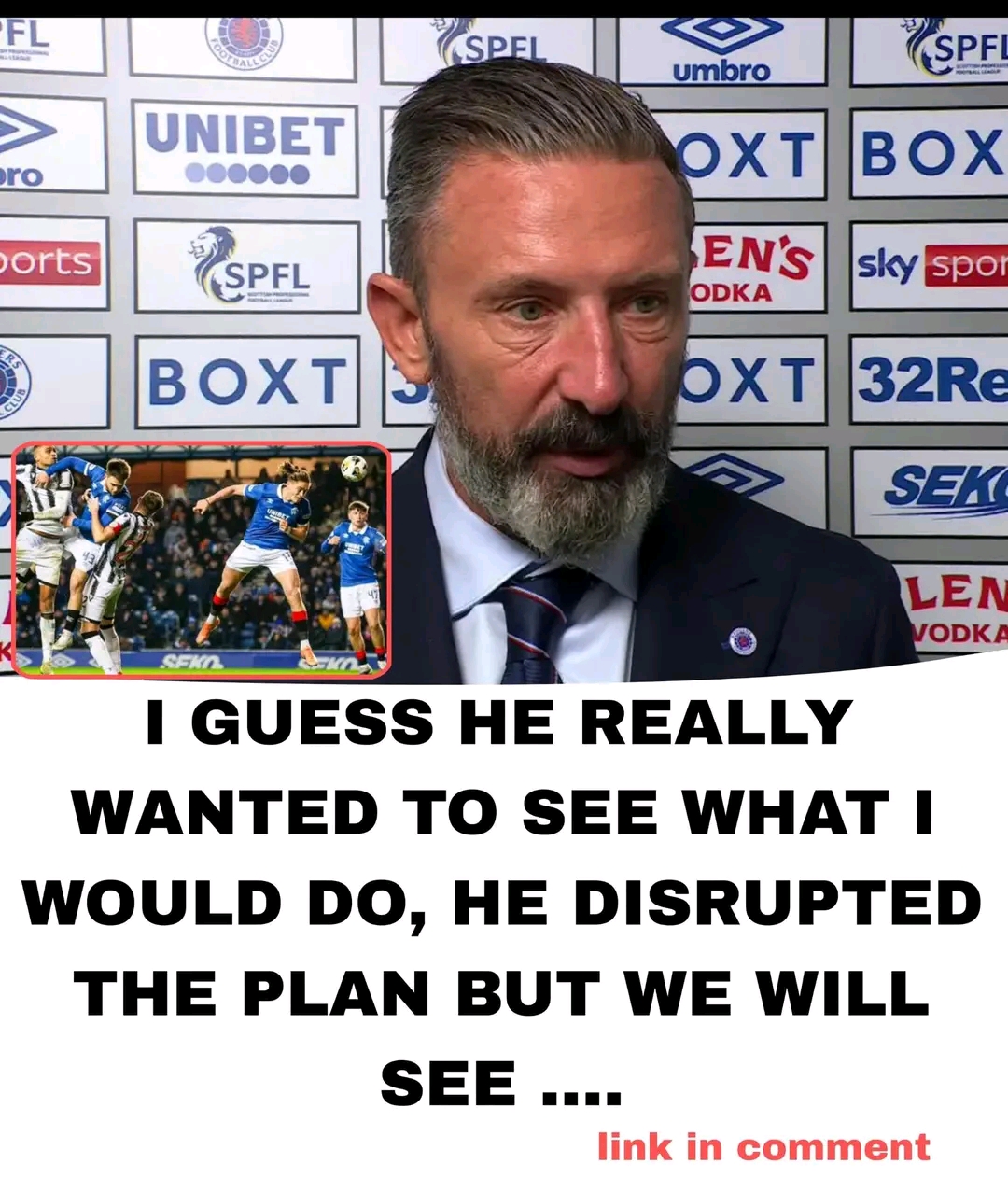
The post I was asked about has all those features. It credits Derek McInnes with a confession that the one thing he hates is having his tactical plans defied. It adds a second line, laughing at the situation: the player ruined the plan, but the goals came anyway, so what is the manager supposed to do? It closes by describing the player as the only one “adamant on the pitch.”
My searches found no source for any of it. No match report, press conference write-up or interview contains those words, and the tone is far from the measured, sometimes grim language McInnes has used in the coverage I did find. That doesn’t prove he never said it. It does mean the quote shouldn’t be treated as real until someone points to a recording, a transcript or a reputable report.
So what follows isn’t an attempt to make the quote true. It’s an examination of why a line like this feels believable, what McInnes’s recorded words and tactical choices at Rangers actually look like, and what the long tension between managerial plans and player instinct can tell us. The quote is the occasion for the piece, not its evidence.
It helps to take the post apart, because it contains several separate claims.
The first is that McInnes hates tactical defiance. That’s a statement about his character as a manager, and it fits a common picture of coaches as control-oriented figures who set out a detailed plan and expect it to be followed.
The second is that one player departed from the plan. The post doesn’t say how or when, so the claim can’t be tested against any particular match.
The third is that the departure produced goals. This is the comic engine of the post: the transgression and the reward arrive together, and the manager is left unable to complain. It’s a familiar shape in football storytelling, where the rebel is vindicated by results.
The fourth is that this player was the only one who was “adamant.” That implies the others were passive or hesitant, which is a criticism of the team folded into what reads as a compliment to one man.
The fifth is the attribution itself, a precise quotation placed in a named manager’s mouth.
Only the last of these is a checkable factual claim, and it fails. The other four are the kind of narrative a reader supplies. That’s how these posts work. They don’t need to be true to be satisfying, only to confirm a story the reader already half-believes.
The most important reason it feels plausible is that McInnes has spent months being scrutinised over his tactics at Rangers, and the public conversation has been about structure, shape and identity. A line about tactical plans being defied lands in ground that has already been prepared.
Coverage from late August described a team whose identity remained unclear under McInnes, who was appointed in June, and noted that he had frequently altered team shape without visible improvement. The same reporting pointed to 11 half-time replacements across seven games as a sign of tactical difficulty. When a manager is being discussed in those terms, a quote about plans going awry sounds like something he could plausibly have said, whether or not he did.
Another reason is the sound of the voice. The quote is wry, self-deprecating and a little exasperated, and it has the rhythm of a manager making a joke at his own expense. Managers do talk that way, and the best of them can turn a press conference into a performance. A good fake borrows that register.
A third reason is incentive. Accounts that post such lines are chasing engagement, and a funny quote attributed to a well-known figure travels further than the same joke would under the poster’s own name. The attribution is the hook.
Compare the post with the recorded record. After Rangers’ opening-day draw at Dundee United, McInnes was blunt. He said his team were not good enough to win and cited too many little mistakes. He also admitted that Dundee United’s front three had unsettled his side at times. He said he’d expected more composure from his players.
None of that sounds like the post. It’s an assessment of players and performance, delivered without jokes. After the Conference League play-off defeat to Jablonec, the tone was darker still: he expressed embarrassment and mortification several times, and apologised after the travelling fans voiced their disapproval.
In the same period he warned that Rangers were “playing with fire” over their defensive options as the transfer window closed, and he acknowledged the pressure of a difficult start to his tenure.
What these statements share is accountability. McInnes accepted responsibility, named specific shortcomings and explained his reasoning. The reporting also notes that, even while taking responsibility, he pointed to deficiencies in the players. That is a manager who is frank about problems, not one who shrugs off a defied plan with a laugh. It’s possible he has said lighter things privately or in less-reported settings, but the public record doesn’t contain this line
To understand what a real conversation about defied plans would involve, it helps to look at what McInnes’s plans have looked like.
The Dundee United game was his first in competitive charge, and it featured starting debuts for Pandur, Ben Godfrey and Cammy Devlin, with Lawrence Shankland as the new captain. That’s a rebuilt team, and plans for a rebuilt team are necessarily provisional. Players are still learning one another’s movements, and a manager’s instructions have to be translated into habits that don’t yet exist.
The match itself was revealing. Dundee United edged the expected goals contest, with 1.64 from 11 shots against Rangers’ 1.46 from 21 attempts. Rangers had far more of the ball in dangerous areas by volume but created less danger per attempt. McInnes responded at half-time by replacing Djeidi Gassama and Ryan Naderi with Dan Neil and Youssef Chermiti, and the change improved the team, which equalised in the 56th minute. But the same report noted that the improved intensity lasted only around 15 to 20 minutes.
That pattern, a plan that doesn’t hold followed by a bench-driven correction, is part of what fed the “identity” criticism. It also suggests a different reading of the idea of a player defying the plan. In a team still searching for its shape, the problem often isn’t a rebel who ignores instructions. It’s a group that hasn’t yet absorbed them, which leaves room for individuals to fill gaps with improvisation, sometimes usefully and sometimes not.
The deeper idea in the post, that a player’s deviation can succeed where the plan would have failed, deserves serious treatment, because it’s one of the oldest tensions in the game.
Managers build plans around probabilities. A system is designed so that, over many repetitions, certain movements and positions produce better outcomes than others. Players are asked to subordinate their instincts to those patterns, because a team of eleven individuals each following their own judgement tends to lose its shape.
But football is also a game of moments, and some of those moments can’t be planned. A forward who senses that a defender has switched off may drift into a position the plan never mentioned. A midfielder may carry the ball into space that wasn’t part of the script. When it works, it looks like genius, and the manager’s reaction tends to be pleasure even when it contradicts what was drilled in training.
That’s the situation the post imagines, and it isn’t an exaggeration of something rare. Most managers accept that they want players who think for themselves. The skill is in defining the boundary. Deviation that exploits an opening is welcome, while deviation that abandons the team’s structure leaves others exposed. A winger who ignores his defensive duties may score once and cost the team three times.
What makes the discipline question hard is that it can only be judged afterwards. The same improvisation that earns praise when it produces a goal earns criticism when it doesn’t. That asymmetry is why the post’s final line, “so what do you expect me to do now,” resonates as a joke. A manager can’t punish success, however unorthodox the route.
The match that brought this conversation into view was Rangers’ 2-0 win at St Mirren on 7 November, and it offers a useful test case, because it was a game where the story was dominated by a decision, not by tactical improvisation.
The central event was a first-half penalty. St Mirren’s Samuel Ramos was penalised for a challenge on James Penrice, and referee Nick Walsh pointed to the spot after what appeared to be minimal contact. Former referees Steve Conroy and Des Roache both said VAR should have overturned the award.
That matters for the question of defied plans for a simple reason: a penalty changes the game state, and a changed game state changes what a plan is worth. A team that leads early can sit deeper, protect the lead and play on the counter. A team that trails has to take risks. Whatever McInnes had designed for the afternoon, the early goal rewrote it. Plans are always conditional on the score, and a manager whose side goes ahead through a refereeing decision is not, in any fair sense, watching his plan fail.
It also complicates any attempt to read the result as evidence about player initiative. A team that wins 2-0 after an early penalty hasn’t necessarily shown that anyone departed from instructions. The match report that framed the story noted the penalty controversy as the main talking point, and the wider coverage mentioned Penrice’s growing influence, which is a different claim from saying he went off script.
Given how easily the post could have spread, it’s worth setting out the steps that would settle the question. They are the same steps a journalist would use.
Start with the exact wording. Searching for distinctive phrases in quotation marks is the fastest filter, because real quotes usually appear in at least one reputable report. Here the phrases returned nothing relevant.
Then look for the occasion. Real quotes come from somewhere: a pre-match press conference, a post-match interview, a podcast, a television appearance. A post that gives no date, no opponent and no outlet has removed the information that would let you verify it, and that omission is itself a warning sign.
Check the source account. Fan pages, parody accounts and aggregators often paraphrase or invent, and an account with a history of dubious posts shouldn’t be trusted on a single new one. Look at whether the account links to a recording or a transcript.
Consider the register. Does the language match the speaker’s known style? McInnes’s recorded comments in this period are direct and often severe about his own team’s performance. A breezy, laughing confession is out of keeping, though not impossible.
Finally, look for corroboration from people who were there. Reporters at a press conference tend to quote the most newsworthy lines, and a line this shareable would have been picked up widely if it had been said. Its absence from the coverage is meaningful.
There’s a more serious point underneath the humour. Attributing words to a real person who didn’t say them isn’t harmless, even when the words are mild.
It misleads the people who read it, who may repeat it as fact. It can distort the public picture of a manager’s character and relationships, and in this case it implies that a player defied his manager and was effectively forgiven because of the result. That could affect how supporters regard both men, and the player in particular, who is left unnamed but easy to guess at in the comments.
It also puts the subject in an awkward position. A manager who is shown a fabricated quote has to decide whether to correct it, which risks drawing more attention, or ignore it, which lets it stand. For someone already under scrutiny, as the coverage of McInnes’s start shows, that’s an unwelcome extra burden.
None of this means that satire is off limits. Parody accounts exist, and many are clearly labelled. The trouble comes when a joke loses its label as it travels, and a screenshot with no context becomes a claim.
It’s worth imagining, without putting words in anyone’s mouth, what an authentic account of this kind of situation might involve, because managers do talk about such moments
A manager asked about a player who departed from the plan would likely begin by acknowledging the result, since that’s the one thing nobody can argue with. He would probably distinguish between the freedom he gives players in the final third and the discipline he expects elsewhere on the pitch. He might say that he wants players with courage who take responsibility, and that the line between courage and recklessness is one the coaching staff work on every day.
He would almost certainly avoid singling the player out in a way that sounded critical, because managers protect their squads in public and save difficult conversations for the training ground. And he’d likely turn the question back to the collective, noting that one player’s initiative only works if the others cover the space he leaves.
That is a reasonable composite of how such answers go, and it’s a long way from the post’s bluntness. It’s also a reminder that the real versions of these conversations are usually less quotable than the invented ones, which is exactly why the invented ones spread
The most overlooked figure in this whole discussion is the unnamed player. The post makes him a symbol, the lone adamant individual in a hesitant team, but a real player in that situation would have a more complicated experience.
Players at a new club, working under a new manager, are trying to learn a system while also proving themselves. Some respond by following instructions to the letter, because they fear the consequences of deviating. Others respond by trusting their instincts, because that’s what earned them their place. Neither approach is wrong, and the manager’s job is to find a way to get the best out of both.
For a team in transition, as Rangers have been, the balance matters even more. The reporting on the early season describes a squad with a lack of cohesion and desire, at least in the worst performance. In that context, a player who shows conviction is valuable almost regardless of whether he’s following the script. The post gets that part right, even if it gets the attribution wrong. Conviction is scarce in a struggling side, and managers tend to forgive a great deal in the player who has it.
The risk is that the praise becomes a pattern. If a team comes to depend on individual initiative to rescue games, it has an organisational problem that no single player can fix. The same reports that questioned Rangers’ identity were asking exactly that: what are the team good at, and what is the plan when the individual moment doesn’t arrive
The quote you asked about can’t be confirmed. It has the look of a social media invention: precise in wording, vague in context, and flattering to a story people already enjoy. McInnes’s recorded comments, from the Dundee United draw to the Jablonec defeat to his warning about defensive depth, are more sober, more self-critical and more specific than anything in the post.
What the post does capture, in exaggerated form, is a real tension at the heart of management. Plans matter, but so does initiative, and the best managers learn to tell the difference between a player who has broken the structure and one who has found a way through it. Rangers, still searching for a settled identity under a new manager, are a team where that distinction matters a great deal