Crystal Palace boss Oliver Glasner has allegedly revealed a shocking post-match conversation with the referee that left him convinced Manchester City are being “favored” in the title race over Arsenal

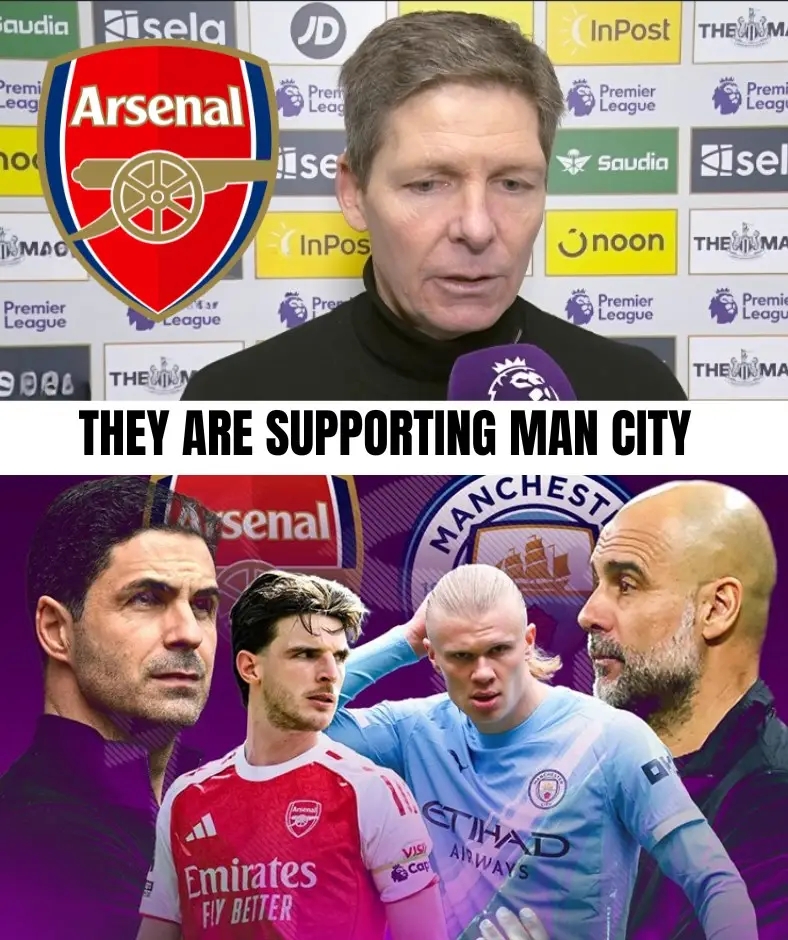
The tension did not start after the match. It had been building for weeks, slowly, quietly, like pressure inside a sealed room. Every decision, every tight call, every VAR moment added something to it. Fans noticed. Players reacted. Managers kept their words careful, but their expressions told different stories.
Then came the night that changed everything.
Manchester City faced Crystal Palace in a match that many believed could shape the destiny of the title race. The pressure was already massive. With Arsenal leading the table and the season coming close to its dramatic end, every point mattered.
Every decision mattered even more.
The game itself, on the surface, looked simple. Manchester City were dominant. They controlled possession, dictated the tempo, and eventually secured a strong victory. But beneath that result, something else was brewing.
Something far more dangerous than just football.
Because after the final whistle, the story took a completely different turn.
Oliver Glasner, the manager of Crystal Palace, walked off the pitch with more than just disappointment. There was frustration in his face, confusion in his body language, and according to reports, anger in his voice.
At first, nobody expected what would come next.
Managers complain all the time. It is part of the game. They question referees, they defend their players, they protect their teams. But this felt different.
This was not just about one decision.
This was about something bigger.
Much bigger.
According to what started spreading quickly across football media and fan discussions, Glasner allegedly had a conversation with the referee after the match. A conversation that, if true, could shake the credibility of the entire league.
The claim?
That something was said which made Glasner believe that Manchester City were being “favored” in the title race.
The moment that rumor hit the public, everything exploded.
Fans did not wait.
They did not hold back.
Within minutes, social media was on fire. Supporters from all sides jumped into the debate. Some were shocked. Some were angry. Some were not even surprised.
Because for many, this was not a new feeling.
There have always been whispers in football.
Whispers about referees.
Whispers about big clubs getting decisions.
Whispers about certain teams receiving “help” at key moments.
Most of the time, those whispers stay quiet.
But now, they were loud.
Very loud.
Arsenal fans, especially, reacted immediately.
For them, this was personal.
They have been leading the title race, fighting game after game, knowing that any mistake could cost them everything. And now, hearing claims that their biggest rivals might be getting favorable treatment only added fuel to an already burning fire.
Some fans called it a disgrace.
Others demanded investigation.
Many simply said what they had been thinking for weeks.
“That something is not right.”
On the other side, Manchester City supporters were quick to respond.
They rejected the claims completely.
For them, this was nothing but excuses.
They pointed to the team’s performances, the dominance, the consistency, the quality. They argued that City do not need help to win games. That they have earned every point through hard work and brilliance.
And they questioned the timing.
Why now?
Why after a defeat?
Why after such a strong performance?
To them, it felt like frustration being turned into accusation.
And so, the battle lines were drawn.
But the biggest question remained unanswered.
What exactly did the referee say?
That question became the center of everything.
Because the truth is, no official statement confirmed the exact words. No recording was released. No direct quote was verified. Everything remained in the space of “allegedly.”
And yet, that did not stop the chaos.
Pundits began discussing it.
Fans began analyzing every moment of the match.
Clips were shared.
Decisions were reviewed again and again.
Every foul, every card, every VAR check became part of the argument.
Was there bias?
Or was it just perception?
That is where football becomes complicated.
Because perception is powerful.
If fans believe something is unfair, it starts to feel real, even without clear proof.
And in a title race as tight as this one, emotions are already at their highest level.
For Glasner, this situation placed him in a difficult position.
If he truly believed what was being reported, then speaking up would be seen as brave by some and reckless by others.
If he stayed silent, questions would remain.
And if the matter reached the Football Association, then it could become something official, something serious.
Because accusing referees of bias is not a small matter.
It touches the integrity of the game itself.
And that is why this story has grown so quickly.
It is not just about Manchester City.
It is not just about Arsenal.
It is about trust.
Trust in referees.
Trust in the league.
Trust in the idea that football is fair.
Once that trust is questioned, everything changes.
Players start to doubt decisions.
Managers start to speak more carefully.
Fans start to believe in narratives that go beyond the pitch.
And the game itself becomes heavier.
More tense.
More emotional.
Meanwhile, the title race continues.
Matches are still being played.
Points are still being won and lost.
But now, there is an extra layer.
An invisible pressure.
Because every decision from now on will be watched more closely than ever.
Every referee will feel the weight of this controversy.
Every call will be analyzed not just for accuracy, but for intention.
And that is a dangerous place for football to be.
Manchester City, led by Pep Guardiola, will try to ignore the noise.
They will focus on winning.
On performing.
On finishing the season strong.
Because for them, the only way to respond is on the pitch.
Arsenal will do the same.
They cannot afford distractions.
They cannot afford to lose focus.
Because in a race this tight, even a small mistake could decide everything.
But no matter what happens, this controversy will not disappear easily.
Even if nothing is proven.
Even if no official action is taken.
The conversation has already started.
And once it starts, it is hard to stop.
Fans will remember this moment.
They will bring it up in future debates.
They will connect it to past decisions.
They will use it to explain results, performances, outcomes.
That is how football works.
Stories grow.
Narratives build.
And sometimes, they become bigger than the truth itself.
For now, everything remains uncertain.
Was there really something said?
Was it misunderstood?
Was it exaggerated?
Or is there something deeper that has not yet been revealed?
Nobody knows for sure.
But what is certain is this.
The Premier League title race is no longer just about football.
It is about controversy.
It is about belief.
It is about what fans think is happening behind the scenes.
And as the final games approach, the tension will only increase.
Because the closer you get to the finish line, the more every detail matters.
Every goal.
Every decision.
Every moment.
And now, every word.
Because one alleged conversation has changed everything.
It has turned a football race into a full-blown debate.
A debate about fairness.
A debate about power.
A debate about whether the game is as clean as it should be.
And until there are clear answers, that debate will continue.
Loud.
Emotional.
Unstoppable.
Because this is football.
And when controversy meets a title race, there is no way to keep things calm.