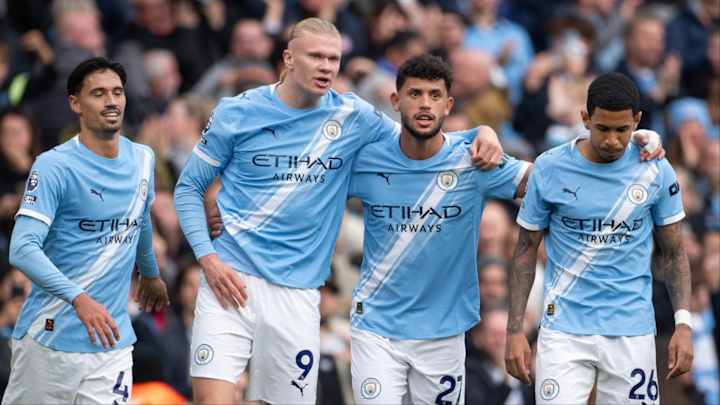
When you’re Erling Haaland, you don’t even need to touch the ball to change a football match. You just need to exist in the right place, at the right moment, and suddenly everything around you bends, shifts, and opens up. That’s the power of a player who has mastered not just the art of scoring goals, but the deeper, quieter science of influence without possession. On a cold Champions League night at the Etihad, against Borussia Dortmund, Haaland gave another reminder that he’s not just a striker—he’s a system, a shadow, a gravitational force pulling defenders wherever he wants them to go.
It wasn’t his most explosive night on the scoresheet. He got just one of Manchester City’s four goals. But as Pep Guardiola stood on the touchline watching his Norwegian machine at work, he must have known something profound: the project might just be complete. This was no longer about Haaland the finisher—it was about Haaland the thinker, the orchestrator, the invisible threat.
The moment that summed it up best came in the first half, when Phil Foden found the net with a stunning strike from twenty yards. The crowd roared for Foden, and rightly so, but rewind the tape and you’ll see the ghost in the machine. Haaland didn’t touch the ball, didn’t even come close to it. Yet he made the goal happen.
As Tijjani Reijnders picked up possession near the edge of the box, Haaland positioned himself between Dortmund’s two centre-backs, Nico Schlotterbeck and Waldemar Anton. He didn’t demand the pass, didn’t shout or gesture. He just *waited*. Then, the moment Reijnders released the ball into Foden’s feet, Haaland moved—a quick, sharp run into space. That simple action caused panic. Schlotterbeck and Anton both dropped deeper to follow him, afraid of what might happen if they lost sight of him for even a second. And that hesitation, that tiny ripple of fear, gave Foden all the room he needed. One touch to steady himself, another to fire, and the ball flew into the top corner.
Haaland didn’t touch the ball, but he touched the play. His run pulled the defence apart like a magnet breaking iron filings. It was tactical poetry—simple, subtle, devastating.
This is what makes the new Haalnd so fascinating. The raw numbers are still ridiculous—27 goals in 17 games for club and country, scoring in 12 of his 14 appearances for City this season—but that’s no longer the whole story. This version of Haaland has evolved. He’s no longer just the sharp end of City’s attacks; he’s part of the machinery that builds them.
Over the summer, Haaland took time off, disconnected, reset. Those who saw him return for pre-season say he looked different—stronger, calmer, sharper. There was a hunger in his eyes again, not just to score goals, but to control games in new ways. And that’s exactly what’s happening. Guardiola’s long, complicated experiment with structure, patience, and positional play seems to have finally merged with Haaland’s instinctive chaos.
For much of last season, the narrative was that City had to change for Haaland. Now it feels like Haaland has changed *for City*.
He’s more involved in the press, more selfless in movement, more intelligent in timing. He drops deep to link up play, drags defenders wide to create central gaps, and even defends his own box with the aggression of a centre-back. His presence in defensive set-pieces has become vital—winning headers, clearing danger, and even shouting instructions to teammates. Guardiola once joked that Haaland wanted to “kill” defenders in attack; now he’s trying to protect his own in defence.
On Wednesday night, there was a moment that captured his fire perfectly. After a slick exchange with Nico González, Haaland made a run expecting the return pass. It didn’t come. His frustration was instant—arms thrown wide, a glare that could burn through concrete. But then, almost immediately, he snapped back into focus, chasing the next phase, dropping to receive again, always demanding, always moving. That’s the Haaland evolution—anger turned into energy.
A few minutes later, he dropped deep again, won a free-kick, and before anyone could blink, he was sprinting forward to take it quickly. He bulldozed through Dortmund’s midfield, a mix of speed and brute force, leaving yellow shirts scattered in his wake. For a moment, it looked like he might do it all himself, the classic Haaland solo charge. Instead, he fed Nico O’Reilly, whose shot forced a brilliant save from Gregor Kobel.
Guardiola clapped on the sideline, not just for the move, but for the intelligence behind it. This was the full circle of his philosophy—the striker not waiting for service but creating it.
For years, Guardiola’s teams have thrived on false nines, rotating mids, and positional fluidity. The challenge when Haaland arrived was how to integrate a pure number nine into that framework. Now, two years on, the answer has arrived. Haaland has become his own kind of false nine—a hybrid who scores like a poacher but plays like a playmaker.
His teammates have learned to trust the chaos too. Foden, now flourishing in central areas, reads Haaland’s movements perfectly. When Haaland drifts left, Foden fills the middle. When Haaland drops deep, Foden attacks the space behind. It’s a telepathic link that’s giving City a new dimension.
But it’s not just about the partnership. The whole team seems more complete with this version of Haaland. Julián Álvarez looks freer when playing behind him, knowing the Norwegian will occupy both centre-backs. Rodri finds more passing lanes because Haaland’s movement constantly stretches the back line. Even the full-backs benefit, as Haaland’s presence draws attention and opens space on the flanks.
It’s all starting to click in the way Guardiola imagined when he first dreamed of bringing Haaland to Manchester. The ruthless scorer is still there—rampant, relentless—but now he’s also the tactical chess piece around which everything else moves. The threat of his runs shapes the geometry of the pitch.
Every time Haaland shifts, defenders panic. They track him, they double-mark him, they forget everyone else. And that’s exactly when City strike—from angles and spaces defenders didn’t even realize they had left open. It’s controlled destruction, executed by design.
Watching Haaland against Dortmund was like watching gravity in motion. He didn’t need to dominate the ball; he dominated attention. Every move he made had a ripple effect. When he ran, defenders ran. When he stopped, they hesitated. When he simply stood still, they stayed close, terrified of what might come next.
And that’s why Pep Guardiola might look at this team now and feel something close to satisfaction—a rare emotion for a manager who is never satisfied. For the first time since Haaland arrived, City no longer look like they’re balancing between two ideas. They look united under one. The mechanical precision of Guardiola’s system has merged perfectly with the unpredictable menace of Haaland’s instincts.
It’s not just about the goals anymore. It’s about the fear. Opponents walk onto the pitch knowing that Haaland doesn’t even need to touch the ball to destroy them. They can defend perfectly for ninety minutes and still lose because of one moment of distraction—one movement, one faint, one run that opens the door for someone else.
As City march deeper into another Champions League campaign, that’s what makes them terrifying. They’re no longer dependent on Haaland’s finishing to win games; they’re using his *existence* to break teams apart.
Haaland might still be only 25, but his football brain has grown older, wiser, more dangerous. He has learned when to run, when to stop, when to sacrifice a goal for the sake of space. And in doing so, he’s become not just City’s scorer but their silent conductor.
When the final whistle blew at the Etihad, Foden’s wonder goal was the highlight, the headline, the replay everyone shared online. But for those who understand the deeper layers of the game, Haaland’s invisible influence was the true masterpiece.
That’s what Pep Guardiola has been building toward all these years—a team where control and chaos live side by side, where genius doesn’t always need the ball. And now, with Haaland mastering both roles, City look frighteningly complete.
He will keep scoring, of course. He will keep breaking records and celebrating with that familiar roar. But what we’re seeing now is something beyond statistics. It’s evolution. The transformation of a striker into a total footballer.
When you’re as good as Erling Haaland, sometimes you don’t need to touch the ball to win a match. You just need to be there, to exist in the right place, and the rest of the world bends around you.
And that’s why, on nights like this, Manchester City don’t just look like champions—they look like the finished product of Pep Guardiola’s grand design.