Chaos does not announce itself quietly in football. It arrives suddenly, violently, and without warning. On what was meant to be a normal training day at the City Football Academy, calm turned into confusion, and confusion quickly became panic. Players arrived expecting routine drills, coaches prepared tactical sessions, and staff followed familiar schedules. But before the sun fully settled over Manchester, something went terribly wrong. Erling Haaland, the face of Manchester City’s attack and one of the most feared strikers in world football, vanished during training.
At first, it felt unreal. Haaland is not the type of player who disappears. He is known for discipline, professionalism, and an almost machine-like focus on football. When he stepped away from the session without notice, alarms quietly began to ring. When minutes passed and no one could reach him, concern spread like wildfire across the training ground. Phones were checked. Messages were sent. Calls went unanswered
Very quickly, this was no longer a small issue. It became a serious situation.
Inside the City Football Academy, the mood shifted dramatically. Coaches stopped drills. Teammates gathered in small groups, whispering, exchanging worried looks. Staff members moved quickly from one office to another. Doctors were alerted. Security personnel were informed. Everyone wanted the same answer, and nobody had it. Where was Erling Haaland?
Sources close to the situation revealed that Haaland had withdrawn from training without informing Pep Guardiola or any senior member of staff. That alone was unusual. What followed was even more troubling. Attempts to contact him failed. His phone appeared unreachable. Messages went unread. It was as if he had gone completely off the grid.
The club immediately escalated the matter. This was not about football anymore. This was about safety.
Haaland’s family were contacted, and their reaction only deepened the concern. They, too, were unable to reach him. Panic replaced worry. The club and the family began working together in urgent coordination, sharing information, retracing movements, trying to understand what had happened and where he could be.
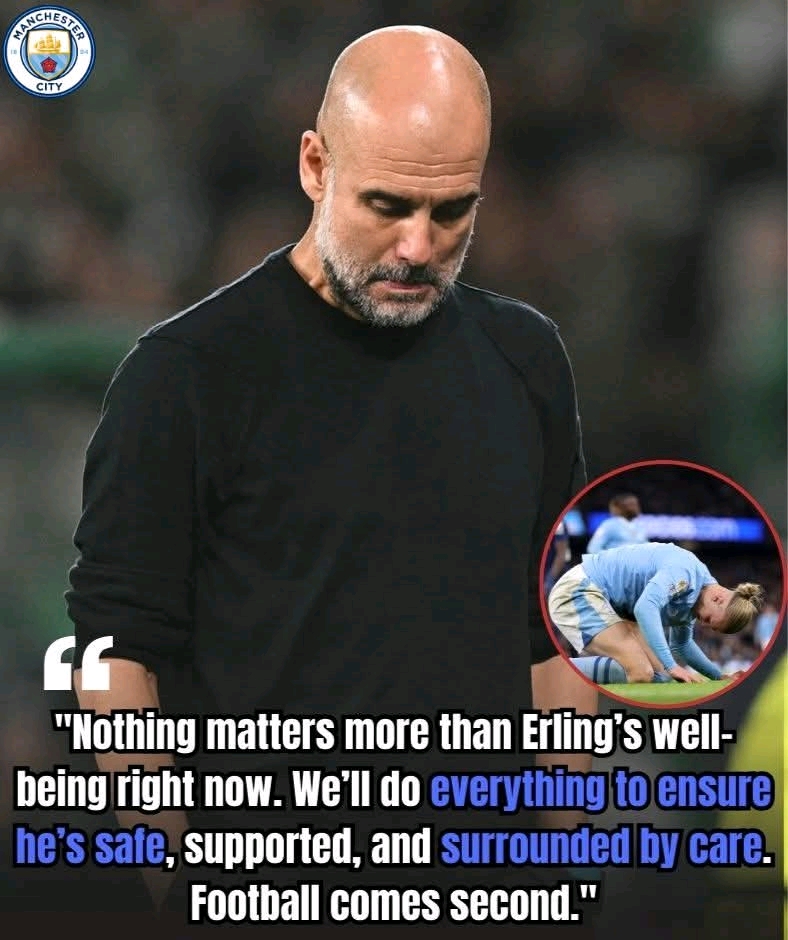
Pep Guardiola, usually calm and measured, was forced to step forward and address the situation. His words were short, controlled, but heavy with meaning. He confirmed that the club was dealing with a serious matter. He made it clear that Haaland’s health and safety were the priority above everything else. He asked for privacy. He did not offer details. He did not speculate. The seriousness of his tone said more than any explanation could.
For a manager who has handled Champions League finals, title deciders, and dressing rooms full of superstars, this was different. Football tactics mean nothing when a player’s well-being is uncertain. Guardiola understood that, and so did everyone watching.
As news began to spread, the reaction was immediate and global. Fans across the world froze in disbelief. Social media exploded within minutes. Supporters asked the same question again and again. What happened to Haaland? Theories appeared instantly. Some feared illness. Others worried about personal emergencies. A few speculated wildly, but the dominant emotion was fear.
Manchester City supporters, usually confident and vocal, were suddenly united by anxiety. Rival fans, too, put football rivalries aside. When a player of Haaland’s stature disappears without explanation, it stops being about club loyalty. It becomes human.
Inside the training ground, the tension was unbearable. Teammates struggled to concentrate. Some sat quietly. Others paced nervously. Haaland is not just a goal scorer; he is a presence. His energy, his intensity, his confidence lift the entire group. His absence felt like a shadow hanging over everything.
This could not have happened at a worse time. Manchester City were days away from a crucial Premier League match. The season was at a delicate stage. Every point mattered. But none of that mattered now. The match felt irrelevant. The table felt irrelevant. The only thing that mattered was finding Erling Haaland and ensuring he was safe.
Club doctors were placed on alert. Staff members coordinated behind the scenes. Information was handled carefully. No one wanted leaks. No one wanted panic to grow further. But in the modern world, silence creates noise. Every minute without news made the story bigger.
International media outlets picked it up quickly. Sports channels interrupted regular programming. Headlines grew darker. Words like “panic,” “chaos,” and “serious situation” dominated coverage. The phrase “off the grid” became a symbol of fear.
Haaland’s rise to the top of world football has been meteoric. From his early days, he has been portrayed as unstoppable, physically dominant, mentally strong. To imagine him vulnerable, unreachable, missing, shook the football world. Heroes are not supposed to disappear.
Behind the headlines, there was real emotion. Teammates worried about their friend. Coaches worried about their player. Fans worried about a human being they had watched grow, celebrate, and dominate. Football stripped back to its rawest form reveals something simple. Players are people first.
As hours passed, the club urged calm. They asked fans and media not to spread rumours. They emphasized cooperation with the family. They stressed that speculation could make matters worse. But fear does not listen to reason. It fills the gaps left by silence.
The City Football Academy, usually a place of precision and control, felt unsteady. Training sessions were disrupted. Conversations stopped mid-sentence. Everyone waited for news. Every phone buzz caused heads to turn.
Pep Guardiola remained present, speaking quietly with staff, offering reassurance where he could. But even he could not hide the weight of the moment. His words earlier echoed again and again. A serious situation. Health and safety. Privacy.
For a club built on structure and planning, this was chaos. Unplanned. Uncontrolled. Uncomfortable.
Supporters began organizing online prayers and messages of support. Hashtags appeared calling for Haaland’s safe return. Messages flooded Manchester City’s official accounts, not demanding updates, but offering concern. Football fans around the world, regardless of club, shared the same hope.
In moments like this, football becomes a mirror. It reflects how deeply connected people are to players they may never meet. How fear for a stranger can unite millions. How fragile even the strongest figures can be.
As night approached, the anxiety did not fade. The silence continued. Every hour felt longer than the last. News outlets refreshed their feeds constantly. Analysts tried to fill airtime without facts. Most refused to speculate, understanding the seriousness.
The club and Haaland’s family continued to work together quietly. That was the only confirmed information. No dramatic rescue. No sudden revelation. Just careful, patient effort behind closed doors.
Whatever the cause, whatever the outcome, this moment left a mark. It reminded everyone that footballers do not live in a bubble. They carry pressure, expectations, personal lives, and private battles that the public never sees. Sometimes, those pressures surface in unexpected ways.
The Premier League watched closely. Rival clubs offered discreet support. Managers and players from other teams sent private messages. When one of the game’s biggest stars is involved in uncertainty, the entire football community holds its breath.
As the story continued to unfold, one truth became clear. No trophy, no goal, no rivalry mattered more than Erling Haaland’s safety. Everything else could wait.
The coming days promised answers, clarity, and perhaps relief. Until then, football paused emotionally, if not officially. Fans waited. Teammates waited. The world waited.
And in Manchester, under the cold winter sky, the City Football Academy stood still, hoping for one thing above all else. That Erling Haaland would be found safe, healthy, and ready to return—not just as a footballer, but as a person whose well-being mattered far beyond the game.