ETIHAD IN CHAOS: Pep Guardiola Set to QUIT in February as Player Revolt Ends His Reign

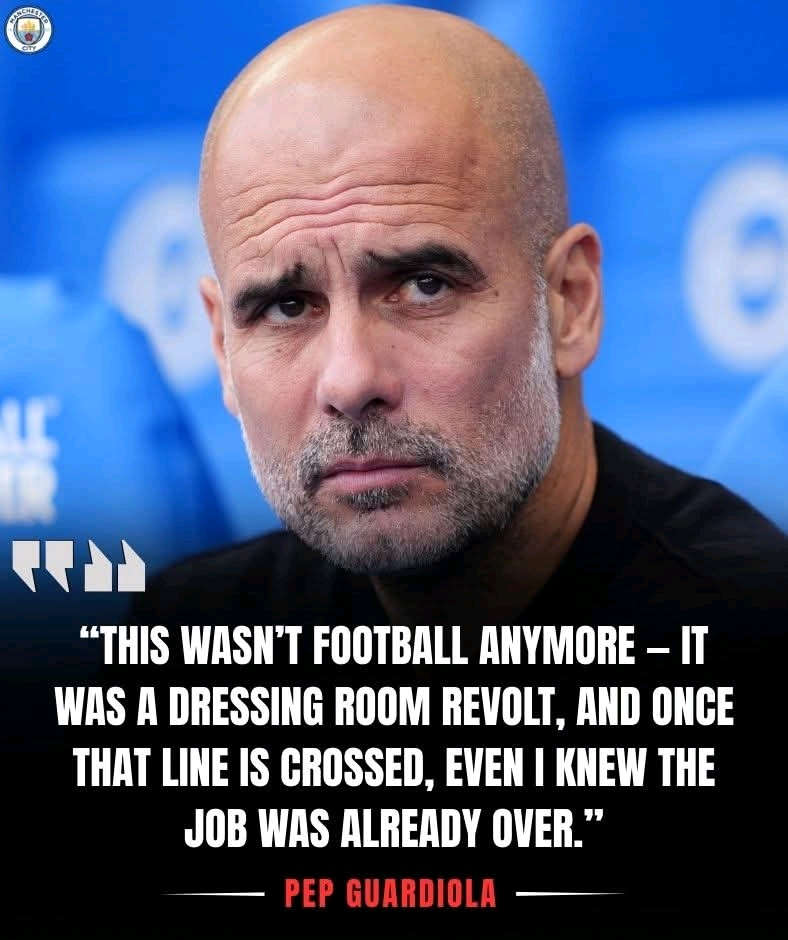
The Etihad Stadium has always been a symbol of power, control, and football intelligence. For many years, it represented calm dominance, a place where Manchester City showed the world how modern football should be played. At the center of it all stood Pep Guardiola, the architect, the teacher, the perfectionist, the man who changed everything. But now that same stadium feels different. The air is heavy. The silence is loud. The certainty is gone. What once felt eternal now feels fragile. The Etihad is in chaos, and Pep Guardiola is preparing to walk away in February after a player revolt that has quietly but completely ended his reign.
This story did not begin with one argument or one bad result. It did not start with a single mistake or a dramatic confrontation on the training ground. It started slowly, almost invisibly, like a crack in a wall that grows wider over time. At first, everything looked normal on the surface. Manchester City were still winning games, still controlling possession, still competing at the highest level. Fans still sang Guardiola’s name. Pundits still praised his ideas. But beneath that smooth surface, something was breaking.
Inside the dressing room, the mood began to change. Players who once felt inspired started to feel drained. Training sessions became longer, more intense, more demanding, but less joyful. Guardiola’s obsession with detail, which once lifted players to new heights, began to feel overwhelming. Every movement was corrected. Every mistake was replayed. Every match was analyzed to the smallest detail. For some players, this was still exciting. For others, it became exhausting.
Several senior players felt that trust was slowly disappearing. They believed they had earned the right to make decisions on the pitch, to express themselves more freely, but instead they felt more restricted than ever. Guardiola wanted total control. He always had. But now, that control felt tighter, heavier, almost suffocating. Players began to feel like robots rather than footballers.
Communication became a major issue. Guardiola spoke a lot, but many players felt he was no longer listening. When concerns were raised, they felt dismissed. When emotions were shared, they felt misunderstood. Meetings became tense. Questions felt unwelcome. Silence started to replace honesty. And in football, silence is dangerous.
Some players also felt the manager’s treatment was inconsistent. One week a player would be praised as essential, the next week dropped without explanation. Rotations increased. Big names found themselves on the bench in important games. Promises made during contract talks seemed forgotten. Confidence dropped. Players began to doubt themselves, and worse, began to doubt the manager.
The younger players were especially affected. They admired Guardiola deeply, but they also felt afraid. Afraid of making mistakes. Afraid of speaking out. Afraid of losing their place. The pressure to be perfect every single day took a mental toll. Some players stopped enjoying football altogether. The game became work, not passion.
As these feelings spread, small groups formed in the dressing room. Nothing official. Nothing dramatic. Just quiet conversations. Shared frustrations. Late-night messages. Players realizing they were not alone in how they felt. These conversations slowly turned into a shared understanding that something was wrong and that it could not continue like this forever.
At the same time, Guardiola himself was changing. Those close to him say he looked tired. Not physically, but emotionally. The constant pressure, the need to win, the demand to evolve, the expectation to be perfect every season had taken its toll. His interviews became more reflective, more emotional. He spoke openly about stress, about needing rest, about how hard it is to maintain standards year after year. These were not the words of a man fully at peace.
Results on the pitch began to reflect the internal tension. Manchester City still looked strong, but they were no longer ruthless. Games that once felt easy became difficult. Players hesitated. Movements were slower. The sharpness was missing. Fans noticed. Analysts noticed. Something was off.
The turning point reportedly came during a private meeting involving several senior players and Guardiola. It was a rare moment of openness. The players spoke honestly about their frustrations. They talked about fatigue, about feeling disconnected, about wanting more trust and clarity. They did not attack Guardiola. They respected him too much for that. But they made it clear that the situation was becoming unbearable.
Guardiola listened, but his response disappointed many in the room. He defended his methods. He reminded them of success, of trophies, of standards. He believed discipline and structure were still the solution. For him, the system was bigger than any individual. For the players, that response confirmed their fear that nothing would change.
From that moment, the relationship was damaged beyond repair. The players did not stop working. They did not refuse to train or play. This was not a loud rebellion. It was a quiet one. A loss of belief. A loss of emotional connection. And for a manager like Guardiola, that is fatal.
Guardiola’s football depends on absolute trust. Players must believe completely in what he asks them to do. They must run without doubt, pass without fear, press without hesitation. Once doubt enters the system, everything collapses. Guardiola knew this. He could feel it every day on the training ground.
The club’s hierarchy soon became aware of the growing problem. Manchester City faced an impossible decision. Guardiola is the greatest manager in the club’s history. He built a dynasty. He delivered trophies beyond imagination. But the squad is also full of world-class players worth hundreds of millions. Losing the dressing room meant losing the future.
Meetings were held behind closed doors. Honest conversations took place. Guardiola was involved. He did not deny the tension. He did not blame the players. He understood that cycles end. He has always believed that staying too long can damage everything you build.
That is when the idea of a February exit emerged. Not a dramatic sacking. Not a public war. A quiet, respectful departure. Guardiola would step aside once it became clear that his message no longer reached the players. Leaving in February would be painful, but staying until the end of the season with a broken relationship would be worse.
News of the possible exit shocked the football world. Fans struggled to accept it. Guardiola leaving Manchester City in the middle of a season felt unreal. Social media exploded. Some fans blamed the players, calling them ungrateful. Others blamed the club. Some questioned Guardiola himself. Emotions ran high.
Inside the Etihad, the mood turned heavy. Staff members felt like they were watching the end of an era in slow motion. Guardiola continued to work with professionalism and dignity, but those around him could see the sadness. This was not how the story was supposed to end.
For the players, emotions were mixed. Many felt guilty. Guardiola had changed their careers. He had made them better footballers and better thinkers. But they also felt relief at the thought of change. They needed a new voice. A new energy. A fresh start.
Manchester City now face a future full of uncertainty. Replacing Guardiola is almost impossible. Whoever comes next will be compared to him constantly. The pressure will be enormous. Some players may leave. New signings may hesitate. Rivals will sense weakness.
February approaches like a slow countdown. Every match feels like a goodbye. Every Guardiola gesture on the touchline feels emotional. Fans watch closely, trying to remember every detail, every moment, every victory.
The Etihad, once calm and confident, now feels fragile. Chaos does not always come with shouting and drama. Sometimes chaos comes quietly, through broken relationships and unspoken truths. That is the chaos Manchester City are living through now.
Pep Guardiola’s legacy will never be erased. No revolt can change what he achieved. He transformed English football. He raised standards. He created beauty. But even the greatest stories must end. And sometimes, they end not with celebration, but with sadness.
As February draws closer, the football world waits. Waiting for confirmation. Waiting for farewell words. Waiting for the final chapter of one of football’s greatest managerial reigns. The Etihad is in chaos, and Pep Guardiola’s time at Manchester City is coming to a dramatic and painful end.