The night Manchester City travelled to the Santiago Bernabéu was supposed to be another chapter in their long quest for European dominance. For years under Pep Guardiola, City had built a reputation as one of the most feared teams in Europe. Their style was precise, their squad packed with stars, and their ambition clear. They wanted to win the Champions League again and prove that their era of success was far from over.
But football does not always follow expectations. Sometimes the biggest stages expose weaknesses, and sometimes decisions made before kick-off become the talking point long after the final whistle.
On this particular night, City walked into the Bernabéu believing they could take advantage of a fragile Real Madrid side. The Spanish giants had not been completely stable during the season. The club had been going through a turbulent period behind the scenes, and former defender Alvaro Arbeloa was currently managing the team on an interim basis.
Despite all of that, Madrid remained Madrid. The Bernabéu remained one of the most intimidating stadiums in world football. And when the Champions League anthem echoed through the arena, the night immediately felt like something special was about to happen.
Unfortunately for City, what followed would become one of their most difficult nights of the season.
From the moment the teams walked out, there was tension in the air. Guardiola had surprised many observers with his starting lineup. The City manager is known for his tactical experiments, but this time the choices raised eyebrows even before the ball was kicked.
Two players in particular drew attention.
City had spent heavily during the January transfer window in an attempt to fix problems that had been appearing throughout the season. The club brought in new signings to strengthen the squad, hoping they would provide fresh energy and help the team push forward in Europe.
Among those signings were Marc Guehi and Antoine Semenyo.
Both players arrived with good reputations. Guehi had impressed in the Premier League with his defensive abilities, while Semenyo had built a name as an energetic attacking player capable of creating chaos for defenders.
But there was one problem.
Neither player had ever played in the Champions League before.
And Guardiola decided that their debut in the competition would come in one of the most intimidating stadiums in the world.
For many fans watching the match, that decision quickly became the biggest talking point of the night.
At first, the game began cautiously. City tried to control possession, just as they always do under Guardiola. The midfield circulated the ball, the full-backs pushed high, and the wingers looked to stretch the Madrid defence.
But the plan quickly began to unravel.
Just before the halfway point of the first half, Madrid struck.
The move started in a simple way. Goalkeeper Thibaut Courtois launched a long ball forward from deep inside his own half.
Normally, City defend such situations comfortably.
But this time there was confusion.
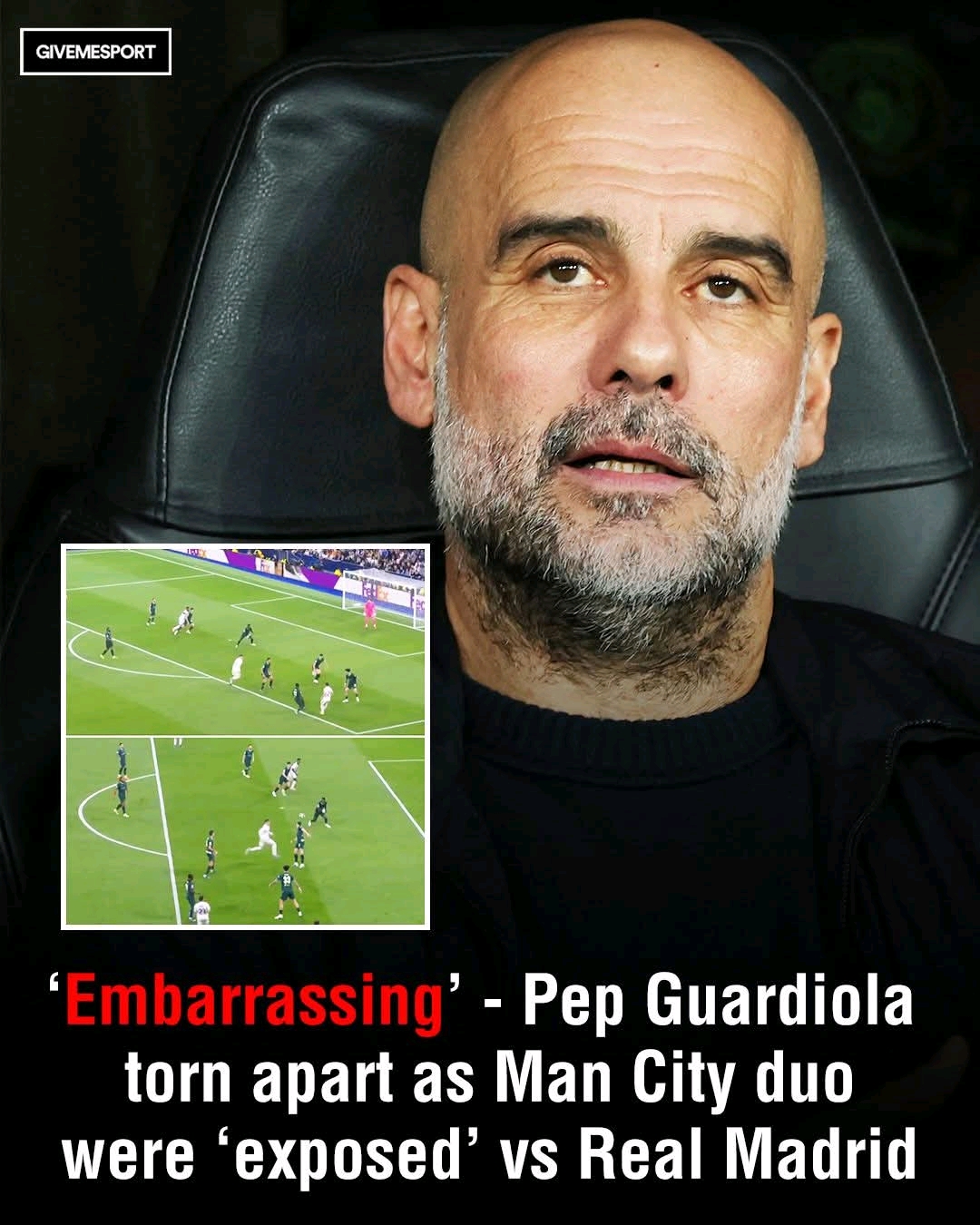
The ball dropped into space, the defensive line hesitated for a split second, and Madrid’s captain Federico Valverde seized the moment.
Valverde ran onto the ball, burst past the defenders, and finished with confidence.
The Bernabéu exploded.
City players looked at each other in disbelief. One moment of hesitation had given Madrid the lead.
And things were about to get much worse.
Valverde was playing the game of his life. Just minutes later, he struck again.
This time it was a powerful finish after Madrid sliced through City’s defence with frightening speed. The ball hit the net, and suddenly the score was 2-0.
Guardiola stood on the touchline, arms folded, watching the nightmare unfold.
City had not even recovered from the first goal when the third arrived.
Once again it was Valverde.
Incredibly, the Uruguayan midfielder completed a hat-trick inside just 22 minutes. His final goal was the most spectacular of all — a clever flick followed by a quick strike that left the goalkeeper helpless.
The stadium roared with celebration.
Three goals.
Twenty-two minutes.
City were stunned.
For a team that prides itself on control and precision, the collapse was shocking.
Even more worrying was how exposed the defence looked.
Observers quickly began focusing on Guehi and Semenyo. The two January signings were clearly struggling to deal with the pace and intensity of the Champions League.
Guehi in particular had a difficult night.
Statistics later showed that the defender won only one of his six ground duels during the match. He was dribbled past three times and looked uncomfortable whenever Madrid attacked at speed.
At several moments he appeared unsure of his positioning, something Madrid’s attackers exploited again and again.
Fans watching the match reacted immediately on social media.
Some were brutal in their assessment.
One supporter wrote that giving Guehi a Champions League debut at the Bernabéu was a huge mistake. Another joked that the defender had just been introduced to “the big boys’ competition.”
The criticism did not stop there.
Semenyo also struggled to make an impact in attack. The forward is normally known for his ability to drive forward with the ball and create chances, but against Madrid he rarely found space.
City’s star striker Erling Haaland was left isolated for long periods. Without service from the wings or midfield, Haaland had very few opportunities to threaten the Madrid defence.
For a player who usually dominates games, it was a frustrating evening.
And the criticism quickly shifted from the players to Guardiola himself.
Many fans questioned why the manager would choose such an important game to experiment with inexperienced players.
One frustrated supporter wrote online that City should have bought players with proven Champions League experience rather than relying on newcomers still learning at the highest level.
Another described the decision as “embarrassing.”
Some even called for Guardiola to leave the club, claiming the defeat was the result of poor management decisions rather than just bad luck.
The criticism was harsh, but the reality was clear.
City had been completely outplayed in the first half.
Despite missing key stars like Kylian Mbappe and Jude Bellingham, Madrid still looked dangerous every time they attacked.
Their confidence grew with every minute.
Meanwhile City looked nervous, unsure, and desperate to reach halftime.
When the referee finally blew the whistle for the break, Guardiola walked quickly down the tunnel with a serious expression on his face.
Inside the dressing room, the atmosphere was tense.
Players knew they had let themselves down.
Guardiola, known for his intense attention to detail, tried to reorganise the team for the second half. But deep down everyone knew the damage had already been done.
City needed a miracle.
The second half was slightly calmer.
Madrid, with a comfortable lead, did not need to attack constantly. They controlled the game and waited for opportunities.
City pushed forward in search of a goal that might bring some hope before the return leg.
At one point Madrid almost made it 4-0.
Vinícius Jr raced through the defence and was brought down inside the penalty area. The referee immediately pointed to the spot.
The Bernabéu held its breath.
Vinícius stepped up to take the penalty, hoping to completely destroy City’s chances.
But the goalkeeper guessed correctly and made an excellent save.
It was one small positive moment for City in an otherwise difficult evening.
Even so, the final whistle eventually arrived with the score still 3-0.
Madrid players celebrated loudly in front of their fans.
City players walked slowly off the pitch.
For Guardiola, it was a painful defeat.
Before this match, City had been on a strong run of form. They had gone 11 games without losing, stretching all the way back to early January.
Confidence had been building.
Now, suddenly, everything looked uncertain again.
The manager knew that the task ahead was enormous.
If City want to reach the quarter-finals of the UEFA Champions League, they will need one of the biggest comebacks in the club’s history.
The second leg will be played at the Etihad Stadium in Manchester.
City must win by at least three goals just to force extra time.
It sounds impossible.
But football has produced incredible comebacks before.
City themselves have beaten Madrid heavily in the past. In 2023 they famously won 4-0 against the Spanish giants on their way to lifting their first Champions League trophy and completing a historic treble.
That memory will give them some hope.
Still, the reality remains difficult.
Madrid have a huge advantage.
They also have the confidence that comes with years of success in Europe.
For Guardiola, the next few days will be crucial.
He must rebuild his team’s confidence, analyse what went wrong, and decide whether he will trust the same players again.
The criticism from fans and media will not disappear quickly.
But the manager has faced challenges before during his long and successful career.
The real question now is whether Manchester City can respond.
Can they produce a comeback that will shock Europe?
Or will this night at the Bernabéu become the moment that ended their Champions League dream?
The answer will come in the second leg.
And the whole football world will be watching.