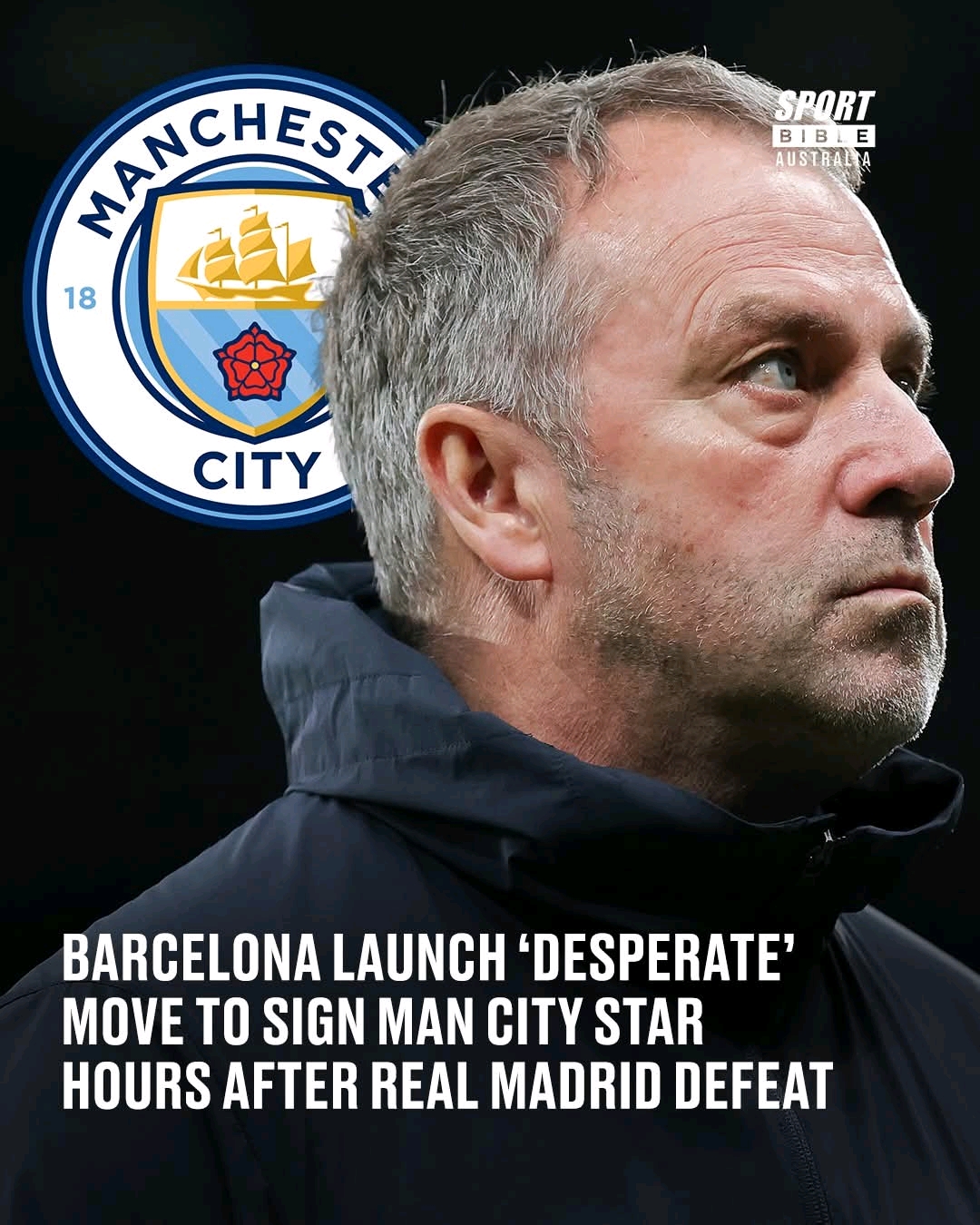
The world of football never sleeps. Just when one story begins to settle, another explodes into headlines, dominating social media, sports channels, and conversations across cafes and living rooms alike. In March 2026, the footballing universe witnessed one of those moments that combined sporting drama with political intrigue, financial speculation, and the endless fascination that comes with star players. Barcelona, one of the most iconic clubs on the planet, found itself at the center of a story that would ignite debate among fans, journalists, and pundits: the reported “desperate” pursuit of Manchester City superstar Erling Haaland.
The saga began in the aftermath of one of the most anticipated matches of the UEFA Champions League. Manchester City, the English powerhouse led by Pep Guardiola, had traveled to Madrid to face Real Madrid at the Santiago Bernabéu, one of football’s most historic stadiums. Expectations were high on both sides. City supporters, confident in their team’s technical mastery and Guardiola’s tactical brilliance, hoped for a strong performance, while Real Madrid fans anticipated a spectacle filled with intensity, passion, and European flair. The match, however, did not unfold according to the expectations of City fans. Real Madrid secured a decisive 3-0 victory, leaving City stunned and grappling with a humbling defeat on one of football’s biggest stages.
Yet, amid the shadows of City’s disappointment, the story of Barcelona’s political and footballing maneuvering was beginning to take shape. In the hours following the Champions League clash, reports began emerging that Barcelona, facing a crucial presidential election, were making a dramatic bid to lure Erling Haaland to the Camp Nou. The timing was explosive: hardly had City’s defeat been processed when news broke that Barcelona were considering a move for one of the most feared strikers in modern football.
Barcelona’s presidential elections are not mere administrative affairs. The club, structured uniquely as a member-owned institution, sees its elections as pivotal moments that determine not just leadership, but the philosophical and sporting direction of the club. On Sunday, more than 100,000 club members, known as socios, were scheduled to cast their votes at various polling stations across Catalonia, including the iconic Nou Camp. Every election carries the weight of history, and this one was particularly significant. Two candidates were vying for the top job: Joan Laporta, a long-serving former president returning to contest the role once again, and Victor Font, a challenger aiming to present a new vision for the club’s future.
According to sources from the Spanish sports media, particularly MARCA, Erling Haaland had emerged as the centerpiece of both candidates’ campaigns. In a football world increasingly intertwined with politics, influence, and spectacle, the idea of signing Haaland was more than just a transfer—it was a symbol. For Barcelona supporters, the prospect of bringing in a striker of Haaland’s caliber represented ambition, a tangible statement of intent, and a promise that the club would compete at the highest level once more. For the candidates, it was a strategic tool to capture votes, excite the fanbase, and reinforce the narrative that their presidency would restore Barcelona to its former glory.
Haaland’s journey to the forefront of European football is well-documented. The Norwegian striker first gained widespread attention during his time at RB Salzburg, before making a sensational move to Borussia Dortmund. At Dortmund, he showcased his extraordinary goal-scoring ability, speed, and physical dominance, quickly attracting interest from Europe’s elite clubs. Barcelona, keen to secure a marquee signing in the years following Lionel Messi’s departure, had previously expressed interest. Haaland had even been a key talking point in the 2021 presidential election, used by both candidates to galvanize voter support, despite the financial constraints that ultimately prevented a move.
The narrative, it seems, was repeating itself five years later. Haaland had long been linked to Barcelona, but Manchester City emerged as the club that finally won the race. City triggered his £51 million release clause and brought him to the Etihad Stadium, a move that would change the trajectory of both the club and the striker’s career. At City, Haaland quickly became a goal-scoring phenomenon. By 2026, he had netted 153 goals in 186 appearances, an astonishing strike rate that placed him among the most prolific forwards in modern football history. His first season alone saw him play a crucial role in Manchester City securing a historic treble—winning the Premier League, FA Cup, and UEFA Champions League—a feat rarely accomplished in European football.
Despite his success in England, Barcelona’s presidential candidates saw an opportunity to reintroduce Haaland into their vision for the club. Joan Laporta, leveraging his experience and previous tenure as president, suggested publicly that signing Haaland was still possible. In a recent book event, Laporta emphasized the striker’s potential role in transforming Barcelona’s squad, highlighting that ambitious signings of world-class players were integral to restoring the club’s competitive edge. Laporta’s comments were carefully measured, designed to inspire hope among the fanbase while acknowledging the practical challenges of orchestrating a transfer of Haaland’s magnitude.
Victor Font, meanwhile, adopted a slightly different approach. In interviews on Catalan media programs such as “Què t’hi jugues?” Font suggested that Barcelona could secure a preferential option to sign Haaland in the future, should the striker ever seek a new project. His words were strategic, aimed at painting a picture of forward-thinking leadership and appealing to supporters who wanted to see Barcelona reclaim European dominance. Font’s narrative relied on the understanding that footballers occasionally seek new challenges, and a well-timed opportunity could align with the club’s ambitions under his leadership.
Yet amidst the speculation, Haaland’s camp quickly sought to quash the rumours. Rafael Pimienta, the Norwegian’s agent, made clear statements to El Chiringuito de Jugones, emphasizing that there had been no contact whatsoever with Barcelona regarding a transfer. He highlighted Haaland’s long-term commitment to Manchester City, having signed a contract extension in January 2025 that secures his future at the club until 2034. Pimienta stressed that Haaland was “very happy” at City, thriving under Pep Guardiola’s management, and that there was “nothing to discuss regarding a transfer.” The agent’s comments were unambiguous: the Norwegian striker remained focused on his current club, enjoying a successful career at one of Europe’s most powerful teams.
The agent’s response, however, did little to dampen the fervour among supporters and pundits. In modern football, the idea of a transfer often carries as much weight as the transfer itself. Speculation is currency, driving media coverage, social media engagement, and fan discussions. Even when denied, stories of potential moves for global superstars capture the imagination. Barcelona supporters, particularly those longing for a resurgence in European competition, latched onto the narrative. The mere possibility of Haaland at Camp Nou offered a tantalizing glimpse of a future where the club could once again compete with Europe’s best.
Haaland’s credentials are undeniable. Physically imposing yet remarkably agile, he combines explosive speed with pinpoint finishing, intelligent movement, and a capacity to dominate both in open play and set-piece situations. His presence on the pitch alters the dynamics of matches, forcing opponents to adjust tactics and often drawing multiple defenders to contain him. At Manchester City, he has not only maintained his goal-scoring prowess but also integrated seamlessly into a squad renowned for its technical sophistication and tactical discipline under Guardiola.
However, football, like all sports, is cyclical. Even the most prolific strikers experience fluctuations in form. In 2026, Haaland’s goal-scoring rate slowed somewhat. In the early months of the year, he managed only four goals across all competitions. Analysts speculated on a variety of factors: opponents’ increased familiarity with his style, tactical adjustments by Guardiola to preserve squad fitness, or perhaps the natural ebbs and flows that accompany the intense demands of professional football. Yet even in a quieter period, Haaland’s presence remains a formidable threat. Defenders respect his pace, strength, and clinical instinct, aware that even a single opportunity could produce a match-defining moment.
For Barcelona, these qualities make him the ultimate prize. The club has been rebuilding carefully, blending experienced players with promising talents from the La Masia academy. Yet history shows that pairing youth with a world-class striker can accelerate success. Haaland represents not just goals but a symbol of ambition—a statement to the world that Barcelona intends to compete at the highest level once more.
As the presidential election approached, the Haaland narrative played a crucial role in shaping perceptions of leadership. Laporta and Font understood that supporters are emotionally invested not just in current performance but in the club’s vision for the future. The promise—or even suggestion—of securing a striker of Haaland’s calibre can energize voters, attract media attention, and reinforce the candidate’s credibility. It is a reminder that football politics, particularly in member-owned clubs like Barcelona, are intertwined with sporting ambition, financial strategy, and the capacity to dream big.
The timing of the rumours, immediately following Manchester City’s Champions League defeat to Real Madrid, added an extra layer of drama. While City and Haaland were dealing with the realities of competition and form, Barcelona’s political theatre was creating headlines around the globe. The juxtaposition of disappointment in England with speculation in Spain created a narrative rich in intrigue: a superstar striker, a historic club election, and a potential transfer that could reshape European football.
Yet, reality grounded the story. Haaland’s long-term contract with Manchester City, combined with the club’s ambition and Guardiola’s tactical plans, made a move unlikely in the immediate future. Manchester City, having invested significantly in the striker, are building a team around his unique abilities. Selling him would not only weaken their squad but also undermine years of strategic planning. Financially, Barcelona face constraints that make an immediate move for Haaland improbable, requiring negotiations, innovative financing, and perhaps years of preparation.
Still, the speculation continues to resonate. For fans, the allure lies not in certainty but in possibility. Football thrives on dreams—the chance to see the best players compete in new settings, the idea that a single signing could redefine a club’s fortunes, and the hope that ambition aligns with opportunity. Haaland embodies that dream. Even a hypothetical scenario—him donning the Blaugrana colors, scoring decisive goals at Camp Nou, and leading a resurgence—sparks imagination, debate, and excitement.
The saga also highlights the broader dynamics of football in the modern era. Player transfers are not merely sporting decisions; they involve strategy, politics, finance, and narrative management. Clubs like Barcelona must balance the aspirations of their fanbase with financial realities, the competitive landscape, and the ambitions of players and agents. Candidates for leadership roles understand that high-profile signings can influence perception, sway opinions, and create momentum during elections. Haaland, as one of the most marketable and impactful players in the world, sits at the nexus of these forces.
Meanwhile, at Manchester City, life continues on the pitch. Guardiola and his team focus on domestic and European competitions, aiming to maintain consistency, form, and squad morale. Haaland, despite the flurry of rumours, remains concentrated on his performances, training, and contributions to the team’s success. Professionalism, commitment, and focus are critical, particularly when external speculation threatens to create distraction.
The story of Barcelona’s “desperate” move serves as a reminder of football’s dual nature: it is both sport and theatre. Matches are contested on the field, but the narrative is built in press conferences, boardrooms, and social media feeds. Fans, journalists, and pundits collectively create meaning, interpreting events, imagining scenarios, and debating possibilities. Haaland’s potential transfer encapsulates this duality perfectly, blending athletic excellence with narrative drama, financial power, and political maneuvering.
In conclusion, while the immediate reality suggests that Haaland will remain at Manchester City, the Barcelona story demonstrates the enduring power of speculation in football. It intertwines sport, leadership, finance, and fan culture in a way few stories do. Presidential elections, strategic signings, star power, and global media attention converge to create a narrative that captivates audiences worldwide.
Erling Haaland continues to be one of the world’s most influential footballers, scoring goals, breaking records, and defining matches. Barcelona, through their election and ambition, have reminded the world that even in moments of uncertainty, dreams of grandeur remain central to football. Whether or not the Norwegian striker ever plays at Camp Nou, the story has already left an indelible mark on fans, pundits, and the fabric of European football.
The saga is far from over. Football is a game of endless possibilities, where today’s rumours can become tomorrow’s headlines, and where ambition, talent, and timing often converge in unpredictable ways. For now, Haaland remains at City, focused on his goals, while Barcelona’s election and strategic ambitions continue to shape discussions, debates, and dreams across the footballing world. ⚽