Too big for pep to say no…Real Madrid assice offer for Erling left everyone talking as the player is considering to play with the spanish giants

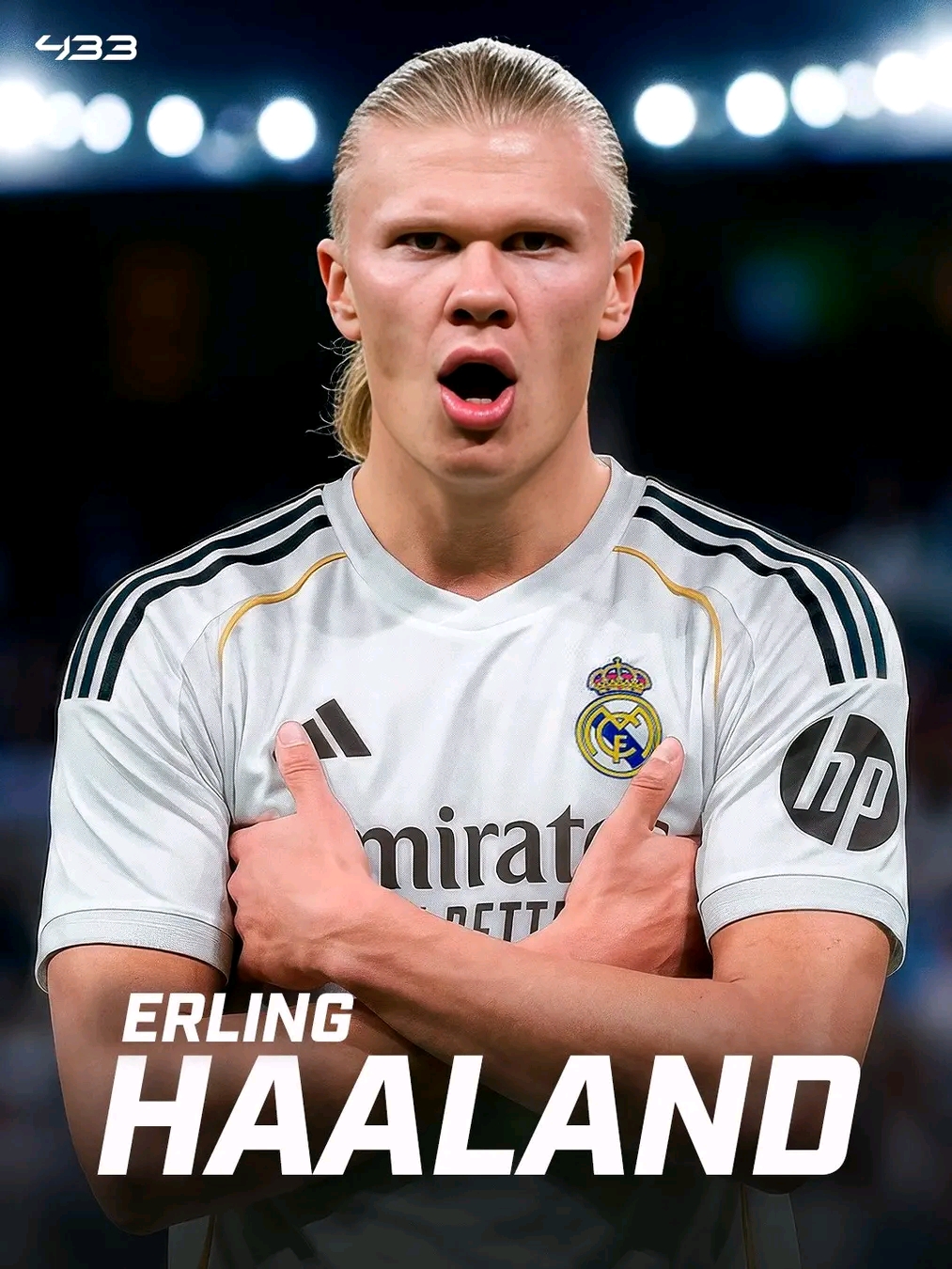
The footballing world rarely experiences a story as compelling, complex, and tantalizing as the potential transfer of Erling Haaland from Manchester City to Real Madrid. Over the past few years, Haaland has emerged as one of the most feared and admired strikers in world football. His explosive pace, raw power, intelligent movement, and clinical finishing have made him a nightmare for defenders and a dream for managers. From his early days at Molde in Norway to his prolific spell at RB Salzburg, then Borussia Dortmund, and now Manchester City, Haaland has always been destined for the biggest stages. Yet, even for a player of his exceptional quality, the rumors linking him to Real Madrid have captured the imagination of football fans around the globe in a way few transfer stories ever do.
Haaland’s journey to becoming one of football’s most talked-about figures is nothing short of meteoric. Born in Leeds, England, to a former professional footballer father, Alf-Inge Haaland, Erling inherited not only talent but also the competitive drive and professionalism required to succeed at the highest level. From the earliest stages of his career, he demonstrated a combination of physicality and technical skill that set him apart from his peers. In Norway, Haaland’s performances quickly drew the attention of scouts from across Europe, leading to a move to RB Salzburg in Austria. It was here that Haaland truly announced himself on the continental stage, scoring goals at a staggering rate in both domestic and European competitions.
His record-breaking form at Salzburg led to a move to Borussia Dortmund in Germany, where Haaland’s reputation skyrocketed. In the Bundesliga, he scored with relentless consistency, showcasing an uncanny ability to time his runs, exploit defensive weaknesses, and finish with both feet and his head. He was no longer just a promising young talent—he was one of Europe’s most feared forwards. At Dortmund, his performances in the Champions League, including spectacular hat-tricks against some of the continent’s best teams, solidified his status as one of football’s elite.
By the time Haaland moved to Manchester City, the world knew his name. Pep Guardiola’s side paid a £51 million release clause to secure him—a bargain by modern football standards, given his ability to alter the outcome of games singlehandedly. In his first season at City, Haaland scored a staggering number of goals, helping the team secure the treble: Premier League, FA Cup, and Champions League glory. His 153 goals in 186 appearances by 2026 is a testament to his consistency, work ethic, and unrivaled finishing ability. Yet, despite all his achievements, the whispers of a move to Real Madrid have never faded.
Why does Real Madrid, in particular, captivate the imagination when it comes to Haaland? The answer lies in history, prestige, and ambition. Los Blancos have long been associated with the galáctico philosophy—signing the world’s most talented players to not only dominate on the pitch but also create global appeal. From the days of Luís Figo, Zinedine Zidane, Ronaldo Nazário, and David Beckham to more recent legends like Cristiano Ronaldo and Karim Benzema, Madrid’s approach has always been about blending talent, ambition, and star power. Haaland fits this profile perfectly. He is a global superstar, a prolific goalscorer, and a player whose presence alone can shift narratives in football.
Madrid’s need for a striker of Haaland’s caliber is also tactical. Over the past few seasons, the team has relied on forwards like Karim Benzema, Vinícius Jr., Rodrygo, and the occasional support from younger talents. While these players have contributed immensely, the club lacks a striker who combines sheer physical presence, clinical finishing, and the ability to dominate games consistently. Haaland would instantly fill this void, providing a focal point for attacks, drawing defenders, and creating space for wingers and midfielders to exploit. His ability to link up play, press effectively, and finish under pressure aligns perfectly with the demands of La Liga and the Champions League.
The financial implications of such a transfer are enormous. Manchester City are not in the habit of selling their marquee players lightly. They built their squad around Haaland, designing their attacking system to maximize his strengths. Losing him would mean more than just the loss of goals—it would disrupt tactical cohesion, squad morale, and the club’s broader strategy for sustained dominance. On the other hand, Real Madrid have the financial clout to execute such a high-profile transfer. They have consistently shown a willingness to spend record sums on players who can define an era, and Haaland’s combination of sporting talent and marketability makes him a prime candidate for such an investment. His shirt sales, sponsorships, and global appeal would offset a large portion of the transfer cost, making him not just a footballing asset but a commercial one.
The saga is further complicated by personal ambition. Haaland is a player whose career trajectory has always been defined by bold moves and ambition. Every transfer he has made has been a step up, each designed to challenge him at higher levels of competition. While Manchester City has offered him a platform to showcase his abilities and achieve historic success, Real Madrid offers a different type of allure: legacy. Madrid is a club where players become legends, where the Champions League is a cultural obsession, and where stars are immortalized in football history. For a player like Haaland, whose ambition and desire for greatness are well-documented, the prospect of joining Real Madrid is as much about personal legacy as it is about footballing challenge.
Media coverage has added fuel to the fire. Every press conference, every subtle hint from agents, managers, or club officials is dissected by journalists, pundits, and fans. The transfer rumor has become a global talking point, with speculation dominating social media platforms and football forums. Fans debate tactical fit, potential partnerships with existing stars, and how Madrid might restructure their attack to accommodate Haaland. Memes, polls, and analysis videos proliferate, creating a narrative that feels almost as dramatic as a Champions League final. This is not just a transfer rumor; it is a cultural phenomenon, reflecting the power of modern football to capture imagination and spark global discussion.
Manchester City’s perspective cannot be ignored. Guardiola’s side is built on a delicate balance of tactical mastery, squad depth, and elite talent. Haaland is central to their plans, and the club would demand astronomical sums to even consider letting him leave. Negotiations, should they occur, would be highly complex, involving City’s hierarchy, Haaland’s agent, potential clauses, and strategic considerations about replacement players. Any move would require alignment among multiple stakeholders, making this a saga of both sporting and financial chess.
For Real Madrid, securing Haaland would be a statement of intent. The club has ambitions not only to dominate La Liga but also to assert themselves as the preeminent force in Europe. The Champions League is a particular obsession for Madrid, and a player of Haaland’s quality could be the missing piece in their quest for further continental glory. Beyond the tactical and sporting rationale, the transfer would send a message to fans, rivals, and the footballing world: Real Madrid are willing to do whatever it takes to maintain their legacy.
Haaland’s arrival would also have profound implications for team dynamics. Madrid’s current attacking options would benefit from his presence, creating new opportunities and combinations. Vinícius Jr. and Rodrygo would gain a striker who can finish moves, hold up play, and draw defensive attention away from the wings. Midfielders like Luka Modric, Toni Kroos, and Federico Valverde would have a central focal point for their passes, improving fluidity and efficiency. Even emerging talents would have the opportunity to learn from a generational striker, enhancing squad cohesion and performance.
From a fan perspective, the excitement is electric. Supporters already imagine Haaland scoring in El Clásico, breaking long-standing records, and inspiring Madrid to new heights. Social media platforms are flooded with speculation about jersey numbers, goal celebrations, and potential partnerships with current stars. Football communities debate the likelihood of the transfer, weighing Guardiola’s potential resistance against Madrid’s historic ability to acquire the world’s best. The narrative resonates beyond Spain, engaging global audiences and reminding fans why football is so captivating: it’s not just about games, it’s about dreams, legends, and the stories that bind us.
Yet, amidst the excitement, caution remains. Transfers of this magnitude are rarely straightforward. Manchester City will likely set a sky-high valuation for Haaland, while Madrid must balance financial commitment with strategic squad planning. Haaland himself must consider adaptation to a new league, expectations from fans, and the immense pressure that comes with being the focal point of one of the world’s most storied clubs. Timing, negotiations, and external interest from other clubs also complicate the situation. Every step requires precision, patience, and strategy.
Haaland’s agent, Rafael Pimienta, has previously emphasized the striker’s focus on Manchester City, noting that he is “very happy” and “nothing to discuss regarding a transfer” at present. Yet the very nature of football means that situations can change rapidly. Injuries, contract renegotiations, or shifts in club priorities could reopen the conversation at any moment. The ongoing interplay between sporting goals, financial incentives, and personal ambition ensures that the Haaland-to-Madrid saga remains fluid and unpredictable.
Historically, Real Madrid’s galáctico strategy has succeeded because it blends star power with tactical need. Players like Ronaldo not only scored goals but also elevated the club’s global brand and inspired teammates. Haaland has the potential to play a similar role. His combination of skill, work rate, and charisma makes him ideal for a club seeking both on-field dominance and off-field influence. If Madrid can secure him, they are likely to reap benefits for years, both in terms of trophies and global recognition.
The narrative is further enriched by the context of modern football. Transfers are no longer just sporting decisions—they are complex events involving branding, sponsorships, fan engagement, and media attention. Haaland represents a convergence of these factors: a player who dominates in performance metrics, attracts commercial opportunities, and creates compelling narratives for fans and media alike. The potential move is a perfect example of how football today operates at the intersection of sport, business, and culture.
In conclusion, the story of Erling Haaland to Real Madrid is one of ambition, legacy, and possibility. It encompasses sporting excellence, financial strategy, tactical innovation, fan engagement, and the thrill of speculation. Haaland is a generational talent whose career trajectory makes him a prime candidate for one of football’s most historic clubs. Manchester City’s dominance, Guardiola’s tactical genius, Real Madrid’s galáctico history, and the global fascination with superstar transfers all collide in this story, creating one of the most compelling sagas in modern football.
Whether Haaland ultimately moves to Madrid or continues his reign at Manchester City, the saga itself has captured the imagination of football fans worldwide. It is a story of talent, ambition, and legacy—a reminder of why football is more than a game. It is about heroes, dreams, and the pursuit of greatness. Every fan, analyst, and player is watching, waiting, and imagining the possibilities. The next chapter of Haaland’s career, whether in England or Spain, will undoubtedly shape the landscape of European football for years to come.