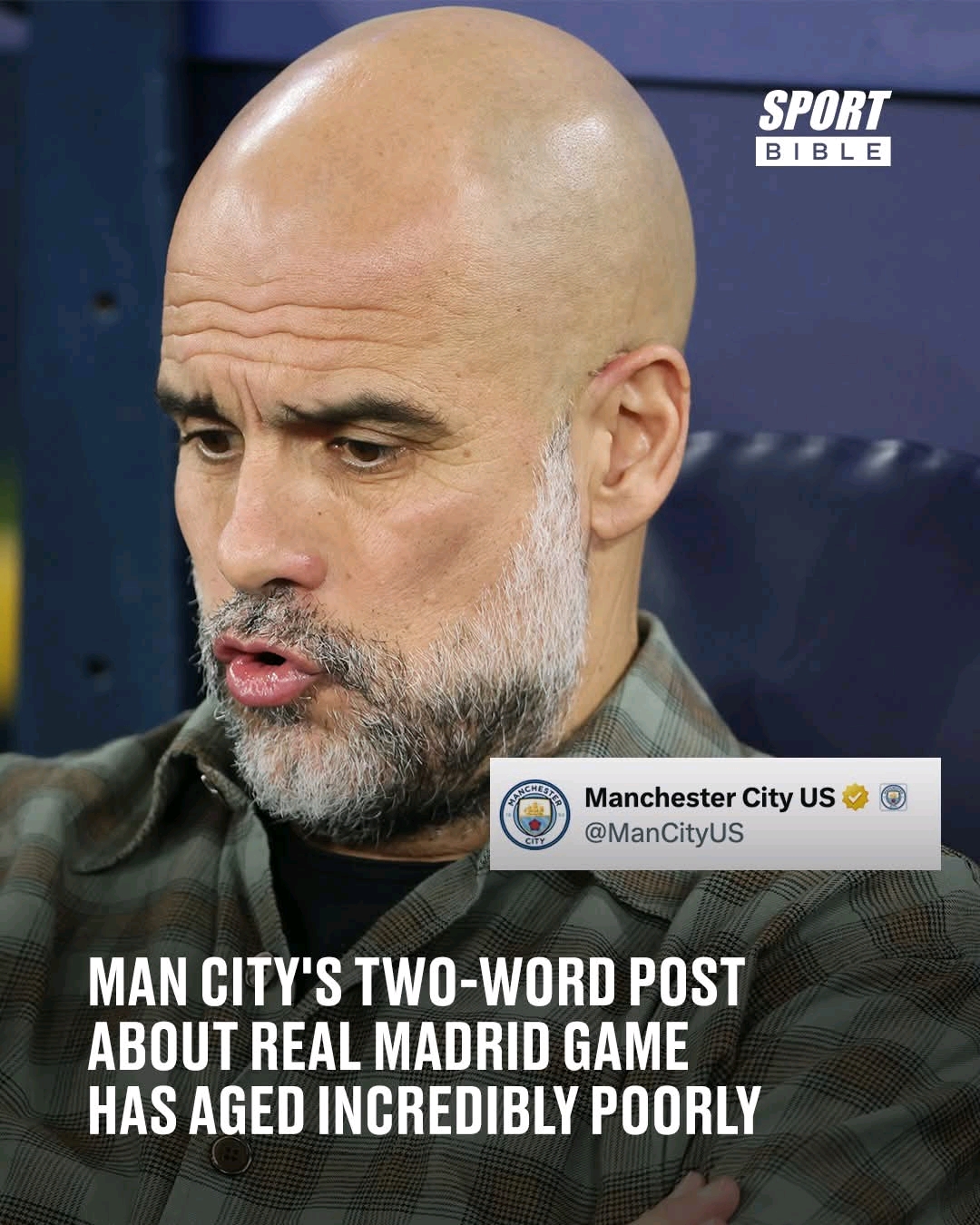
The message was simple, bold, and filled with confidence. Just two words, but they carried the weight of an entire club, an entire fanbase, and an entire belief system built on years of dominance and success. “We believe.” That was what Manchester City posted before one of the biggest games of their season, a Champions League night that was supposed to be about courage, comeback, and rewriting history. At that moment, those two words felt powerful. They felt right. They felt like something only a team with City’s mentality could say.
But football has a cruel way of turning confidence into irony.
By the time the final whistle blew, those same two words had taken on a completely different meaning. What was once a message of hope became a symbol of how quickly things can fall apart at the highest level. What was meant to inspire ended up being remembered for all the wrong reasons.
The story did not start on that night. It started a week earlier, in Spain, where City traveled to face Real Madrid in the first leg of their Champions League clash. It was supposed to be a tight contest, a battle between two giants of European football. Instead, it turned into a nightmare. Real Madrid were ruthless, clinical, and unstoppable. City, usually so composed and dominant, looked vulnerable. By the end of the match, the damage was done. A heavy defeat. A three-goal deficit. A mountain to climb.
For most teams, that would have been the end of the story. But City are not most teams. Under Pep Guardiola, they have built a reputation for believing in the impossible. Comebacks, dominance, control, these are things that define them. So when they returned home for the second leg, there was still hope. There was still belief.
And that belief was captured perfectly in that social media post.
An image of Bernardo Silva dressed like an astronaut, a creative nod to the idea of going beyond limits, of achieving something extraordinary. It was also a reference to a popular film project, adding a modern, cultural touch to the message. But the most important part was the caption. “We believe.” Simple. Direct. Powerful.
Fans saw it and felt inspired. This was the mindset they expected from their team. No fear. No surrender. Just belief.
But football is not played on social media. It is played on the pitch.
From the very beginning of the second leg, the tension was clear. City needed a fast start, a goal to ignite the comeback. The crowd was ready, the energy was there, but Real Madrid were calm. Experienced. Unshaken. They have been in these situations many times before, and they know exactly how to handle them.
City tried to push forward, to create chances, to build momentum. But every attack felt heavy, every pass carried pressure. Time was not on their side, and the more minutes passed without a goal, the more difficult the task became.
Then came the moment that changed everything.
A quick attack from Real Madrid. The ball found Vinícius Júnior, one of the most dangerous players in world football. He moved with speed, with confidence, with intent. He took his shot, aiming to test the goalkeeper and possibly end the tie once and for all.
But the ball did not reach its target.
Instead, it struck the arm of Bernardo Silva inside the penalty box.
At first, it looked like just another blocked shot. Players appealed, but that is normal in football. The referee allowed play to continue for a moment. Then came the signal. VAR.
Everything stopped.
The replay showed the contact clearly. The ball hit Silva’s arm. But as always, the debate began instantly. Was it intentional? Was his arm in a natural position? Did he have time to react? These are the questions that make handball decisions so controversial.
The referee, Clément Turpin, was called to review the incident. He walked to the monitor, watched the replay, and made his decision.
Penalty to Real Madrid.
But that was not all.
Red card.
In one moment, everything collapsed for Manchester City. Not only were they facing a penalty, but they were now down to ten men. And not just any player. Their captain. One of their most important players. Gone.
The stadium fell into a mix of shock and disbelief. City players protested. Silva himself could not accept it. But the decision stood.
Real Madrid stepped up for the penalty. Calm. Confident. Clinical. The kind of moment they thrive in. The ball hit the net, and just like that, the dream of a comeback was almost completely gone.
From that point on, it was no longer about belief. It was about survival.
With ten men, City had to change everything. Their attacking plans disappeared. Their focus shifted to defense, to damage control. But against a team like Real Madrid, even that is not easy.
Madrid sensed weakness and pushed forward. They controlled the game, created chances, and punished every mistake. By the end of the night, the scoreline told the full story. A 5-1 aggregate victory for Real Madrid. A dominant performance. A clear message.
Manchester City were out.
And suddenly, that social media post came back into the spotlight.
“We believe.”
What once felt powerful now felt ironic. Fans across the world shared it again, but this time with a different tone. Some mocked it. Some used it as a joke. Others saw it as a reminder of how unpredictable football can be.
It is not the first time something like this has happened, and it will not be the last. In the modern game, social media is part of the experience. Clubs use it to connect with fans, to build excitement, to show confidence. But when things go wrong, those same messages can come back to haunt them.
For City, this was not just about one post. It was about a pattern. For the second season in a row, they had been eliminated from the Champions League by Real Madrid. A team that seems to have a special connection with this competition, a team that always finds a way to win when it matters most.
For Guardiola, it was another painful moment in his European journey with City. Despite all the success, all the trophies, all the dominance in domestic football, the Champions League remains the ultimate challenge. And nights like this only make it harder.
But the season is not over.
City still have a lot to fight for. In the Premier League, they are chasing the title, trying to catch Arsenal FC, who currently sit at the top of the table. The gap is significant, but not impossible. And if there is one team capable of closing it, it is Manchester City.
There is also a cup final ahead. A chance to win silverware, to remind everyone of their quality, to turn disappointment into motivation. Facing Arsenal again in the Carabao Cup final, City have an opportunity to make a statement.
And then there is the FA Cup, another competition where they remain strong contenders. A quarter-final clash against Liverpool FC awaits, another big test, another chance to prove themselves.
This is the reality of football. One moment you are dreaming of European glory, the next you are picking yourself up after a painful defeat. The key is how you respond.
For the players, it is about learning from the experience. For Silva, it is about moving forward, putting the red card behind him, and focusing on the next challenge. For Guardiola, it is about finding solutions, keeping the team motivated, and pushing for success in the competitions that remain.
And for the fans, it is about belief. Real belief. Not just words on a screen, but the kind that stays even when things go wrong.
Because at the end of the day, football is not just about winning. It is about moments. Highs and lows. Joy and pain. Confidence and disappointment. And sometimes, it is about two simple words that mean everything before a game and something completely different after it.
“We believe.”
Before the match, it was a promise.
After the match, it became a lesson.
A reminder that in football, nothing is guaranteed. Not even belief.