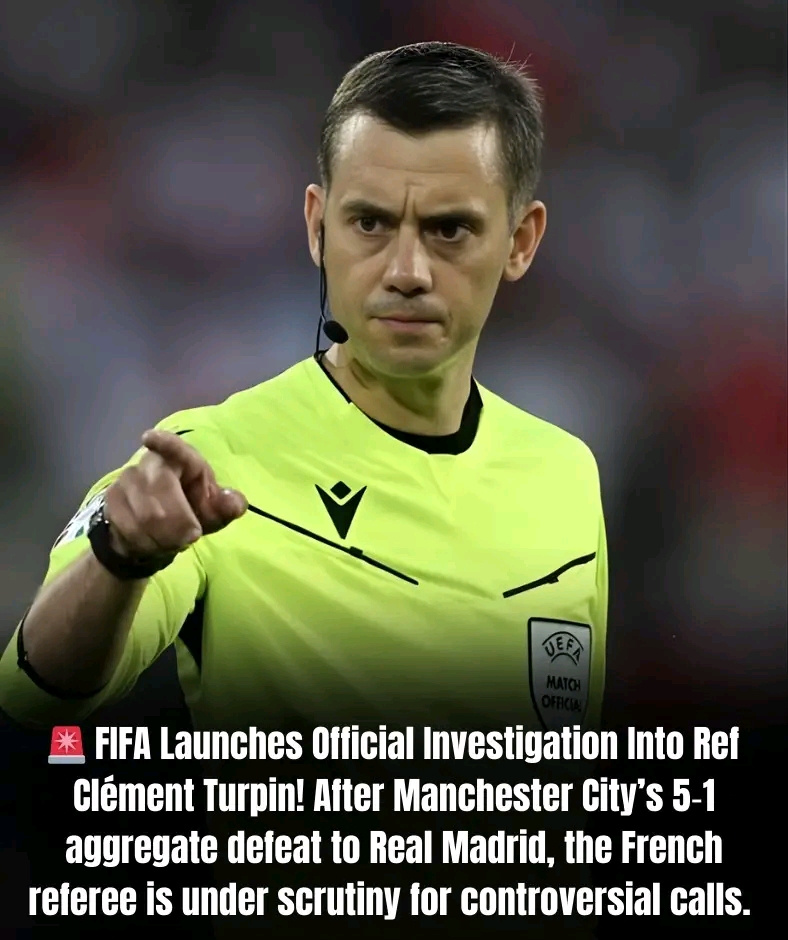
The night that was supposed to be remembered for football brilliance, goals, and elite competition between two giants of the modern game quickly turned into something far more controversial, something far more uncomfortable, and something that has now dragged one of the most respected referees in the world into the center of a growing storm. What happened during the explosive clash between Manchester City and Real Madrid has refused to fade away. Instead, it has grown louder, heavier, and more serious with each passing day. And now, the spotlight has shifted fully onto one man, Clément Turpin.
What began as frustration from fans and heated debates on social media has now escalated into something official, something that has captured global attention. Reports have emerged that FIFA has launched an extended investigation into Turpin’s performance during that high-stakes encounter. The decision did not come out of nowhere. It followed a wave of complaints, accusations, and growing pressure from different corners of the football world, all pointing to one central claim, that the match may not have been officiated fairly.
To understand why this situation has become so serious, you have to go back to that game, a match filled with intensity, expectations, and the kind of pressure that only the biggest European nights can produce. Manchester City came into the game desperate to prove themselves, while Real Madrid carried their usual aura of confidence and history. The result, a 5-1 aggregate score, was already shocking on its own. But the result was not what people kept talking about after the final whistle.
Instead, attention turned to the decisions made during the match. Moments that seemed small at first began to look bigger on replay. Challenges that were waved on, incidents that did not receive VAR attention, and calls that appeared inconsistent started to pile up. Fans from both sides, as well as neutral observers, began to question what they had seen.
At the center of all those moments stood Clément Turpin, a referee known for handling some of the biggest matches in world football. He has officiated Champions League finals, international tournaments, and countless high-profile fixtures. His reputation has always been one of authority, calmness, and control. That is what made this situation even more shocking. This was not an inexperienced official. This was one of the best.
But football can be brutal. One night, one match, one series of decisions can change everything.
As clips from the game spread online, debates intensified. Some pointed to specific moments where they believed Manchester City were treated unfairly. Others argued that Real Madrid were on the receiving end of questionable calls. The truth became blurred by emotion, loyalty, and the natural bias that exists in football discussions.
Then came the complaints.
According to reports, multiple formal complaints were submitted regarding the officiating of the match. These were not just emotional reactions from fans. They included detailed analyses of key decisions, timelines of incidents, and calls for accountability. The pressure began to build on FIFA to respond.
And eventually, they did.
The decision to launch an extended investigation signaled that this was not being taken lightly. It was not just about reviewing a few decisions and moving on. It was about examining the entire performance of the referee, looking at every key moment, every call, every non-call, and determining whether there was any form of bias, error, or breach of officiating standards.
For Clément Turpin, this represents one of the most challenging moments of his career. Referees often operate in the background, their work only noticed when something goes wrong. Now, he finds himself at the very center of global attention, with his decisions being analyzed frame by frame.
The investigation is expected to cover multiple aspects. First, the consistency of decisions. Were similar incidents treated the same way? Were there clear patterns that suggest inconsistency? Second, the use of VAR. Was technology applied correctly? Were there moments where VAR should have intervened but did not? Third, communication. How did Turpin interact with players? Were there signs of control, or lack of it?
Each of these areas will be examined carefully, because the stakes are high. This is not just about one referee. It is about trust in the game itself.
For fans of Manchester City, the investigation represents a chance for answers. Many of them feel that their team was on the wrong end of key decisions that influenced the outcome of the tie. They want clarity. They want to know if those moments were simply human error or something more serious.
On the other side, supporters of Real Madrid have defended the result, arguing that football matches are decided by performance, not just refereeing. They believe their team earned the victory and that focusing too much on the referee takes away from the players’ efforts.
This divide is part of what makes the situation so complex. Football is emotional. It is passionate. And when controversy enters the picture, those emotions can quickly turn into strong opinions.
Meanwhile, within the world of officiating, this case is being watched very closely. Referees at the highest level understand how difficult the job is. They know that decisions have to be made in seconds, often with limited angles and intense pressure from players, coaches, and fans. But they also understand that accountability is part of the role.
The outcome of this investigation could have serious consequences. If FIFA finds that there were significant errors or breaches of protocol, it could lead to sanctions. These could range from temporary suspension to removal from major competitions. On the other hand, if the investigation concludes that the decisions were within acceptable limits, it could reinforce the idea that refereeing, like any human activity, is not perfect.
There is also a broader issue at play here, the role of VAR in modern football. Technology was introduced to reduce controversy, to bring more accuracy to decisions. But situations like this raise questions. Is VAR being used effectively? Are there inconsistencies in how it is applied? Are referees relying on it too much, or not enough?
These are questions that go beyond one match, beyond one referee. They touch on the future of the game itself.
As the days pass, more details are expected to emerge. Reports, statements, and possibly even leaked information could shape the narrative further. Every new piece of information will be analyzed, debated, and discussed across the football world.
For Clément Turpin, the focus will be on cooperating with the investigation and defending his decisions. For FIFA, the challenge will be to ensure that the process is thorough, fair, and transparent.
And for the fans, the waiting continues.
Because in football, moments like this do not just disappear. They linger. They become part of the story. They influence how matches are remembered and how future games are approached.
The clash between Manchester City and Real Madrid will always be remembered for its dramatic scoreline. But now, it will also be remembered for something else, a controversy that has reached the highest levels of the game, pulling a top referee into an investigation that could define his career.
And as the football world watches closely, one question remains at the center of it all.
Was it just a difficult night for a referee, or is there something deeper that needs to be uncovered?
Only the investigation will tell.