Manchester City F.C. were unfairly treated.” — former City boss Roberto Mancini has launched a strong attack on referee Clément Turpin following the UEFA Champions League clash with Real Madrid. 😡⚖️🔥 Mancini didn’t hold back, claiming there were three key decisions during the second leg that went against City and ultimately prevented their comeback. According to him, the officiating raised serious questions about fairness at the highest level.

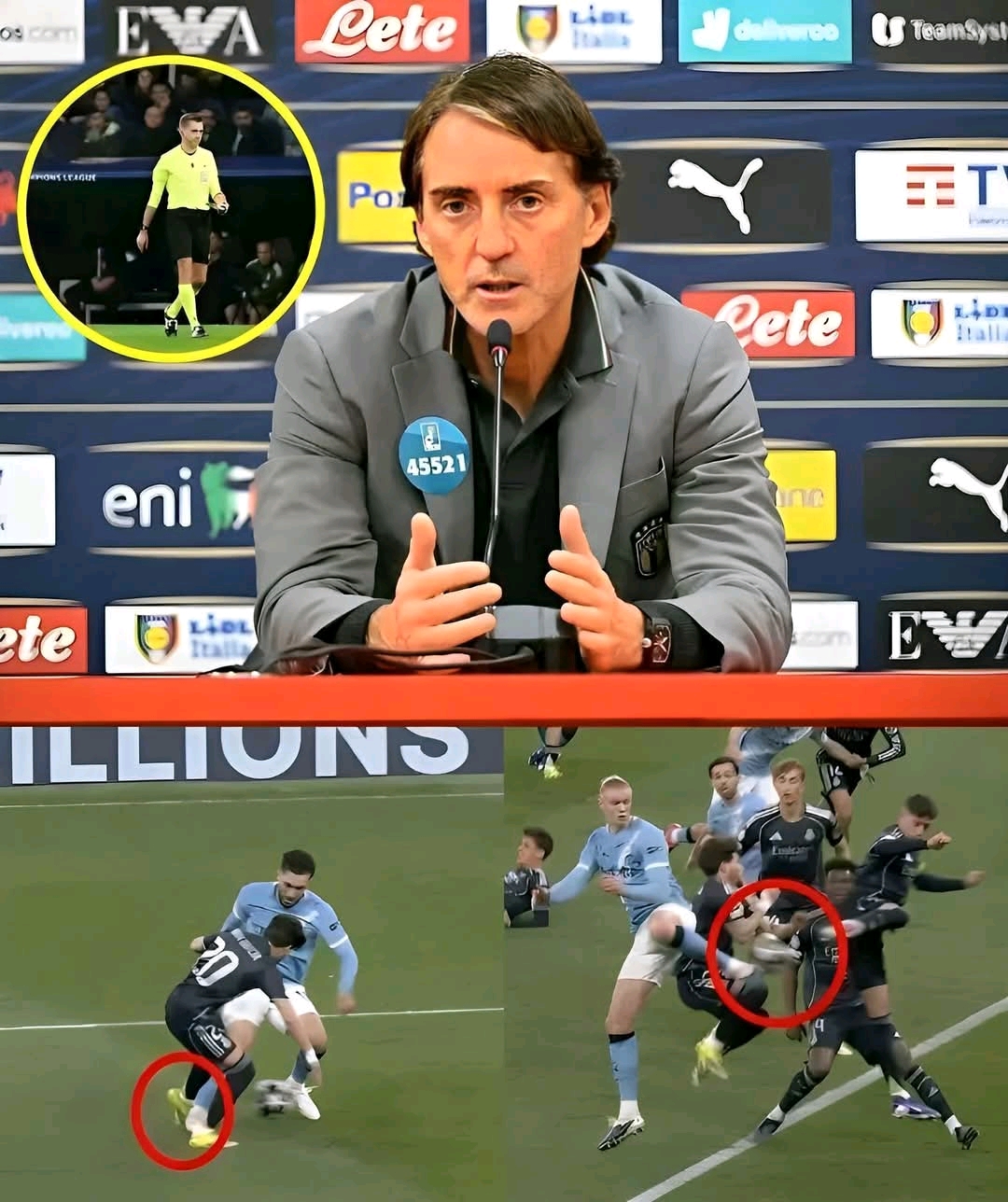
The night was supposed to be about football, about passion, about one last fight under the bright lights of Europe’s biggest stage, but instead it has turned into something far more controversial, something that has shaken conversations across the football world, something that refuses to go away quietly. When the final whistle blew on that intense UEFA Champions League clash between Manchester City and Real Madrid, many expected the usual analysis about tactics, missed chances, and moments of brilliance, but what followed was very different, very explosive, and very emotional.
At the center of it all now stands Roberto Mancini, a man who knows Manchester City better than most, a man who once led them to glory and understands exactly what it means to fight for success at the highest level. And he did not hold back, not even a little. His words came out strong, sharp, and full of frustration as he openly questioned the decisions made during that crucial second leg, decisions he believes changed everything.
According to Mancini, this was not just a normal game where things simply did not go City’s way. No, in his eyes, this was something deeper, something more troubling. He described the performance of the referee, Clément Turpin, as one that left serious doubts about fairness, and that alone has been enough to ignite a firestorm of reactions among fans, pundits, and analysts across the globe.
The match itself had all the ingredients of a classic European night. The tension, the noise, the expectations, everything was perfectly set. Manchester City came into the game knowing they had a mountain to climb, but also believing they had the quality to do it. Real Madrid, on the other hand, carried their usual aura in this competition, a club that has built its identity on moments like this, where pressure becomes fuel rather than fear.
But as the game unfolded, moments began to appear, small at first, then bigger, then impossible to ignore. Mancini pointed to three key decisions, three moments that he believes completely changed the direction of the match. In football, games are often decided by fine margins, by inches, by seconds, and when those moments are influenced by refereeing calls, the impact can be massive.
The first incident, according to him, came at a time when Manchester City were building momentum, when the belief inside the team and among the fans was starting to grow. A decision went against them, a call that stopped their flow, and suddenly the energy shifted. It may have looked small on the surface, but in a match of this magnitude, even the smallest interruption can have huge consequences.
Then came the second moment, one that has already been replayed countless times across social media and television screens. This was not just a minor call, this was one that directly affected a potential goal-scoring opportunity. Mancini believes this decision was simply wrong, that it denied City a chance to get back into the tie in a meaningful way. And when you deny a team like Manchester City that kind of opportunity, you are not just stopping a play, you are potentially deciding the outcome.
The third incident was perhaps the most controversial of them all, the one that has drawn the strongest reactions. By this point, emotions were already high, the tension was already unbearable, and this call felt like the final blow. Mancini described it as a moment that left him in disbelief, a moment that, in his words, made it impossible for City to complete their comeback.
As his comments spread, they quickly found support among a large section of fans. Supporters of Manchester City have taken to social media, expressing their anger, sharing clips, analyzing every angle, and demanding answers. For them, this is not just about one match, it is about a pattern, about the need for transparency and accountability at the highest level of the game.
But it is not only City fans who are talking. Neutral observers, former players, and analysts have also joined the conversation. Some agree with Mancini, pointing out inconsistencies in refereeing decisions not just in this game but across the competition. Others, however, have pushed back, arguing that referees are human, that mistakes are part of the game, and that focusing too much on officiating takes away from the performances on the pitch.
Still, the debate refuses to die down. That is because of what is at stake. The UEFA Champions League is not just any competition, it is the pinnacle of club football, the stage where every decision carries enormous weight. When questions are raised about fairness here, they echo louder, they travel further, and they demand attention.
For Manchester City, this is a painful moment. A team built with ambition, with talent, with the desire to dominate Europe, now finds itself facing questions not just about performance but about what might have been. The players gave everything, they fought, they pushed, but in the end, the story has been overshadowed by controversy.
For Real Madrid, the situation is different. They move forward, as they so often do in this competition, but even their victory is now being discussed through the lens of these decisions. That is the nature of football when controversy enters the picture, it changes how everything is viewed, it adds a layer of doubt, even when a team has performed well.
Mancini’s words have also put pressure on UEFA. When a figure of his stature speaks so openly, it cannot be ignored. Questions will be asked, discussions will take place behind closed doors, and there may even be reviews of the decisions in question. Whether that leads to any real change, however, remains to be seen.
Refereeing has always been one of the most debated aspects of football. Even with the introduction of technology, with systems designed to reduce errors, controversy still finds a way to appear. Some argue that this is part of the game’s drama, that it adds to the emotion, but others believe that at this level, there should be no room for doubt, no room for decisions that can be questioned so strongly.
As the days pass, more details are likely to emerge. More analysis, more opinions, more reactions. This story is far from over. In fact, it may only just be beginning. Because when something like this happens on such a big stage, it does not disappear quickly. It stays, it grows, it becomes part of the narrative of the season.
For Mancini, this is about defending a club he once led, about standing up for what he believes is right. His passion is clear, his frustration is obvious, and his message is simple: football at the highest level must be fair, must be transparent, and must be accountable.
For the fans, it is about justice, about wanting answers, about believing that their team deserved better. Football is more than just a game to them, it is emotion, it is identity, it is something deeply personal. And when they feel that something unfair has happened, they will not stay silent.
And for the rest of the football world, it is a reminder of how quickly things can change, how one match can become more than just a match, how a few decisions can spark a global conversation.
The images from that night will remain. The moments, the reactions, the controversies. They will be replayed, discussed, debated for a long time. And no matter what happens next, this game will not be remembered just for the football, but for everything that came with it.
Because sometimes, in football, the story goes beyond the pitch. Sometimes, it becomes something bigger, something louder, something impossible to ignore. And right now, that is exactly what has happened.