𝘚𝘏0𝘊𝘒𝘐𝘕𝘎 𝘜-𝘛𝘜𝘙𝘕! 𝘙𝘢𝘯𝘨𝘦𝘳𝘴 𝘎𝘪𝘷𝘦𝘯 𝘕𝘌𝘞 𝘙𝘦𝘥 𝘊𝘢𝘳𝘥 𝘝𝘦𝘳𝘥𝘪𝘤𝘵 𝘢𝘴 𝘚𝘍𝘈 𝘛𝘢𝘬𝘦𝘴 𝘝𝘈𝘙 𝘍𝘢𝘳𝘤𝘦 𝘵𝘰 𝘭𝘕𝘚𝘈𝘕𝘌 𝘕𝘦𝘸 𝘓𝘦𝘷𝘦𝘭𝘴 𝘪𝘯 𝘛𝘪𝘵𝘭𝘦 𝘙𝘢𝘤𝘦

What started as a normal weekend in Scottish football quickly turned into chaos, controversy, and total confusion, as a shocking new twist in the refereeing drama involving Rangers sent fans into a frenzy and forced the Scottish Football Association to step in again with yet another update that nobody saw coming.
This is not just football anymore.
This is a full-blown VAR storm.
And the title race? It is now hanging by a thread.
Everything began with one decision. One moment. One red card that changed everything.
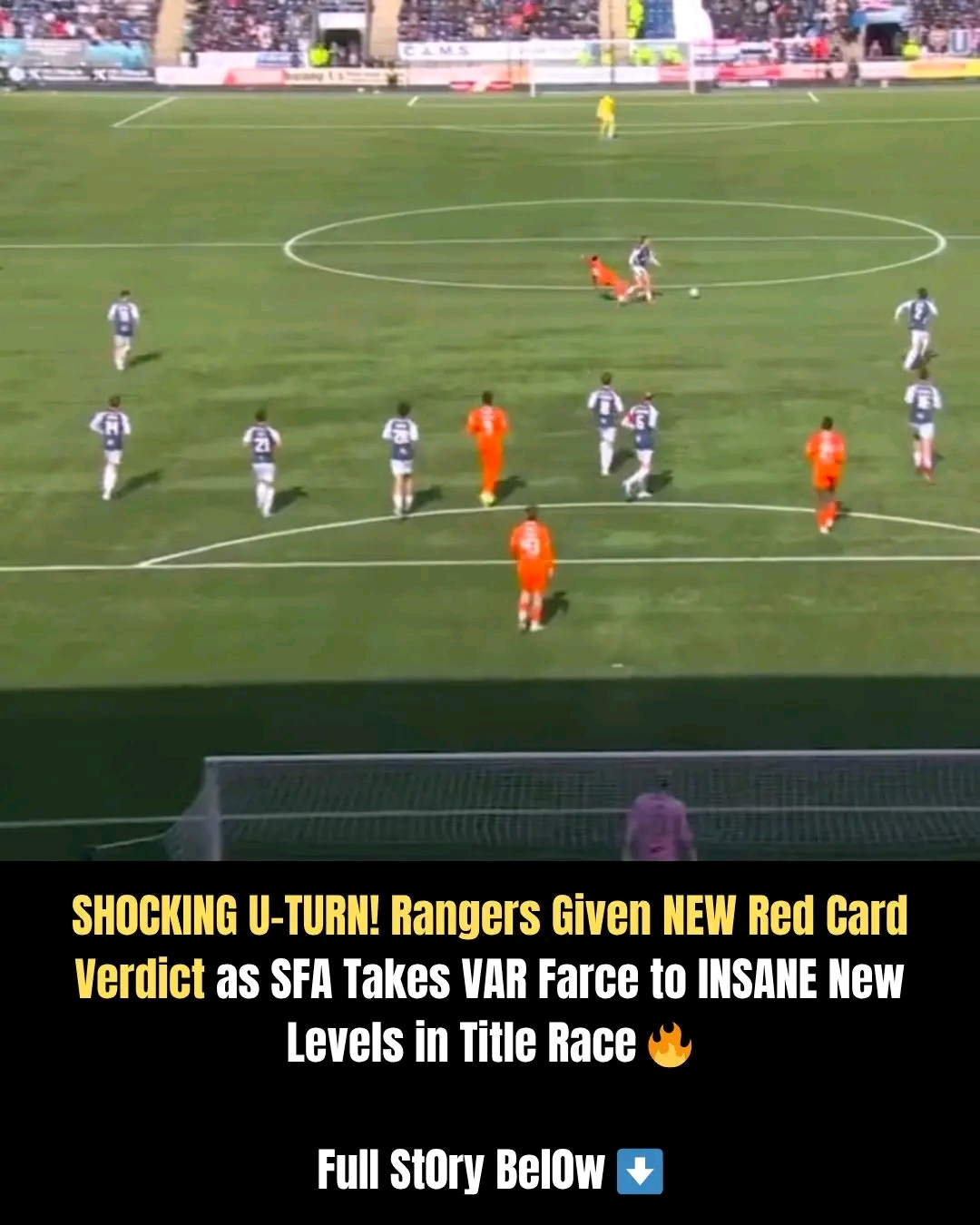
During a heated league match, Rangers were involved in a controversial incident that saw a player sent off after a challenge that split opinion right across the football world. Some said it was a clear foul. Others said it was never a red card. But the referee made his decision, VAR reviewed it, and the card stood.
At that moment, the stadium exploded. Fans shouted. Players argued. The bench reacted in disbelief. And social media went into meltdown within seconds.
But nobody knew that this was only the beginning.
Because days later, the conversation did not die down. Instead, it grew louder. Former referees started speaking out. Pundits questioned the consistency of VAR. Fans demanded answers. And pressure built on the SFA to explain exactly what happened inside the VAR room during that decision.
Then came the shock.
A reported U-turn.
According to emerging discussions, officials within the Scottish football system reviewed the incident again and came to a different conclusion. The same challenge. The same footage. But this time, the interpretation reportedly changed.
The red card decision, once confirmed, was now being questioned again.
And just like that, Scottish football was thrown into chaos.
People could not believe it. How can a decision that stood after VAR suddenly be reconsidered again? How can the rules change after the game has already moved on? And what does that mean for the match result, the suspension, and even the title race?
These are the questions that fans are now asking everywhere.
Inside Rangers’ camp, frustration quickly grew. Players and staff were said to be stunned by the situation. One moment they were dealing with the fallout of a red card. The next moment, they were hearing that the decision itself might not even have been correct.
It felt like the ground was moving beneath them.
Supporters were even more emotional. Some felt angry, believing their team had been unfairly punished. Others felt confused, unsure what to believe anymore. Many pointed fingers at VAR, calling it inconsistent, unreliable, and damaging to the spirit of the game.
And at the center of it all, the SFA found themselves under intense pressure.
Because this was no longer just about one match.
This was about trust.
Trust in referees. Trust in VAR. Trust in the system that is supposed to keep football fair.
When that trust breaks, everything else starts to collapse.
The SFA reportedly stepped in to review the situation again, trying to clarify how the decision was made, why VAR did not overturn it initially, and whether the red card should have been shown in the first place.
But instead of calming things down, the process only added more confusion.
Different interpretations began to emerge. Some officials reportedly stood by the original decision, saying the referee followed the correct procedure. Others suggested that the VAR intervention should have been stronger. And a third group believed the entire situation highlighted a deeper problem with consistency in Scottish football officiating.
So instead of clarity, fans got contradiction.
Instead of answers, they got more questions.
And instead of closure, they got chaos.
The phrase “VAR farce” started trending again, with supporters across different clubs sharing their frustrations. Many pointed out that this was not the first controversial decision of the season. In fact, it was becoming a pattern.
Games affected by tight calls. Matches changing direction after long VAR checks. Players unsure whether to celebrate goals. Managers confused in post-match interviews. And fans slowly losing patience.
Football is supposed to be simple. Score more goals, win the game. But VAR has changed that simplicity into something more complicated, more emotional, and often more controversial.
For Rangers, the timing of this latest drama could not be worse.
The title race is extremely tight. Every point matters. Every decision matters. And every suspension can change the direction of a season.
If the red card stands, it could mean key players missing important matches. If it is overturned, questions will be raised about fairness and consistency. Either way, someone feels wronged.
And that is the problem.
There is no middle ground anymore.
Former players and analysts have also entered the debate, adding fuel to the fire. Some argue that football has lost its human element. Others say VAR is necessary but poorly managed. A few even suggest that referees are now under too much pressure to make perfect decisions in impossible situations.
Because slow-motion replays do not always tell the truth.
What looks like a dangerous tackle in one angle may look like a normal challenge in another. What seems intentional in real time may look accidental when slowed down. And what feels like a clear red card in the stadium can feel very different in a studio with multiple camera angles.
This is the modern football problem.
Technology has improved the game, but it has also complicated it.
And in Scotland right now, that complication is reaching breaking point.
Inside the SFA, discussions are reportedly ongoing about how to prevent similar confusion in the future. Some officials want clearer VAR guidelines. Others want fewer interventions. A few even suggest full transparency, where referees explain decisions live after VAR checks.
But every solution comes with its own risks.
Too much intervention slows the game. Too little leads to mistakes. Too much explanation creates more arguments. Too little explanation leads to suspicion.
There is no perfect answer.
Meanwhile, Rangers must prepare for their next matches while carrying the emotional weight of this controversy. Players are professionals, but they are also human. Moments like this stay in the mind. A red card that may or may not have been correct can affect focus, confidence, and momentum.
Managers often talk about “controlling what you can control.” But in cases like this, even that becomes difficult. Because refereeing decisions are outside the team’s control, yet they can define everything.
Fans are now watching every SFA update closely, waiting for final confirmation. Will the red card be fully overturned? Will it remain in place? Will there be any punishment for VAR officials? Or will the situation quietly fade away without a clear resolution?
Nobody knows.
And that uncertainty is what is making everything worse.
Social media continues to explode with opinions. Some fans post slow-motion clips frame by frame, trying to prove their point. Others compare similar incidents from previous matches, asking why those were handled differently. Memes, arguments, and heated debates are spreading everywhere.
Football has always been emotional, but VAR has added a new layer of tension.
Every decision now feels like a courtroom case.
Every foul feels like evidence.
Every replay feels like a trial.
And every match feels like it might not end even after the final whistle.
For Rangers, the focus now has to return to football. Because while controversy dominates headlines, the season continues. Games still have to be played. Points still have to be earned. And the title race will not wait for any investigation to finish.
But it is not easy to move on when the feeling of injustice is still fresh.
Players will have to reset mentally. Coaches will have to refocus the squad. And fans will have to decide whether to keep trusting the system or keep questioning it.
That is the reality of modern football.
One decision can change everything.
One replay can rewrite a story.
One VAR check can shift an entire season.
And right now in Scotland, that reality is louder than ever.
The SFA’s final clarification is expected to arrive soon, but whether it brings peace or more controversy remains to be seen.
Because in situations like this, even answers do not always end the argument.
They sometimes begin a new one.
And as the dust slowly settles, one thing is clear.
Scottish football is standing at a crossroads.
Between fairness and frustration.
Between technology and tradition.
Between control and chaos.
And at the heart of it all… is a red card that nobody can fully agree on.
The story is not over yet.
In fact, it may only just be beginning.