The Premier League season was entering its most dangerous stage, the point where every small moment could decide everything, where every touch of the ball could carry the weight of a trophy, and where every mistake could become a memory that haunts players forever. The fixtures list was packed, the pressure was rising, and across England, fans were watching closely as the title race between Arsenal and Manchester City reached a boiling point.
Games were lined up one after another. Crystal Palace were preparing to face West Ham. Brighton had a tough battle against Chelsea. Burnley were waiting for Manchester City. Bournemouth were set to meet Leeds. Sunderland would take on Nottingham Forest. Fulham against Aston Villa, Wolves against Tottenham, Liverpool against Crystal Palace, and Arsenal facing Newcastle. Every team had something to fight for, but above all, the focus of the football world remained fixed on one story — the intense and emotional battle for the Premier League crown.
And right at the center of it all was the clash at the Etihad Stadium.
It was not just a match. It was a statement. It was a war.
When Manchester City hosted Arsenal, everyone knew the stakes. For Arsenal, it was a chance to move closer to ending years of waiting and finally lifting the league title again. For City, led by Pep Guardiola, it was about survival in the title race, about refusing to give up their dominance, about proving that they are still the kings of English football.
The game itself delivered everything fans expected — intensity, drama, goals, controversy, and moments that would later be discussed again and again.
But while many people focused on the result, others began to look deeper, searching for the hidden details, the small decisions that may have changed everything.
And that is where the controversy truly began.
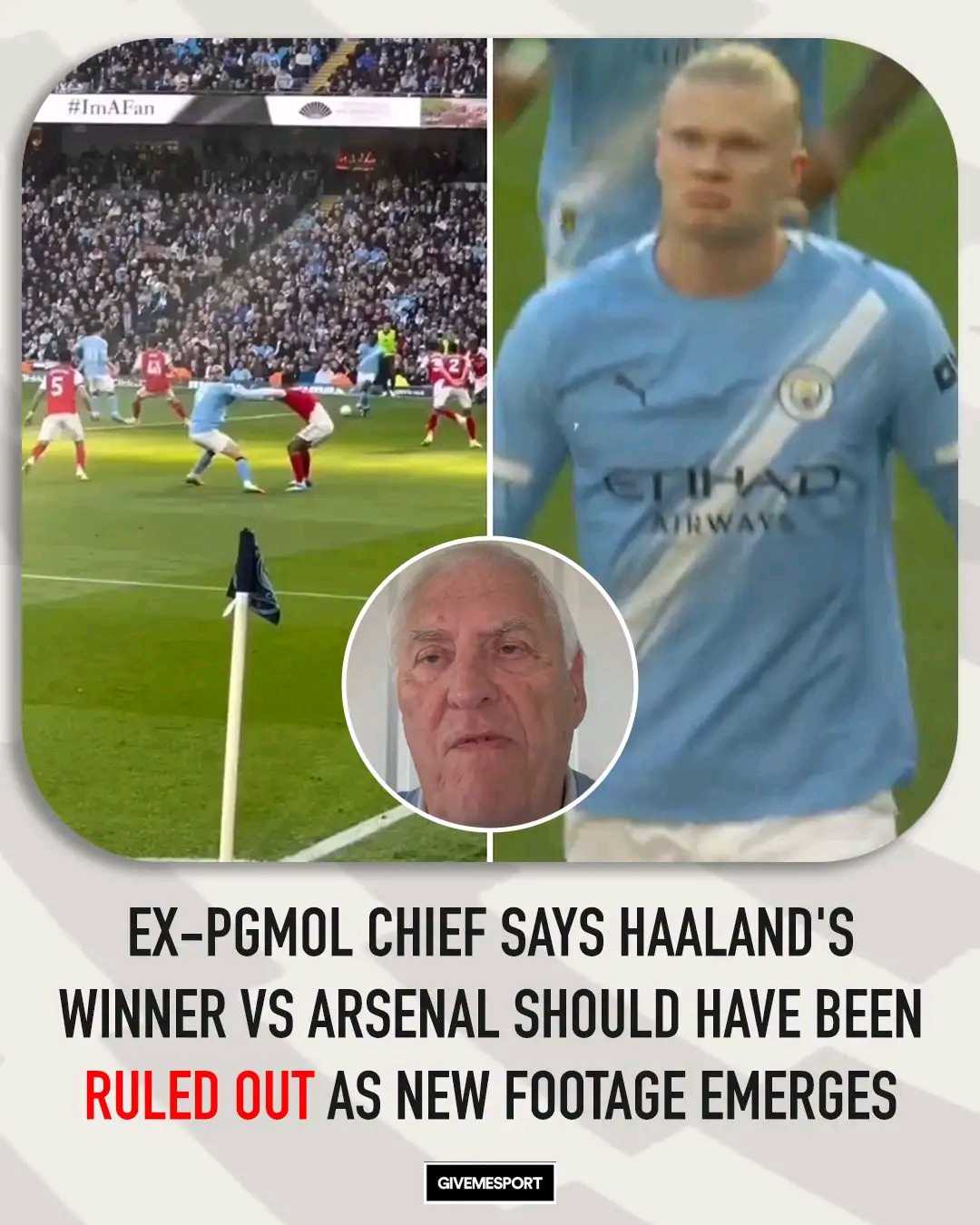
After the final whistle, when emotions were still high and debates were already starting, former refereeing chief Keith Hackett stepped forward with a bold claim. According to him, Manchester City were lucky to win. Not just lucky in a general sense, but lucky because the winning goal itself should never have counted.
That statement alone was enough to shake the football world.
Because if true, it would mean the entire result of the match was built on a mistake.
The moment in question came during the build-up to the decisive goal scored by Erling Haaland. It was a fast-moving situation inside the penalty box. The ball was delivered across goal, players were scrambling, and everything happened in seconds.
Rodri missed the ball. It fell kindly for Haaland. And with the calmness and power that has made him one of the most feared strikers in the world, he struck it into the net.
The stadium exploded. The fans celebrated. City players ran in joy.
At first, nothing seemed wrong.
But football is a game of details. And sometimes, those details only become clear when you slow everything down.
Hackett explained that in the build-up to that goal, Haaland had his hands on Arsenal defender Gabriel Magalhães. Not just light contact, but enough of a hold to affect Gabriel’s ability to defend properly.
In simple terms, Hackett believed Haaland had committed a foul before scoring.
According to the rules of football, if an attacking player holds a defender and gains an advantage from it, the goal should not stand. A free-kick should be given to the defending team instead.
Hackett’s words were clear and direct. He said the holding offence had a clear impact. He said it stopped Gabriel from doing his job. And he said the officials — both the referee and VAR — should have spotted it.
In his view, the goal should have been ruled out.
That one statement changed the entire conversation around the match.
Instead of simply talking about Manchester City’s victory, fans and analysts began asking a different question — did the referee get it wrong again?
The referee for the match, Anthony Taylor, had already been at the center of other controversial moments during the game. There had been the clash between Gabriel and Haaland, where some believed a red card should have been given. There was also the incident involving Kai Havertz and a City defender, where Arsenal players wanted a foul and possibly even a sending-off.
Each of these moments added to the tension.
But this new claim about the winning goal took things to another level.
Because this was not just about a decision during the game. This was about the final result itself.
If the goal should not have stood, then Arsenal may have taken something from the match. Maybe a draw. Maybe even a win if the game had unfolded differently.
Football is full of “what if” moments, but this one felt especially painful for Arsenal supporters.
They had fought hard. They had believed. They had pushed one of the strongest teams in the world to the limit.
And now, there was a suggestion that it was all decided by a missed foul.
For Manchester City, however, the feeling was completely different.
From their point of view, the goal was fair. The physical battle between Haaland and Gabriel had been happening all game. Both players were using their strength, both were pushing the limits, and neither wanted to back down.
Moments like that are common in football, especially in big matches. Defenders hold attackers. Attackers hold defenders. It becomes a test of power, balance, and timing.
Haaland himself seemed to enjoy that battle.
After the match, he spoke about the physical fight with Gabriel. He did not complain. He did not question anything. Instead, he embraced it. He said it was part of the game. He said he enjoyed those moments.
And most importantly, he said he won that battle.
For him, the proof was simple — he scored the winning goal.
That is the mentality of a striker. Results matter more than anything else.
But while Haaland celebrated, the debate continued to grow.
Fans on social media argued endlessly. Some agreed with Hackett, saying the goal should have been disallowed. Others defended the decision, saying it was just normal physical contact.
Pundits on television discussed it from every angle. Slow-motion replays were shown again and again. Every movement was analysed. Every hand placement was examined.
And still, there was no agreement.
That is the beauty and frustration of football.
Two people can watch the same moment and see completely different things.
For Arsenal, the frustration was not just about one decision. It was about a pattern. The feeling that multiple key moments had gone against them in one of the biggest games of the season.
First, the possible red card incident involving Gabriel. Then the Havertz situation. And now, the winning goal itself being questioned.
It felt like too much.
But the reality of football is harsh. Once the final whistle is blown, the result stands. There are no replays. No second chances. No way to change the outcome.
The table does not care about controversy.
And the table now shows Manchester City just three points behind Arsenal, with a game in hand.
That is the most dangerous part for Arsenal.
Because City are not just close — they are ready to strike.
Their next match against Burnley suddenly became even more important. Win that game, and they could move level on points. Depending on goals scored or goal difference, they could even go top.
Just like that, the pressure shifts.
Instead of Arsenal being in control, they are now looking over their shoulders.
And Manchester City, with all their experience, know exactly how to handle this situation.
They have been here before. They know how to chase. They know how to win when it matters most.
For Arsenal, the challenge now is mental strength.
They must forget the controversy. They must move on quickly. Because more games are coming, and there is no time to feel sorry for themselves.
Newcastle, Fulham, and other tough opponents are waiting. Each match is another test. Each match is another chance to prove they deserve the title.
But deep down, the memory of this game will remain.
The moment Havertz went down. The clash between Gabriel and Haaland. And most of all, that winning goal.
The goal that some believe should never have counted.
As the season continues, this match may become one of the defining moments of the title race. Not just because of the result, but because of the controversy surrounding it.
If Manchester City go on to win the league, Arsenal fans will look back at this game and wonder what could have been.
If Arsenal manage to hold on and win the title, this match will still be remembered as a moment of drama and tension that tested their resolve.
That is what makes football so powerful.
It is not just about goals and points. It is about emotions, debates, and moments that stay with us long after the game is over.
And right now, as the Premier League season moves closer to its final chapter, one thing is clear.
The story is far from finished.
The drama is only just beginning.