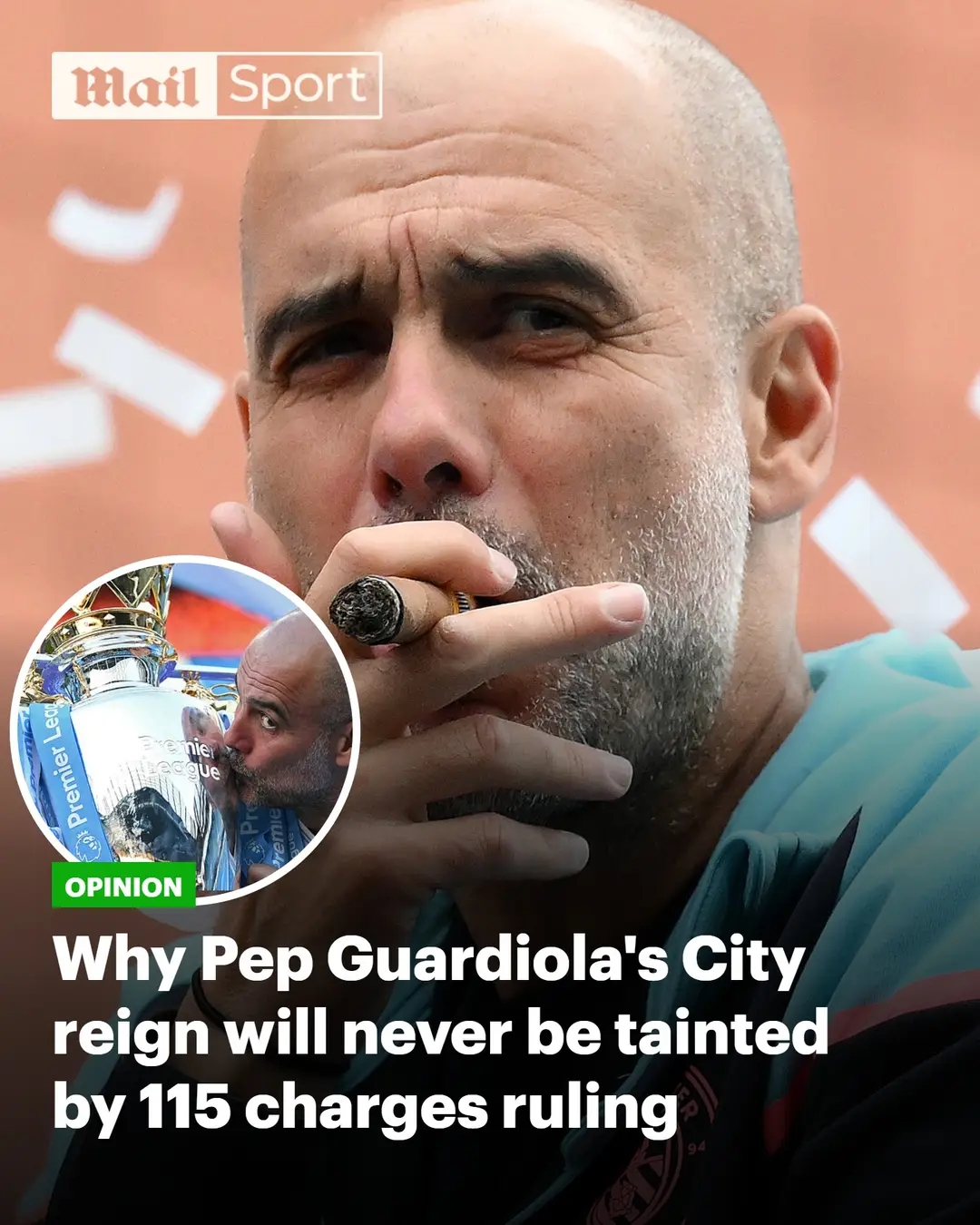
Pep’s legendary City era may be ending soon, but his impact on English football is untouchable!

The feeling is growing stronger with every passing week, and even though many people inside football still refuse to say it out loud, there is a quiet belief spreading across England that something big is coming to an end. Pep Guardiola, the man who changed everything at Manchester City, the man who built one of the most dominant teams English football has ever seen, may be preparing to walk away. It is not official, it is not confirmed, but sometimes in football you do not need an announcement to sense the truth. You can feel it in the air, in the small details, in the way people talk, and most of all in the way a manager behaves when the journey is reaching its final chapter.
Those who have followed Guardiola closely over the years know that he is not a man who stays too long in one place. At Barcelona, he created a team that many still call the greatest of all time, but he left while he was still at the top. At Bayern Munich, he dominated domestically, yet he chose to move on again. And at Manchester City, he has built something even bigger, something more powerful, something that has redefined success in English football. But now, there are signs, small but clear, that his time may finally be coming to an end.
People close to the game have started to talk. Analysts who understand Guardiola’s patterns, journalists who hear whispers behind the scenes, and even former players who have worked with him all seem to be saying the same thing. They do not claim to have inside confirmation, but they all feel it. They see it in his body language, in his words, and in his actions. Guardiola looks like a man who has given everything and is slowly preparing to let go.
One moment in particular stood out. It was after Manchester City won the Carabao Cup final. It should have been just another celebration, another trophy added to an already overflowing cabinet. But something about that day felt different. Guardiola was not just celebrating like a manager who had won again. He was emotional in a deeper way. He walked onto the pitch with his daughter, smiling, almost taking in the moment as if he knew it meant more than just another victory. It felt personal. It felt like someone who was quietly saying goodbye, even if no words were spoken.
Guardiola has always been intense. He demands everything from himself and from his players. That intensity is what made Manchester City so successful. It is what pushed them to win titles again and again, to break records, to dominate games in ways that other teams could only dream of. But that same intensity also takes a toll. Managing at the highest level is not just about tactics and training. It is about pressure, expectations, and constant scrutiny. Every decision is judged. Every result is analysed. And for someone like Guardiola, who cares deeply about every detail, it can become exhausting.
There are also the challenges that have surrounded Manchester City in recent times. The 115 financial charges have been hanging over the club like a dark cloud. No matter how successful the team has been on the pitch, those accusations have created tension and uncertainty. Guardiola has always defended the club strongly, standing by the owners and the players, but it is impossible to ignore how such a situation can affect a manager. Even if he remains loyal, even if he believes in the club, dealing with such a heavy issue for such a long time can slowly drain the energy of anyone.
And yet, despite all of this, Guardiola’s legacy in England is already secure. No matter what happens with those charges, no matter what decisions are made in the future, what he achieved on the pitch cannot simply be erased. He brought a style of football that changed how teams play in the Premier League. He showed that possession-based football, combined with intelligence and discipline, could dominate even in the most competitive league in the world. He turned Manchester City into a machine, a team that could control games, score goals, and win trophies with incredible consistency.
Players who have worked under him often speak about how he changed their careers. He improved them, challenged them, and pushed them to levels they did not think were possible. Some struggled with his demands, but many became better because of him. That is part of his greatness. It is not just about winning trophies. It is about transforming players, teams, and even the entire league.
But even the greatest journeys must come to an end. Football moves quickly. New challenges appear, new stories begin, and even the most successful managers eventually step aside. Guardiola may feel that he has done everything he set out to do at Manchester City. He has won the Premier League multiple times. He has conquered Europe. He has built a dynasty. What more is left to achieve?
There is also the question of motivation. For a manager like Guardiola, motivation is everything. He thrives on challenges, on proving something, on building something new. When a team reaches the level that Manchester City has reached, it becomes harder to find that same hunger. Winning becomes expected. Dominance becomes normal. And sometimes, that can make the job less exciting for someone who is always searching for the next big challenge.
Some believe he may take a break from football. Others think he could move to another league, perhaps looking for a new project in a different country. There are even those who suggest he might one day manage a national team, where the pressure is different and the rhythm of the job allows for more time away from the constant demands of club football. Nothing is certain, but the feeling remains that change is coming.
Inside Manchester City, there will already be quiet planning. Clubs at this level do not wait until the last moment. They prepare for every possibility. If Guardiola decides to leave, the club will need to find someone capable of continuing the success he created. That will not be easy. Replacing a manager like Guardiola is one of the hardest tasks in football. It is not just about finding someone who can win. It is about finding someone who can maintain the identity, the style, and the culture that he built.
For the fans, it will be an emotional moment. Guardiola has given them some of the greatest memories in the club’s history. The titles, the incredible matches, the moments of brilliance that made them believe they were watching something special. Saying goodbye to such a figure will not be easy. But at the same time, there will be gratitude. Gratitude for everything he achieved, for the way he elevated the club, and for the joy he brought to the supporters.
As the season moves forward, every match, every celebration, every reaction from Guardiola will be watched more closely. People will look for signs, for clues, for anything that might confirm what many already suspect. But Guardiola is not someone who reveals his plans easily. He keeps his thoughts private, focusing on the present, on the next game, on the next challenge.
Still, the feeling does not go away. It grows stronger, like a quiet voice that becomes harder to ignore. This could be the final chapter of Guardiola’s time in England. And if it is, then it will mark the end of an era, one of the most successful and influential eras the Premier League has ever seen.
Whatever happens next, one thing is clear. Pep Guardiola’s time at Manchester City will never be forgotten. It will be remembered as a period of greatness, of innovation, and of dominance. It will be remembered as the time when football in England was changed by a manager who dared to think differently, who believed in his ideas, and who proved that those ideas could lead to extraordinary success.
And if he does leave at the end of the season, he will not be leaving because of failure. He will be leaving as a winner, as a legend, and as a man who gave everything he had to the club. That is why, no matter what happens with the 115 charges, no matter what debates continue in the future, his legacy will remain untouchable in the eyes of many.
Because in football, results matter, but so does the way you achieve them. And Guardiola did not just win. He changed the game.