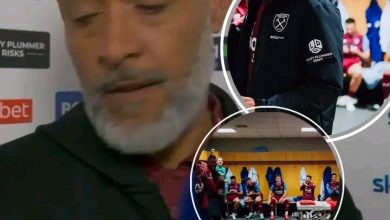
The Premier League season was entering one of its most intense and dramatic periods, and every single match now carried huge importance. Fans across the world were watching closely, knowing that one decision, one goal, or even one controversial moment could completely change the direction of the title race. The tension was rising, the pressure was growing, and emotions were running high across clubs, players, managers, and supporters alike.
The schedule itself showed just how packed and demanding the league had become. Big games were lined up one after another, with clubs fighting for titles, European places, and survival. Tottenham were set to face Leeds United in a clash that carried weight for both teams, while just two days later, Manchester City would take on Crystal Palace in a match that could have serious implications for the title race. Aston Villa versus Liverpool was another massive fixture, followed by Manchester United against Nottingham Forest, and several other key games happening at the same time.
Every match mattered. Every point mattered. And in a season like this, even the smallest controversy could explode into a major talking point.
But despite all these fixtures, all these battles, and all these storylines, one particular game had captured the attention of everyone. That was the match between Manchester City and Brentford. On the surface, it looked like a comfortable victory for City. A 3-0 win, strong performance, three goals, and another step forward in the title race. But beneath that result, there was something else. Something that would spark debate, anger, and serious questions about fairness in the league.
Before this match, the title race had already been heating up. Arsenal had just secured a narrow but important 1-0 victory over West Ham United. That result allowed Arsenal to re-establish a five-point lead at the top of the table. However, even that match was not free from controversy, as VAR decisions had once again played a major role.
So when Manchester City stepped onto the pitch against Brentford, they knew exactly what was at stake. A win would reduce the gap and keep the pressure firmly on Arsenal. And that is exactly what they did.
Goals from Jeremy Doku, Erling Haaland, and Omar Marmoush sealed the victory. It was a performance that looked dominant on paper. The kind of result that champions produce. Calm, controlled, and clinical.
But football is not always just about the scoreline.
As the game progressed, several decisions made by the referee and VAR began to attract attention. These were not small or insignificant calls. These were big moments. Moments that could have changed the entire outcome of the game.
In total, three major VAR-related decisions went in favour of Manchester City. And for Brentford, these decisions were not just frustrating—they were deeply confusing.
One of the most talked-about moments came in the 71st minute. At that point, Brentford were trailing 1-0. Still very much in the game. Still believing they could fight back. Then came a moment that many believed should have resulted in a penalty.
Kevin Schade made a move into the box and went down under a challenge from Matheus Nunes. From the perspective of Brentford players, fans, and coaching staff, it looked like a clear foul. A clear penalty. A golden chance to equalize and change the momentum of the match.
But the referee, Michael Salisbury, waved play on. No penalty. No VAR intervention to overturn the decision.
That moment alone created huge frustration. But it was not the only one.
There was another incident involving Bernardo Silva and Nathan Collins. During the match, Silva appeared to lash out and make contact with Collins’ leg. Many believed this should have resulted in at least a booking, if not something more serious. Yet again, no punishment was given.
Earlier in the game, there had also been a potential red card situation involving Nunes and Schade. Brentford felt there was a strong case for a last-man foul, which would have changed the entire match. However, VAR reviewed the situation and decided that there had been contact with the ball, and therefore no red card was given.
Interestingly, Brentford manager Keith Andrews accepted that particular decision. He showed understanding and said that if there was contact with the ball, then it was fair enough.
But when it came to the penalty decision, his tone changed completely.
He was clearly frustrated, and his words reflected the confusion that many people were feeling. He questioned how such a decision could be made, especially considering the situation and the player involved.
He explained that Kevin Schade is a very fast player, someone who would not go down easily when he has a clear chance on goal. From his point of view, it made no sense for Schade to fall unless there was real contact.
He said that the explanation given—that there was “not enough contact”—was difficult to understand. What exactly counts as enough contact? How much contact does a player need before a penalty is awarded?
These questions were not just coming from Brentford. They were being asked by fans, pundits, and former officials across the football world.
And then, another moment added even more fuel to the fire.
After the match, an image began to circulate online. It showed fourth official Rob Jones with his arm around Manchester City manager Pep Guardiola as they walked down the tunnel.
On its own, it might have seemed like a harmless moment. A simple gesture. But in the context of everything that had happened during the game, it raised serious concerns.
One of the strongest reactions came from former PGMOL chief Keith Hackett. He did not hold back in his criticism.
He described the image as “unacceptable” and stressed that referees must always be seen as impartial. Not just impartial in their decisions, but also in their behaviour and body language.
For him, this was not just about one game. It was about the integrity of the entire league. The trust that fans place in officials. The belief that matches are decided fairly.
When that trust is shaken, even slightly, it creates a much bigger problem.
And that is exactly what seemed to be happening.
Because this was not an isolated incident. It came at a time when VAR decisions across the league were already under heavy scrutiny. Fans were already questioning consistency. Already debating whether certain teams were being treated differently.
The combination of controversial decisions and that image only made things worse.
Meanwhile, the title race continued.
Manchester City’s win reduced the gap at the top, putting pressure back on Arsenal. Every game from this point forward would feel like a final. Every decision would be analyzed, discussed, and debated.
Other fixtures were also adding to the drama. Tottenham versus Chelsea promised to be a huge London derby. Newcastle against West Ham was another important clash. And on the final day, multiple matches would take place at the same time, creating a dramatic and unpredictable finish to the season.
Manchester City would also face Bournemouth before the season ended, while Arsenal still had difficult games to navigate. Liverpool, Aston Villa, and others were also fighting for their own goals, whether it was Champions League qualification or pride.
But no matter what happened on the pitch, one thing was clear.
The conversation around refereeing and VAR was not going away.
If anything, it was becoming even louder.
Fans want clarity. Players want consistency. Managers want fairness.
And when those things are missing, even the biggest victories can feel overshadowed.
Manchester City may have won the game 3-0. They may have taken an important step in the title race. But the discussion after the match was not just about goals or tactics.
It was about decisions.
It was about fairness.
It was about trust.
And as the season moved closer to its dramatic conclusion, those issues would only become more important.
Because in a league where margins are so small, where titles can be decided by a single point, every moment matters.
Every call matters.
And sometimes, the biggest story is not the result itself, but everything that happens around it.