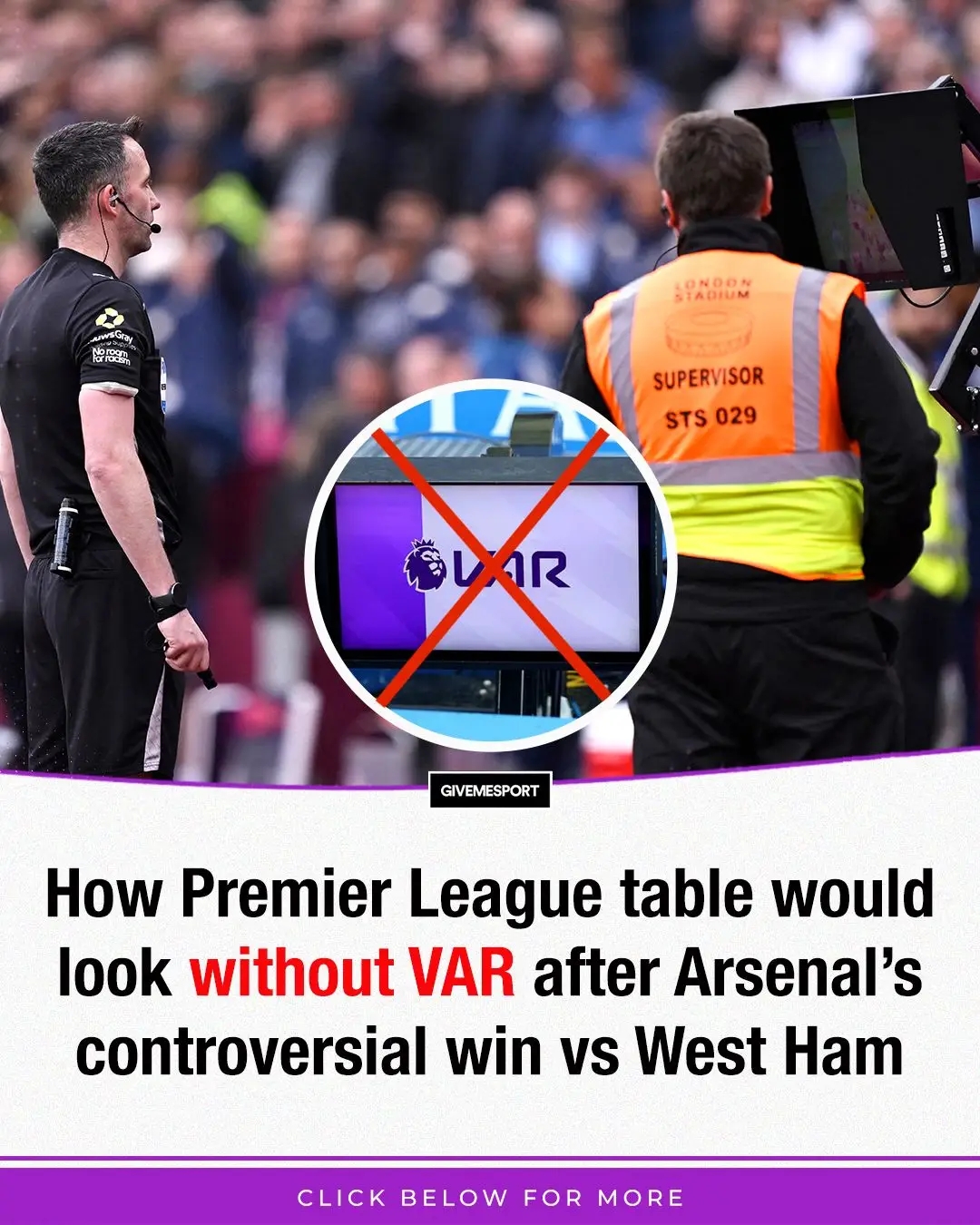
The Premier League season is reaching its most dramatic stage, and once again the biggest talking point is not just the football being played on the pitch, but the technology that continues to divide fans, players, and managers across the world. VAR has once again taken centre stage, and after another controversial weekend, many supporters are asking the same question that has been growing louder for years — what would the league table look like without it?
This question became even more intense after Arsenal secured a narrow 1-0 victory over West Ham in a match filled with tension, emotion, and yet another major VAR decision that changed everything. That single moment has now sparked fresh debate, fresh anger, and fresh curiosity, as data experts released an alternative Premier League table showing how things would stand if VAR had never existed this season.
And the results are shocking.
From the title race to the relegation battle, everything changes. Some teams benefit massively, others suffer badly, and the entire story of the season suddenly looks very different.
To understand the full picture, we need to go back to where this all started.
When VAR was first introduced into the Premier League during the 2019-20 season, it was meant to bring fairness, accuracy, and justice to the game. The idea was simple — reduce human error and ensure that the correct decisions are made. But football is not just about decisions. It is about emotion, speed, passion, and those unpredictable moments that make the game special.
Over time, instead of solving problems, VAR created new ones.
Fans started to complain about long delays, confusing decisions, and moments where even after watching multiple replays, nobody could clearly understand why a decision was made. Goals were celebrated, then cancelled. Matches were stopped for minutes. The natural flow of football began to disappear.
And now, years later, the frustration has reached its peak.
A recent survey by the Football Supporters’ Association revealed just how serious the situation has become. The numbers were not just surprising — they were overwhelming. Three out of every four fans said they are against VAR. Almost everyone agreed that it has damaged the matchday experience. Even watching games on television has become less enjoyable for many people.
The biggest complaint is simple — VAR has taken away the joy.
That moment when a goal goes in, when the stadium explodes with emotion, when fans jump, scream, and celebrate without thinking — that moment is no longer guaranteed. Now, there is always doubt. Always a pause. Always a wait.
And that wait is slowly killing the magic of football.
So when the alternative Premier League table without VAR was released, it did not just feel like a statistic. It felt like a different version of reality. A version of the season where decisions were made instantly, where goals stood, and where the game flowed naturally.
Let’s start at the bottom of the table, where the battle for survival is always full of drama.
Even without VAR, some things do not change. Wolves and Burnley would still be heading towards relegation, despite picking up a few extra points. It shows that while VAR can influence matches, it cannot completely change the fate of teams that have struggled all season.
West Ham’s situation is perhaps the most painful. Their points total would remain exactly the same, but the emotional damage from recent decisions tells a different story. That disallowed goal against Arsenal was not just about points — it was about belief, momentum, and fairness. Moments like that can break a team, especially at such a critical stage of the season.
Moving slightly up the table, the impact of VAR becomes more visible.
Tottenham would be in a better position, gaining extra points and creating more distance from the relegation zone. Nottingham Forest, however, would suffer badly, losing valuable points and finding themselves dangerously close to the drop. This shows how VAR decisions can completely change the pressure on teams. One decision can lift a team up, while another can drag them into danger.
Leeds United would benefit, climbing higher in the table, while Sunderland would lose points and drop positions. Crystal Palace would also fall, showing that VAR has played a significant role in shaping the middle of the table.
Brentford’s situation is also interesting. Despite performing well this season, they would drop several places without VAR, suggesting that some key decisions have gone in their favour during important matches.
As we move into the top half of the table, the changes become even more dramatic.
Chelsea would lose points, while Everton and Fulham would rise, showing how small decisions can have big consequences over a full season. Liverpool’s drop is particularly surprising. Despite maintaining the same number of points, other teams would move above them, pushing them down the table.
Aston Villa would also drop slightly, while Bournemouth would emerge as one of the biggest winners. Without VAR, they would climb into a Champions League position, gaining valuable points that could completely change their future.
This is where the true impact of VAR becomes clear.
It is not just about individual matches. It is about the entire season. It is about who qualifies for Europe, who misses out, and who gets the financial rewards that come with success.
And then we reach the top of the table, where everything becomes even more intense.
Brighton would be one of the biggest beneficiaries, gaining extra points and climbing into the top four. Their rise shows how consistent performances, combined with different refereeing outcomes, can completely transform a season.
Manchester United, interestingly, would remain unchanged. Their position and points would stay the same, suggesting that VAR has had little impact on their overall campaign.
But the biggest story is at the very top.
Arsenal would still be leading the table, but their advantage would be much smaller. They would lose several points, including those gained from controversial decisions. The gap between them and Manchester City would almost disappear.
Manchester City, on the other hand, would be in a stronger position. Losing only a single point, they would be right behind Arsenal with a game in hand, making them favourites to win the title.
This changes everything.
Instead of Arsenal being in control, the title race would be completely open. The pressure would shift. The narrative would change. Every match would become even more important.
And this is why the debate around VAR is so intense.
Because it is not just about fairness. It is about the story of the season.
Fans want to believe that what they are watching is real, that the results are decided by the players on the pitch, not by lines on a screen or decisions made in a remote room. They want clarity, consistency, and above all, trust.
Right now, that trust is broken.
Managers are frustrated. Players are confused. Fans are angry.
Every weekend, there are new controversies, new arguments, and new moments that leave people asking the same question — what is the point of VAR if it cannot provide clear and consistent decisions?
The situation is becoming impossible to ignore.
Some believe VAR just needs improvement. Faster decisions, better communication, and clearer rules could solve many of the problems. Others believe the system is fundamentally flawed and should be removed completely.
But one thing is certain.
The longer these controversies continue, the louder the calls for change will become.
Football is a simple game at heart. Two teams, one ball, and moments of magic that cannot be predicted or controlled. That simplicity is what makes it special.
When technology starts to interfere too much, when decisions become too complicated, and when fans no longer understand what is happening, the game begins to lose its identity.
This alternative table is not just a different set of numbers.
It is a reflection of what football could look like without VAR. A reminder of how much the game has changed, and a warning about what might happen if those changes continue without proper control.
As the season approaches its final matches, the tension will only increase. Every decision will be analysed. Every moment will be questioned. And every result could be the difference between success and failure.
For Arsenal, the pressure is now greater than ever. They may be leading the table, but questions remain about how much VAR has helped them along the way.
For Manchester City, the opportunity is clear. With a game in hand and strong form, they know that the title is within reach.
For the rest of the league, the battle continues.
Relegation, European qualification, pride, and survival — everything is still to play for.
But above all, one thing remains at the centre of the conversation.
VAR.
A system that was meant to bring clarity has instead created confusion. A tool designed to improve football has instead divided it.
And until something changes, the debate will never end.
Because in football, more than anything else, people want to feel something real.
And right now, too many fans feel that something important has been taken away.