Erling Haaland has shown his class with reaction to Arsenal’s Premier League title win. Taking to social media on Wednesday night, Haaland showed his class by posting: “Not the ending we hoped for, but we’ll use this feeling the right way next season. To every City fan who travelled with us this season, thank you Congrats to Arsenal for the title.” “Every game in the Premier League is difficult, we tried, it wasn’t enough.”

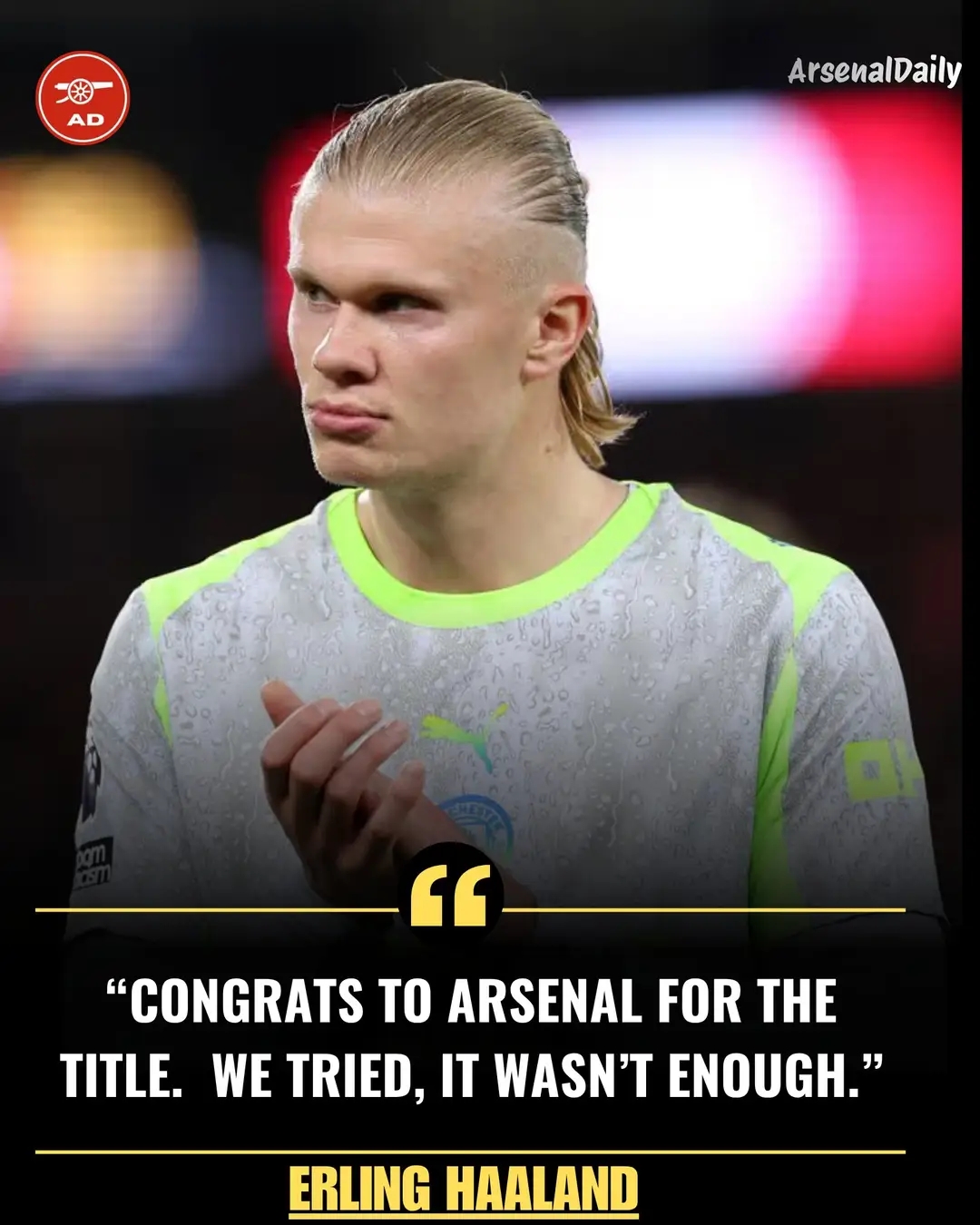
The pain was obvious. You could see it in his face long before the words appeared online. For a player who has built his reputation on winning, scoring goals, and breaking records, this moment felt different. Erling Haaland had just watched another Premier League title slip away from Manchester City FC, and despite all his goals, despite all his effort, it was not enough.
But while frustration surrounded Manchester City after losing the league to Arsenal FC, Haaland’s reaction immediately caught attention across the football world.
Not because he blamed teammates.
Not because he attacked rivals.
Not because he made excuses.
Instead, the Norwegian striker showed class.
On Wednesday night, while emotions were still raw and disappointment still heavy inside the City dressing room, Haaland took to social media with a message that quickly spread everywhere.
“Not the ending we hoped for, but we’ll use this feeling the right way next season. To every City fan who travelled with us this season, thank you. Congrats to Arsenal for the title.”
Simple words. Respectful words. But powerful words too.
In modern football, where emotions often explode publicly after painful defeats, Haaland’s reaction stood out immediately. Fans from different clubs praised him for showing sportsmanship during one of the most frustrating moments of the season.
Because the truth is, losing a title hurts.
Especially for a team like Manchester City.
For years, City made winning look normal. Under Pep Guardiola, they turned dominance into a habit. Every season began with expectations of trophies. Every campaign was measured by success.
That level of pressure changes everything.
At Manchester City, second place often feels like failure, even when most clubs would celebrate it.
That is why the mood around the club after the draw against AFC Bournemouth felt so heavy. The 1-1 result effectively ended City’s hopes of catching Arsenal, confirming that the Premier League trophy would finally return to North London after more than two decades.
For Arsenal supporters, it was a moment of celebration and relief. Years of disappointment, criticism, and rebuilding had finally led to glory again.
For City, however, it felt like the end of something.
The final whistle at the Vitality Stadium carried a strange atmosphere. City had avoided defeat thanks to Haaland’s late equaliser, but nobody celebrated like normal. The goal changed little. The title was gone.
Several players stood motionless after the match. Some stared into the distance. Others dropped to the pitch. The realization slowly settled across the squad.
The era of total control was slipping.
Haaland understood that feeling better than most.
Since arriving in England, he has become one of the most feared strikers in world football. Goals followed him immediately. Defenders struggled to stop him. Records disappeared almost weekly.
He scored in huge games. He delivered in important moments. He helped City dominate again.
But football is cruel sometimes.
Even extraordinary individual performances cannot always guarantee trophies.
This season tested Manchester City differently.
Unlike previous years, there was no feeling of inevitability surrounding them. Opponents no longer looked completely defeated before kickoff. City still produced brilliant football at times, but cracks began to appear more frequently.
Unexpected dropped points damaged momentum. Injuries hurt rhythm. Some performances lacked the ruthless control Guardiola’s teams normally show.
Meanwhile, Arsenal kept believing.
Under Mikel Arteta, Arsenal matured into a serious title-winning side. They handled pressure better. They stayed consistent during difficult periods. Most importantly, they took advantage whenever City stumbled.
That consistency ultimately decided the title race.
And Haaland admitted it honestly after the season ended.
“Every game in the Premier League is difficult, we tried, it wasn’t enough.”
That sentence perfectly captured the reality of English football.
There are no easy matches anymore.
Smaller clubs are stronger. Tactics are smarter. The intensity is relentless. One poor performance can completely change an entire title race.
Manchester City learned that repeatedly this season.
Games they once controlled comfortably suddenly became battles. Teams defended deeper, pressed harder, and attacked with more confidence against them.
The Premier League has evolved.
And despite City still being one of the strongest teams in Europe, they could not maintain the same unstoppable level that defined previous campaigns.
For Haaland personally, the disappointment felt even stronger because of how competitive he is naturally. The striker hates losing. Every match matters to him. Every missed opportunity frustrates him.
That mentality is partly why he became one of the best players in the world so quickly.
Some players disappear emotionally after setbacks. Haaland becomes even more motivated.
That was clear in his message.
Even while congratulating Arsenal respectfully, he was already thinking about revenge next season. Already thinking about how Manchester City respond. Already turning pain into motivation.
“We’ll use this feeling the right way next season.”
Those words immediately excited City fans.
Because great teams often respond strongest after disappointment.
Over the years, Guardiola built a culture where failure is never accepted quietly. Every setback becomes fuel. Every criticism becomes motivation.
That mentality helped City dominate English football for so long.
And now, after losing the title, supporters are hoping the squad reacts with the same hunger again.
Still, uncertainty surrounds the club right now.
Rumours about Guardiola’s future continue growing. Reports suggest the legendary manager could leave at the end of the season after ten years at the Etihad Stadium.
If that happens, the loss of the title could represent more than just one disappointing campaign. It could symbolize the end of an era entirely.
That possibility makes Haaland’s comments even more important.
The striker’s leadership is becoming increasingly visible. When he first arrived, people mainly focused on goals. But now supporters are beginning to see another side of him — responsibility.
After painful defeats, players often react emotionally. Some disappear. Some avoid interviews. Some become defensive.
Haaland did the opposite.
He thanked the fans.
He respected the champions.
And he promised improvement.
That attitude matters inside dressing rooms.
Especially during periods of transition or uncertainty.
City supporters appreciated the message because they understand how difficult this season became mentally. Fans travelled across the country supporting the team, hoping for another title celebration. Instead, they watched Arsenal finally take the crown.
Yet Haaland still made sure to acknowledge their loyalty.
“To every City fan who travelled with us this season, thank you.”
Those words were small, but meaningful.
Football supporters never forget when players recognize their effort, especially after disappointment. Fans spend money, travel long distances, and invest emotions into every season. Hearing appreciation directly from one of the world’s biggest stars strengthens that connection.
Interestingly, even rival supporters admitted Haaland handled the situation well.
Social media quickly filled with praise for his maturity and sportsmanship. In a football culture often dominated by rivalry and arrogance, respectful reactions still stand out strongly.
Congratulating Arsenal also carried significance.
Some players struggle to praise rivals after losing major trophies. Emotions can create bitterness. But Haaland chose respect instead.
“Congrats to Arsenal for the title.”
Simple. Direct. Honest.
It reflected reality.
Arsenal earned the championship through consistency and resilience. City pushed them hard, but ultimately fell short.
Acknowledging that publicly showed professionalism.
At the same time, Haaland’s message also contained a warning for next season.
Manchester City are wounded now.
And wounded elite teams are dangerous.
Already, reports suggest the club are preparing major changes this summer. New signings could arrive. Tactical adjustments may happen. Questions remain about Guardiola’s future.
But one thing seems certain: Haaland is not satisfied with finishing second.
The striker has experienced enormous success already in his career, yet his hunger continues growing. Every season he wants more goals, more trophies, more records.
That mentality could become crucial if City enter a new era soon.
Especially if Guardiola eventually leaves.
Many supporters now see Haaland as one of the faces of Manchester City’s future. Young enough to lead the next generation, talented enough to dominate for years, and ambitious enough to demand constant improvement.
That combination is rare.
And after this painful title defeat, his determination may become even stronger.
Football history shows that great dynasties often experience setbacks before responding again. Teams cannot dominate forever without challenges. Rivals improve. Pressure increases. Motivation becomes harder to maintain.
Sometimes losing reminds elite squads how much winning matters.
That could be exactly what happens with City now.
For Arsenal, this title represents the reward for years of rebuilding.
For Manchester City, it may become the spark that reignites another era of dominance.
Haaland’s reaction suggests the players are already thinking that way.
Not with anger.
Not with excuses.
But with focus.
The Premier League remains the hardest league in world football precisely because of moments like this. Nothing is guaranteed. No team stays on top forever. Every season creates new drama, new champions, and new pressure.
And even for players as dominant as Haaland, success must constantly be earned again.
That reality makes football beautiful and brutal at the same time.
One season you celebrate trophies. The next you stand watching rivals lift them instead.
What defines great players is how they react afterward.
Haaland’s response showed maturity, class, and hunger all at once.
He accepted the disappointment.
He respected the champions.
And he immediately focused on coming back stronger.
That mentality is exactly why Manchester City fans still believe their team will return.
Because while Arsenal may be champions today, players like Erling Haaland are already preparing for the fight to reclaim the crown.