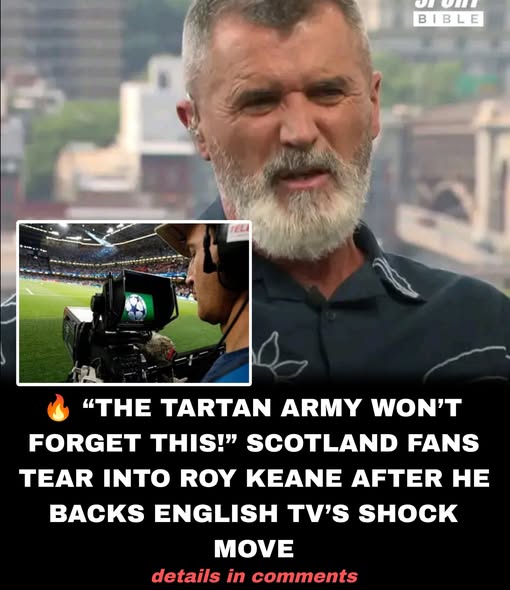
🤯 “From Football Icon to Fan Enemy?” Roy Keane Faces Scottish Backlash After Defending Decision Not to Air Scotland’s World Cup Games

Monday, June 15, 2026 was already shaping up to be a chaotic day in football news before the Roy Keane story even exploded. Earlier reports had suggested that Ivan Basic was being tracked as a possible Celtic transfer target, with whispers that a World Cup scouting mission could even give Martin O’Neill the chance to land a double signing that would excite supporters ahead of the next transfer window. That story alone was enough to get Celtic fans talking, dreaming, and debating what the club might do next.
But just as that conversation was building momentum, a completely different controversy took over the football world.
This time, it was not about transfers.
It was not about tactics.
It was about broadcasting, pride, identity, and one of football’s most outspoken figures: Roy Keane.
A storm quickly erupted after Scotland fans reacted with fury to comments made by Keane regarding a reported decision by English television broadcasters not to show Scotland’s World Cup matches. The issue, which at first appeared to be a straightforward broadcasting rights discussion, quickly turned into a heated cultural debate that divided opinion across the UK and beyond.
For Scotland supporters, the news felt like a punch to the stomach. After years of waiting, rebuilding, and dreaming of a strong World Cup campaign, many fans expected full coverage and celebration of their national team on the global stage. Instead, reports suggested that English broadcasters would not air Scotland’s matches, focusing instead on other fixtures that were expected to draw higher viewing numbers.
The reaction from the Tartan Army was immediate and emotional.
Many fans expressed frustration online, saying the decision felt disrespectful. For them, the World Cup is not just another tournament. It is a rare moment where national pride, history, and football passion come together. To feel ignored or overlooked at that moment was something many supporters found difficult to accept.
But the situation escalated even further when Roy Keane entered the conversation.
Known for his blunt honesty, sharp analysis, and often uncompromising opinions, Keane did what he has always done in football debates: he spoke without hesitation. However, this time, his comments appeared to side with the broadcasters’ decision, or at least defend the logic behind it.
That single stance changed everything.
Almost instantly, sections of Scottish fans turned their attention toward him. Social media platforms were flooded with reactions, and the tone of the discussion shifted from disappointment with broadcasters to anger directed at one of football’s most respected former captains.
Some supporters felt Keane had dismissed the emotional importance of Scotland’s World Cup journey. Others believed he failed to understand what it meant for a nation to return to football’s biggest stage and not be given equal visibility.
One fan reportedly wrote that Keane had “lost the respect of the Tartan Army,” while another said that his comments made it feel like Scotland’s achievements were being “pushed aside and ignored.”
The emotional intensity of the reaction showed just how sensitive the issue had become.
But to understand the controversy fully, it is important to look at why such a broadcasting decision would even be considered in the first place.
In modern football broadcasting, decisions are often driven by two major factors: audience size and financial return. Broadcasters invest huge amounts of money to secure rights for tournaments like the World Cup, and they must make choices about which matches will attract the most viewers.
England matches traditionally generate significantly higher television ratings across the UK compared to other home nations. Because of this, broadcasters may prioritise those games, along with other high-profile international fixtures, in order to maximise viewership and advertising revenue.
From a purely business perspective, this approach is not unusual.
However, for Scottish fans, the issue is not about business logic. It is about representation.
Many supporters argue that a World Cup should be about equality among nations. Every qualified team, they believe, deserves equal respect and equal coverage, regardless of size or predicted audience numbers. To them, football at this level is about pride, not profit.
Another factor being discussed is the cost and complexity of broadcasting a global tournament. World Cup coverage involves massive logistical planning, studio setups, commentary teams, production crews, and scheduling across different time zones. Broadcasters sometimes make strategic decisions about which matches to show live and which to limit to highlights or secondary coverage.
Still, none of these explanations eased the frustration among Scotland fans.
For many, the emotional disappointment was tied to the significance of the moment. Scotland’s return to the World Cup stage was seen as a major achievement, something that fans had waited years to experience. The idea that those matches might not receive full live coverage felt like a missed opportunity to celebrate that journey properly.
And that is where Roy Keane’s involvement became even more controversial.
Keane has built a reputation over decades as someone who does not soften his opinions to please anyone. Whether as a player, captain, or pundit, he has consistently spoken in a direct and often uncompromising way. Many admire him for that honesty, even when they disagree with him.
But this time, his comments were interpreted differently by Scottish supporters.
Instead of seeing his remarks as neutral analysis, many viewed them as dismissive. Some felt he was prioritising business reasoning over emotional understanding. Others believed he was simply reflecting the reality of modern football economics, where decisions are often driven by audience data rather than sentiment.
The debate quickly spread beyond Scotland.
Football fans across the UK, Ireland, and Europe began discussing whether Keane was right or wrong. Some agreed with him, saying broadcasters naturally choose the most profitable and widely viewed matches. Others sided with Scotland fans, arguing that international tournaments should not be reduced to financial calculations alone.
The discussion also raised a broader question about football identity.
Should every national team receive equal spotlight during a World Cup, or should broadcasting naturally follow demand?
For some, football is a cultural experience that deserves equal representation. For others, it is a commercial product shaped by audience interest.
Roy Keane, intentionally or not, found himself in the middle of that debate.
While the controversy unfolded online, Scotland’s national team continued their preparations for their World Cup campaign. Inside the camp, the focus remained on training, tactics, and performance. Players were reportedly aware of the external debate, but the coaching staff tried to keep attention on football rather than media noise.
However, supporters were not as easily distracted.
The Tartan Army, known for their passionate support, expressed disappointment not just at the broadcasting decision, but also at how the story had shifted attention away from the team itself. Many fans wanted the focus to remain on the pitch, where Scotland would be representing their country on the world stage.
Instead, headlines were dominated by controversy.
Some fans even argued that the situation highlighted a wider issue in football media coverage: that smaller nations often struggle for equal attention unless they achieve extraordinary success or dramatic results.
Meanwhile, others defended the broadcasters, pointing out that television schedules are limited and decisions must be made based on viewership data. They argued that it is impossible to show every match live and that prioritisation is a normal part of sports broadcasting.
This division of opinion showed just how complex the issue had become.
Roy Keane, for his part, remained silent after the backlash initially grew. But his earlier comments continued to circulate, replayed across television segments, social media clips, and fan debates. In many ways, his voice had become the centre of a much larger argument about fairness in football coverage.
As the day progressed, the story began to take on a life of its own.
What started as a broadcasting report turned into a national conversation about respect, visibility, and identity in football. And at the heart of it all was a simple but powerful question: should every team at the World Cup be treated equally in the eyes of broadcasters, or does business naturally decide what the world sees?
For Scotland fans, the answer was clear.
They wanted to be seen.
They wanted their team’s journey to matter.
And they wanted their World Cup moments to be shared with the same importance as any other nation.
For Roy Keane, however, the debate was more complicated, rooted in realism rather than emotion.
And as both sides continued to clash online, one thing became certain.
This was no longer just about television coverage.
It had become a story about football itself, and how the modern game struggles to balance passion with profit, identity with audience, and emotion with economics.
As Scotland prepared for their World Cup journey, the hope among supporters was simple: that whatever happened off the pitch would soon be forgotten, and that their team’s performances would speak louder than any broadcasting decision ever could.