Ally McCoist has just said what we all Scotland fans are thinking” 🗣️ “Clarke’s tactics killed us before the whistle even blew.”

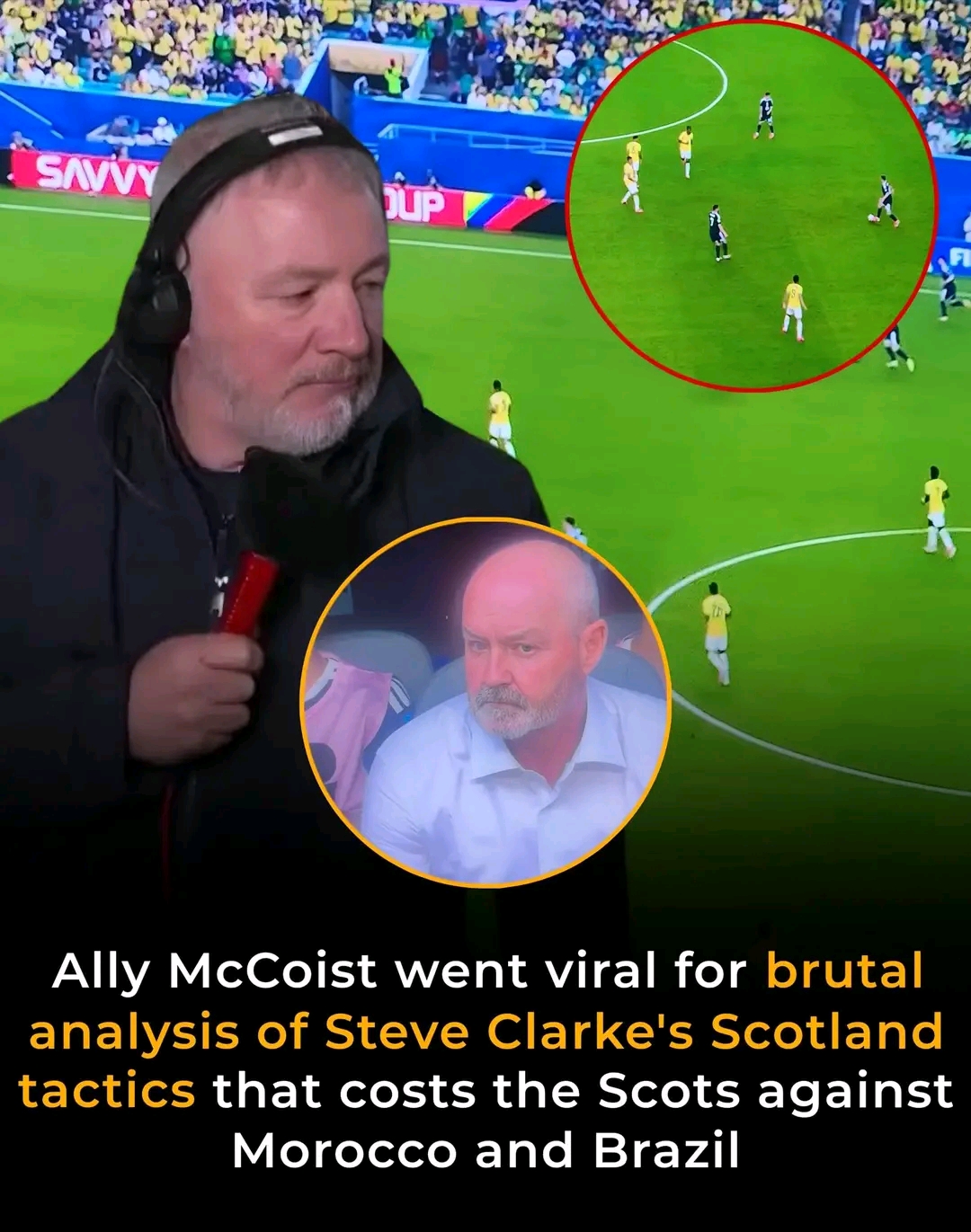
As I sit here in my favourite armchair, the familiar ache of a Scottish football supporter settling deep into my bones, I find myself staring at a blank television screen. The roaring crowds, the fluttering flags, the hopeful chants—they have all faded into an echoing silence. The harsh, unyielding mathematical reality has finally caught up with the romantic dream we all allowed ourselves to believe in. Barring a miracle of biblical proportions—the kind of sporting alchemy that happens perhaps once in a generation, if we are lucky—the World Cup 2026 for Scotland is over.
I am eighty-three years old. I have seen wars, witnessed the rise and fall of industries that built this great nation of ours, and I have watched more football matches than I could ever possibly count. I have stood on freezing terraces in the howling wind and rain, wrapped in scarves so thick they obscured my vision, just to catch a glimpse of men in dark blue shirts running out onto a patch of hallowed turf. I have experienced the vertiginous highs of Wembley in 1967, when we became the unofficial champions of the world by beating the actual champions on their own patch. I have endured the agonizing lows of endless near-misses, cruel deflections, and the soul-crushing agony of penalty shoot-outs.
Through it all, the undying, almost foolish optimism of the Scottish football fan has been the heartbeat of my life. But today, my heart is heavy. I am profoundly disappointed. Yet, in this disappointment, I feel a burning necessity to say something to my fellow Tartan Army, to the critics, and to the players themselves. I need to ask you, plead with you even, not to succumb to the bitter cynicism that so often follows defeat.
Let me address the first and most urgent point: the players. I have read the newspapers. I have listened to the phone-in shows on the radio, where angry voices spew venom from the anonymous safety of their cars or living rooms. I have scrolled through social media—though my old eyes struggle with the glowing screens—and I have seen the abuse hurled at the footballers who had the audacity to step forward and represent our country.
Stop it. Just stop it.
I want you to take a deep breath, look in the mirror, and ask yourself a simple question: Are you genuinely qualified to judge them? These footballers, whatever their flaws, whatever their mistakes on the pitch, were judged by professionals—managers, scouts, and coaches—to be good enough to wear the dark blue of Scotland. Do you honestly believe that they woke up on the morning of a crucial qualifier and thought to themselves, *“I know how I’ll spend my day: I’ll go out and play terribly, let my country down, and subject myself to a torrent of online abuse”?*
Of course they didn’t. They went out there carrying the weight of five million souls on their shoulders. They went out there knowing that the eyes of the world, or at least the eyes of a deeply passionate and unforgiving nation, were upon them. When a midfielder misplaces a pass, or a striker snatches at a chance, it is not born of malice or a lack of pride. It is born of the suffocating pressure that comes with pulling on that jersey. It is born of human error, amplified on a grand stage.
At eighty-three, I have lived long enough to know that perfection is a myth. We demand gods, but we send mortals out onto the pitch. When they fail, we crucify them. It is a uniquely Scottish tragedy that we build our heroes up only to delight in tearing them down at the first sign of weakness. We need to break this cycle. We need these players. Not just for the matches happening right now, but for the ones that will follow. If we turn on our own, if we make wearing the Scotland jersey a poisoned chalice, a burden rather than an honour, then who on earth will ever want to wear it again?
Think of the young boys coming through the academy systems right now. They are watching how we treat our senior players. If they see a culture of vilification, a environment where a single mistake leads to national damnation, they will choose a different path. They will take their talents elsewhere, or they will simply abandon the sport altogether out of fear. We cannot allow that to happen. We must wrap our arms around these players, not sharpen the knives at their backs. We must offer them our constructive support, our patience, and our unwavering loyalty, because that is what true support means. It is easy to cheer when the sun is shining and the goals are flying in. The true test of a supporter is how they act in the darkest, coldest moments.
This brings me to the broader picture, the reason I am forcing my arthritic fingers to type these words. Disappointment is a natural reaction to failure, but despair is a choice. And right now, we cannot afford to choose despair. We must be positive for the future. This is not just a platitude; it is a matter of absolute survival for our national game.
I have been around long enough to remember when Scottish football was feared. When our clubs were reaching European finals, when our national team was a formidable force that nobody wanted to draw in a tournament. I am not naïve enough to think we can magically transport ourselves back to the 1960s or 70s. The world has changed. The game has globalized. Money has flooded into the sport, creating a chasm between the wealthiest nations and the rest. We are a nation of roughly five and a half million people. We are competing against countries with ten, twenty, or fifty times our population, backed by bottomless petro-dollars or decades of state-sponsored sporting infrastructure.
When you look at it through that lens, merely competing at the highest level is an achievement in itself. But competing is not enough, is it? We want to win. We want to taste the glory again. And to do that, we need a fundamental shift in our mindset.
Being positive for the future means looking at our structures, our coaching, and our footballing philosophy with a clear, unblinkered eye. For too long, Scottish football has been trapped in a paradigm of physicality over technique. We have prized the hearty tackle, the long ball, and the “get it intae the mix” mentality over the subtle arts of possession, spatial awareness, and technical precision. If we are to inspire the next generation, we must change the culture from the bottom up.
It starts in the parks. It starts with the volunteers coaching five-year-olds on a Saturday morning. We must encourage our kids to fall in love with the ball. We must teach them that it is okay to make mistakes while trying to play the right way. We must stop screaming from the sidelines to “get rid of it” every time a young defender gets the ball at his feet. How will they ever learn to play if we demand they panic the moment they are pressed?
We need to look at the models of success around the world. Look at what Austria has done under Ralf Rangnick, implementing a cohesive, high-intensity, technically demanding system across their entire footballing infrastructure, from the youth teams all the way up to the national side. Look at how Croatia, a nation with a smaller population than Scotland, consistently produces technically gifted midfielders who can dictate the tempo of a match at World Cups. They do not have a secret genetic advantage. They have a system. They have a philosophy. They have a culture that values the beautiful game in its purest form.
We can have that too. But it requires patience. It requires us to accept that building a new footballing identity might take a decade. It might mean we lose some matches in the short term because we are trying to play a different way. But if we stick to it, if we believe in the process, the rewards will come. And that belief has to start with us, the supporters.
Which leads me to the most crucial point of this entire letter: the need to INSPIRE the young Scots growing up today.
Football is a cyclical game. The generation that is currently wearing the dark blue jersey will eventually hang up their boots. Who is going to replace them? The answer lies in the school playgrounds, the local community pitches, and the academy training grounds scattered across our country. But those young minds are incredibly malleable. They are sponges, soaking up the atmosphere, the commentary, and the general mood of the nation regarding our national sport.
If the overarching narrative they hear is one of misery, of “we’re not good enough,” of “what’s the point,” then we will lose them. They will turn to video games, to other sports, or to a life completely detached from the beautiful game. And if that happens, the well will run dry. We won’t have anyone left to play for our National Team. The thought of Scotland being unable to field a competitive team because a generation of children was turned off by the toxic negativity of the adults around them fills me with more dread than any defeat on the pitch ever could.
We have to make the Scotland national team an aspirational goal again. We have to make the dark blue jersey the most coveted piece of clothing a young Scottish boy or girl can wear. And how do we do that? We do it by being positive role models. We do it by creating an atmosphere at Hampden Park—even in friendlies or dead-rubber qualifiers—that is vibrant, joyful, and welcoming.
Think about the Tartan Army’s reputation abroad. When we travel to Germany, to France, to Spain, we are lauded as the best supporters in the world. We sing, we dance, we mix with the locals, and we leave a trail of goodwill wherever we go. Why can’t we bring that energy home? Why does Hampden so often feel like a funeral parlour, where the anxiety of the crowd transmits directly to the players on the pitch? We need to change the dynamic. The players should feel lifted by the crowd, not crushed by its expectations.
Imagine a ten-year-old boy from Fife, or a young girl from Glasgow, walking into Hampden for the first time. What do we want them to see? Do we want them to hear groans of despair before the ball has even been kicked? Do we want them to see a stadium full of angry, middle-aged men venting their frustrations? Or do we want them to see a sea of colour, to hear the thunderous roar of “Flower of Scotland” shaking the very foundations of the stadium, to feel an electric sense of belonging and joy? That is what inspires. That is what captures a heart for a lifetime.
I was that ten-year-old boy once. I remember the sheer magic of seeing the greats of my era. I remember the pride that swelled in my chest. That pride stayed with me for over seventy years. It carried me through the tough times, through personal tragedies and the hardships of life. Football was my sanctuary, and the national team was the ultimate expression of my Scottish identity. I want these young Scots to have that same sanctuary. I want them to feel that same fierce, unbreakable bond with their country.
To do that, we must talk about the game differently. When a young player makes his debut, we must celebrate his presence, not immediately dissect his weaknesses. When we play a superior team and lose, we must acknowledge the quality of the opposition while highlighting the moments of bravery and technical excellence from our own side. We must hunt for the positives, not because we are delusional, but because hope is the oxygen that keeps the flame of football alive.
I look at some of the young talents we have emerging right now, and I see glimpses of a brighter future. I see players who are comfortable on the ball, who are playing in top-flight leagues across Europe, who are being exposed to different footballing cultures and bringing that knowledge back home. We need to nurture them. We need to make them feel that stepping onto the international stage is the pinnacle of their careers, a stage where they will be supported no matter what.
At eighty-three years old, I am acutely aware of my own mortality. I know that my time on this earth is drawing to a close. I accept that with the peace that comes with a long life well-lived. But I confess, there is one selfish desire that burns within me before I take my final bow. I want to see Scotland at a major tournament just one last time. I want to hear the roar of the crowd as the national anthem rings out under a bright summer sky. I want to see the saltire waving proudly among a sea of international flags.
If 2026 is indeed beyond us, then my eyes will turn to 2030. It is a long shot for a man of my age, I know. But if the footballing gods are kind, maybe they will grant me that one last miracle. And if they do, I want to know that the team taking the pitch is carrying the hopes of a nation that believed in them, not the scars of a nation that berated them.
To the current squad: hold your heads high. You stepped into the arena when many others could not or would not. You have my respect, and you have my gratitude. Do not let the critics drown out the voices of those who truly care. Use this disappointment as fuel. Go back to your clubs, work harder, and come back stronger.
To my fellow supporters: take a breath. Pour yourself a cup of tea, or something stronger if you prefer, and let the dust settle. Tomorrow is a new day. The World Cup may be gone, but the soul of Scottish football is not dead. It is merely resting, waiting for us to revive it with our passion, our positivity, and our unwavering love for the game.
And to the young Scots growing up right now: listen to me. The pitch is waiting for you. The ball is at your feet. Don’t listen to the cynics. Don’t let the grey clouds of disappointment obscure your dreams. Play with joy. Play with skill. Play with the fearless audacity that defines the very best of our character. We, the older generation, have carried this torch for as long as we can. It is getting heavy, and our arms are tired. But we will hand it over to you with pride, provided you are willing to take it and run with it into a brighter, more beautiful future.
Scotland needs you. Scottish football needs you. And as an old man sitting in the quiet of his living room, staring out at the rain-swept streets of this wonderful, stubborn, resilient country of ours… I need you too. Let’s turn this disappointment into our greatest inspiration. Let’s build a future worthy of the dark blue jersey.