Scotland Are On The Brink — The Painful Story Of How The Tartan Army’s World Cup Dream Is Slipping Away 💙😢⚽

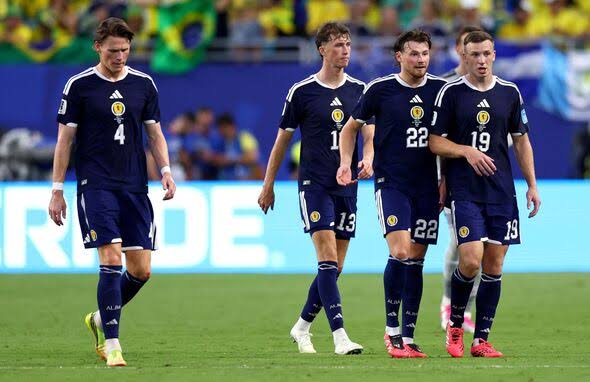
It was supposed to be different this time. It was supposed to be the summer that Scotland finally broke the curse — the tournament where a generation of genuinely talented players, hardened by years of qualification campaigns and heartbreaking near-misses, would step onto the world stage and make history. For one brief, glorious night in Boston, it felt like it just might be happening. And now, less than three weeks later, Scotland are sitting in tenth place in the third-place rankings, watching results in other groups with the desperate, helpless hope of a nation that has been here too many times before.
The brutal truth is this: Scotland are almost certainly going home.
After a 3-0 defeat by Brazil in Miami that left Steve Clarke’s side third in Group C with three points and a goal difference of -3, Scotland were left relying on other teams to do them favours across multiple groups. In a 48-team tournament with a generous format that allows eight third-placed sides to advance, that should not feel impossible. But the results that have come in overnight have made the task close to mathematical fantasy — and the window is closing by the hour.
—
**How Scotland Got Here: The Full Group C Story**
To understand the scale of Scotland’s achievement and the agony of their current situation, you need to go back to the very beginning of their World Cup adventure.
Scotland were drawn in Group C alongside Brazil, Morocco and Haiti — a group that was never going to be easy, featuring the five-time world champions and one of the most exciting African nations in world football. The draw was not what anyone in the Tartan Army had hoped for, but there was enough quality in Clarke’s squad to believe they could compete for second place and earn a spot in the knockout rounds.
The opening game, against Haiti, delivered Scotland’s first World Cup victory since 1990 — a moment of enormous historic significance. John McGinn’s scuffed but decisive rebound goal gave Scotland a 1-0 win that sent the Tartan Army into raptures and broke a 36-year drought without a World Cup win. The celebrations in Boston were unforgettable. The Tartan Army, who had been marching through the streets of the city all week, danced long into the night. For one evening, everything felt possible.
Scotland’s fans had been the talk of Boston throughout the week, bringing their unique brand of colour, warmth, and noise to a city that embraced them completely. The connection between the Tartan Army and their adopted American host city became one of the stories of the tournament’s opening phase. But football has a cruel habit of following joy with pain, and what came next tested the patience and faith of even the most devoted Scotland supporter.
Morocco delivered a harsh lesson in the second group game, taking the lead in the second minute through Ismael Saibari — who struck the ball into the corner from the right after being played in by Brahim Díaz — before controlling the game to seal a 1-0 win. Scotland competed hard and had legitimate grievances about a penalty not given for a foul on John McGinn, but the result left them needing a result against Brazil in their final group game to guarantee progress.
That, of course, was always going to be the defining moment of Scotland’s tournament. Brazil — five-time world champions, packed with elite talent at every position, brimming with the kind of quality that simply does not exist in Scottish domestic football. And yet, there were reasons to believe. Scotland had produced brave, organised performances throughout qualifying. They had quality and character throughout the squad. And in a tournament format where even a draw could be enough to advance, there was a realistic scenario in which Clarke’s side held their nerve and earned the point they needed.
It was not to be. A chastening 3-0 defeat to Brazil in Miami sealed Scotland’s fate as a group stage third-place finisher and left them entirely dependent on results elsewhere. The goal difference swung wildly in the wrong direction. The margin of defeat was harsh, perhaps, but Brazil were clinical when it mattered, and Scotland could not find a way to threaten at the other end.
And so began the wait.
—
**The Agonising Vigil: Results That Have Broken Hearts**
The format of the 2026 World Cup, with 48 teams spread across 12 groups, means that the final round of group games does not all happen simultaneously. Instead, groups finish at different times across several days, creating a rolling series of results that Scotland have been forced to monitor with increasing anxiety and, as the hours have passed, increasing despair.
Their hopes suffered a major blow almost immediately after the Brazil game when Ecuador produced a remarkable comeback win against Germany in New York — coming back from a goal down to win 2-1 with ten minutes remaining — to move onto four points and jump into third place with a positive goal difference. That single result caused immediate damage to Scotland’s third-place ranking and set the tone for what was to follow.
Sweden and Paraguay draws in their respective groups added further complications, as both sides moved onto three points with goal differences that either matched or exceeded Scotland’s -3 figure. Every result, it seemed, was either neutral or damaging to Scotland’s cause. The ranking table moved relentlessly in the wrong direction.
Then came the blow from Group I that felt, for many Scotland fans, like the moment the dream truly died. Senegal trounced Iraq 5-1 on Friday night to finish third in Group I on three points and a goal difference of +2, dropping Scotland into ninth place in the third-place standings. A +2 goal difference versus Scotland’s -3 is a difference of five goals — an almost impossible gap to close when you are already done playing and can only watch.
—
**One Piece Of Good News — And Then More Pain**
In the early hours of Saturday morning, Scotland finally got the result they had been desperately praying for. Uruguay lost 1-0 to Spain to finish on two points in Group H, becoming the first third-placed side to be officially eliminated from the tournament — meaning their record is worse than Scotland’s.
That gave the Tartan Army something to hold onto. A sliver of hope. Confirmation that at least one third-placed team had done worse than them. But the relief lasted only as long as it took for the next result to come in.
In Group G, the match between Egypt and Iran finished in a 1-1 draw — a result Scotland desperately needed Egypt to win. Instead, Iran finished third in Group G on three points with a goal difference of zero, immediately dropping Scotland to tenth in the third-place rankings.
A goal difference of zero versus Scotland’s -3 is still a three-goal swing against Clarke’s side. Scotland now sit outside the top eight third-placed teams with only a handful of games remaining to change the picture — and the results they need are increasingly unlikely.
—
**What Scotland Need: The Near-Impossible Equation**
The path to survival for Scotland involves a very specific and unlikely series of results across multiple groups, each of which needs to go precisely the right way. Scotland will be officially eliminated on Saturday night if Ghana fail to beat Croatia by at least three goals in Group L, with that match kicking off at 10pm UK time in Philadelphia.
That is the first, most immediate hurdle. Ghana beating Croatia by three clear goals in a group game. It is not impossible — Ghana are a good side and Croatia have looked inconsistent in this tournament — but it is by no means likely, and Croatia have enough experience and defensive quality to protect themselves in a game they would only need to draw to advance as group winners.
Even if that unlikely result occurs, Scotland would still need favourable outcomes in two remaining groups in the early hours of Sunday morning. In Group K, Scotland would need the match between DR Congo and Uzbekistan to end in a draw, or for Uzbekistan to win by three goals or fewer, with that game starting at 12:30am UK time in Atlanta.
And finally, Scotland would require Austria to beat Algeria by at least a two-goal margin in the final Group J match, which kicks off at 3am UK time in Kansas City on Sunday morning.
Three separate results, in three separate games, across three separate time zones, all needing to go Scotland’s way. The statistical probability of all three happening simultaneously is vanishingly small. The Scotsman’s own assessment put Scotland’s chances of survival at just four per cent — and that figure may even be generous given the direction of travel in the overnight results.
Scotland need a minor miracle. And Scottish football does not have a great track record with those.
—
**The Wider Context: What This World Cup Has Meant**
It would be wrong, even in this moment of likely elimination, to frame Scotland’s 2026 World Cup campaign purely as a failure. That would be deeply unfair to a group of players who achieved something historic simply by qualifying for the tournament and competing on this stage.
Scotland’s 1-0 victory over Haiti marked the first time the national team had won a World Cup match since 1990 — a 36-year wait that finally ended on a warm June evening in Boston. That result alone represents a genuine milestone in Scottish football history, and no amount of subsequent disappointment can take it away from this generation of players.
The Tartan Army, for their part, have been magnificent throughout. They led fan marches through the streets of Boston, complete with bagpipes, and embraced American host cities with a warmth and good humour that won admirers across the globe. They are, as they have always been, the best travelling supporters in world football — a credit to their country even when their country’s football team cannot match their enthusiasm with results on the pitch.
The performances, too, deserve to be judged in context. Group C contained Brazil — one of the tournament favourites — and Morocco, one of the most improved sides in African football who reached the semi-finals of the 2022 World Cup. Scotland were not expected to dominate that group. The questions were always about whether they could beat Haiti, hold their nerve against Morocco, and give Brazil a game in the final match. Two of those three things happened to varying degrees. The third ended in a defeat heavier than most had feared, and the goal difference cost them dearly.
—
**The Future Of Steve Clarke And Scottish Football**
Whatever happens in the next 24 hours, this World Cup will inevitably prompt significant reflection on the future of Scottish football — and particularly on the future of Steve Clarke as national team manager.
Clarke has been a steady and dignified presence in the Scottish football landscape for years. He guided Scotland through qualifying, navigated the pressures of a major tournament for the first time in decades, and oversaw a group of players who gave everything they had on the biggest stage of their careers. The Haiti victory was a moment he deserves enormous credit for delivering.
But there are also legitimate questions to be asked. The defeat to Morocco, with a concession in the second minute, suggested a team that was too slow out of the blocks in a game they needed to control. The 3-0 loss to Brazil, while understandable in isolation, left a goal difference that has proven fatal. And the overall sense that Scotland, for all their organisation and effort, lack the clinical edge needed to compete at the very highest level is a structural challenge that goes beyond any individual manager’s influence.
Scottish football’s infrastructure, its player development pathways, and its ability to produce elite technical talent are all issues that will need to be addressed if Scotland want to be more than tournament participants in future editions of this competition. The 2026 World Cup has shown the gulf that still exists between Scotland and the world’s elite sides. Closing that gap — not just qualifying for tournaments but genuinely competing in them — is the work of years, not weeks.
—
**The Final Hours**
Right now, though, the focus is on the present — on a group of Scottish players sitting in their base camp in Charlotte, watching results come in from across the continent, hoping for combinations of outcomes that feel further and further out of reach with every passing hour.
It now seems only a matter of time before Scotland are sent home from a ninth World Cup where they have failed to progress beyond the group stages. The history is there, written in painful detail — nine tournaments, nine group stage exits, nine summers that ended too soon.
Cape Verde, meanwhile, are celebrating their place in the knockout round after drawing 0-0 with Saudi Arabia to finish runners-up in Group H. The African nation — with a population of just over 500,000 people — will face reigning champions Argentina in the round of 32, on their World Cup debut. Football can be a beautiful, infuriating, wonderful and devastating game all at once. Cape Verde’s fairy-tale run and Scotland’s anxious vigil capture that perfectly.
Scotland will almost certainly know their fate by Sunday morning. The results needed are too specific, too improbable, too reliant on the generosity of fate for a nation that has rarely been favoured by it at World Cups. The Tartan Army will keep believing, because that is what they do. They have never stopped believing, through all nine heartbreaks, through all the group stage exits, through decades of qualifying anguish.
But this time, the belief may not be enough. Scotland are almost certainly going home. And the long journey back — not just from America, but from the margins of world football to its centre —