View: 8/10 can’t be sold, 4/10 struggles again – Rangers player ratings vs Aberdeen

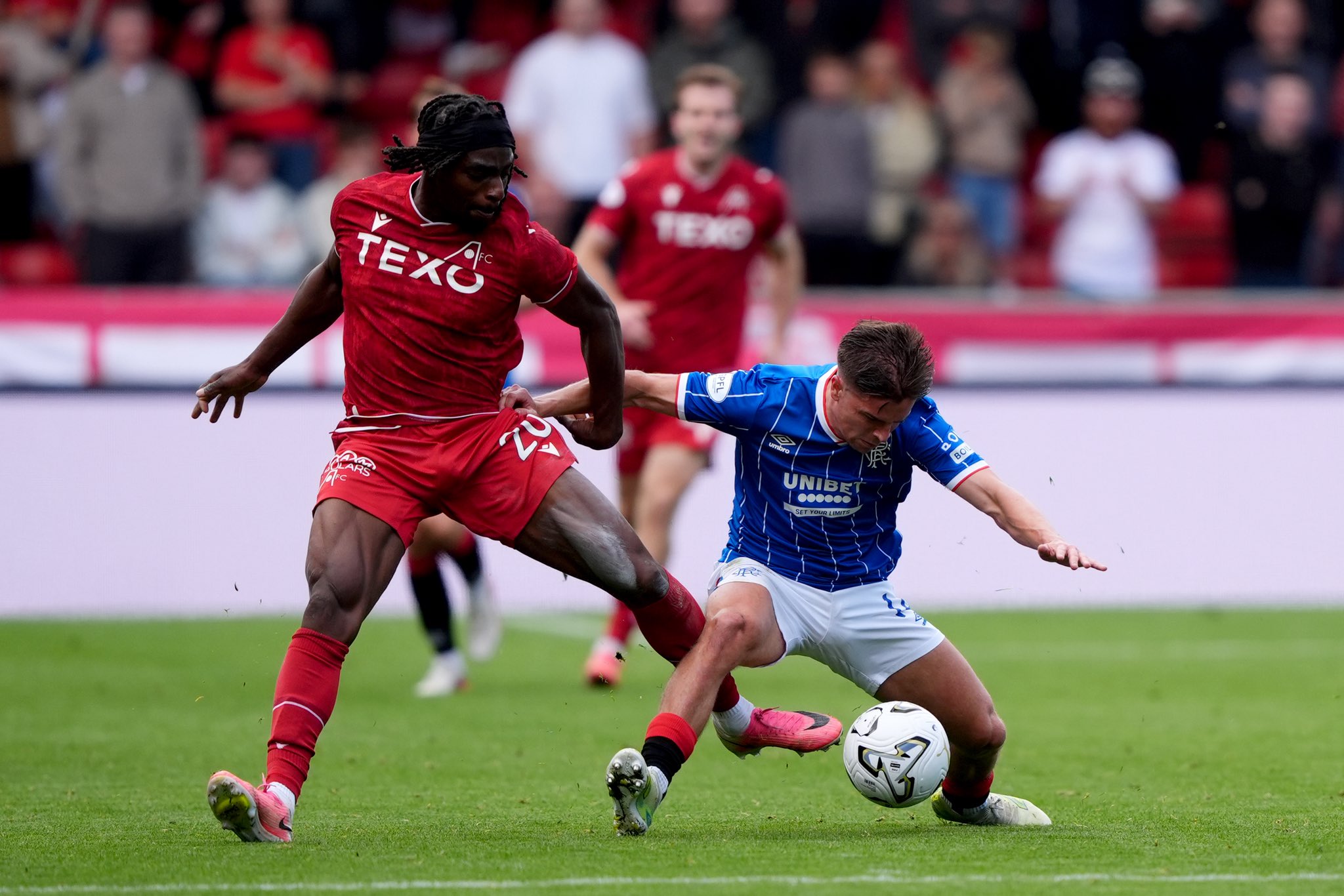
Derek McInnes needed a response, and against Aberdeen at Pittodrie his players largely delivered one, even if the performance itself, as most match reports were careful to note, remained some distance short of convincing. This was Rangers’ first Premiership win of the season, arriving off the back of a chastening Conference League exit to Jablonec just three days earlier, and the pressure attached to this specific fixture cannot be overstated given everything that had built up around McInnes in the preceding week. Judged purely on the result, and on the significance of that result to a manager whose position had genuinely come under public scrutiny, several individuals deserve real credit. Judged on pure footballing quality, this remained, as the Scotsman’s own report bluntly put it, a game low on prettiness, with Rangers’ overall level only marginally improved on the abject standard set in the Czech Republic in midweek — a low, low bar to clear.
Ivor Pandur was arguably one of Rangers’ most important performers on the day, even though his most significant contributions came in the game’s closing stages rather than across ninety minutes of sustained action. With Aberdeen throwing everything at Rangers in search of an equalizer once Shankland’s penalty had put the visitors ahead, Pandur produced saves to deny both Kevin Nisbet and substitute Ayoub Mouloua in the buildup to what eventually became Nisbet’s disallowed goal — reactive, high-pressure stops that kept Rangers in front at a moment when the atmosphere inside Pittodrie had turned decisively hostile. That he then watched the resulting header ruled out by VAR for an infringement in the build-up offered him a slice of fortune, but the saves that preceded it were entirely his own doing, and on a day when Rangers needed their goalkeeper to stand up under real pressure, he did exactly that.
In front of him, the back four of Dujon Sterling, Emmanuel Fernandez, Olwethu Makhanya and James Penrice gave McInnes something he’s been searching for across a genuinely chaotic opening month of the season: a measure of defensive consistency. Sterling found himself at the centre of both of the match’s major refereeing flashpoints, first appearing to impede Nisbet in the buildup to an Aberdeen penalty shout that went unpunished in the 81st minute, and then, just two minutes later, becoming the player whose treatment in the build-up to Nisbet’s header saw the goal chalked off by VAR. That’s an unusual amount of incident to be wrapped up in for a full-back who otherwise had a fairly disciplined, low-key afternoon defensively — proof, if nothing else, that even a solid individual performance can end up defined by moments largely out of a player’s own hands. Fernandez and Makhanya, McInnes’s preferred centre-back pairing in recent weeks, continued to look like a partnership the manager trusts, holding firm against a direct, physical Aberdeen attack built around Nisbet’s aerial threat and the willingness of Stephen Robinson’s side to get bodies forward in numbers, particularly once they were chasing the game in the second half. Neither centre-back was singled out for any specific error in the reporting available, which in the context of a match Aberdeen dominated for long stretches in search of an equalizer, counts as a genuinely creditable, if unspectacular, showing. Penrice, still first-choice at left-back with Tuur Rommens unavailable, continued a run of steady, largely uneventful performances in that position — exactly the kind of reliability McInnes has needed given how much turnover and uncertainty has characterized the rest of his squad selection since arriving from Hearts.
Central midfield saw McInnes turn to two players with genuine history under him rather than continuing to rotate through less familiar options, bringing in Cammy Devlin alongside the retained Dan Neil. Devlin’s inclusion made obvious sense given his relationship with the manager from their time together at Tynecastle, and reports described his focus, alongside Neil, on securing every pass and avoiding turnovers in dangerous areas — unglamorous defensive-midfield work that doesn’t generate the same eye-catching praise as a goal or an assist, but which mattered enormously in a match where Rangers, having taken the lead, spent much of the closing stages simply trying to protect what they had. Neil’s inclusion carries its own significance given the context of his previous outing: he’d been substituted at half-time during the Jablonec defeat, in what was widely read as one of the more damning individual moments of that entire European humiliation, given he’d been Rangers’ captain for that specific match. Returning to the side just days later and helping marshal a midfield that, whatever its lack of attacking flair, did its defensive job effectively enough to protect a one-goal lead, represents a meaningful bounce-back, even if it’s the kind of quietly competent performance that rarely gets picked out individually in post-match analysis.
Further forward, Findlay Curtis came into the side as one of McInnes’s four changes but featured less prominently in the specific buildup play referenced across match reports than some of his attacking teammates — one of the less heralded pieces of a win built more on collective resilience than any one individual’s attacking brilliance, beyond the two standout performers discussed below. Djeidi Gassama, by contrast, had a genuinely important hand in the only goal of the game, directly involved in the passage of play that led to Aberdeen conceding the penalty Shankland would go on to convert, and earlier in the match produced a driving run from deep that carried Rangers up the pitch and set up a teammate for a shot on goal. It was the kind of direct, purposeful contribution in the final third that Rangers have often lacked during their difficult start to the season, and it marks Gassama out as one of the more encouraging attacking performers on an afternoon when genuinely fluent, front-foot football was in short supply for both sides.
The individual performance drawing the most consistent praise across every match report, though, belonged to Kim Min-su, making his full Rangers debut having been signed from Girona for a reported £8.5 million only days earlier. For a player parachuted straight into a pressure-cooker fixture against a fired-up home side, with his new manager’s job security being openly debated in the media that same week, Min-su’s contribution stood out as the single most encouraging sign to emerge from ninety testing minutes at Pittodrie. He had Rangers’ first meaningful sight of goal inside eight minutes, forcing a save from Aberdeen goalkeeper Marius Müller, and he continued to look Rangers’ most incisive attacking threat as the game progressed — a powerful strike from around thirty yards midway through the first half required a genuinely excellent save from Müller, tipped over the crossbar at full stretch, and he was directly involved in the buildup that eventually led to the game’s decisive moment, seeing his own shot blocked before the loose ball fell for Shankland to win the penalty that settled the contest. Reports consistently described him as having “performed well” before his eventual withdrawal in the second half, and for a fanbase desperate for some tangible reason for optimism after a torrid European week, a composed, threatening full debut from a twenty-year-old signed for a significant fee offers exactly that. Whether he can sustain that level of impact once Scottish Premiership defenders have had more time to study him remains to be seen, but as opening statements go, this was about as encouraging as McInnes could have hoped for.
And then there was Lawrence Shankland, whose contribution requires little embellishment given the context surrounding it. Handed the captaincy on arrival at Ibrox despite being a brand-new signing, Shankland had spent much of his opening weeks at the club fighting for a starting place rather than cementing one, dropped for both the Jagiellonia Bialystok defeat and the League Cup win over St Mirren in favour of alternative options up front. Restored to the side against Aberdeen as one of McInnes’s four changes, he took his opportunity in precisely the manner a captain is meant to: winning, and then converting, the penalty that ultimately separated the two sides, sending Müller the wrong way from twelve yards with the kind of composure that suggested none of the pressure of the preceding week had gotten to him. It was his first goal in a Rangers shirt, arriving at the exact moment his own manager needed a response most, and it’s difficult to overstate how significant that timing makes the contribution — not just a goal, but the goal that eased mounting scrutiny on McInnes, kept Rangers within touching distance of Celtic at the top of the table, and offered the clearest possible statement that a squad under real external pressure could still find a way to grind out a result when the situation demanded resilience over style.
Beyond the specific individuals already discussed, it’s worth being honest about the limits of what’s publicly available regarding this particular match in terms of granular, player-by-player statistical detail — touches, duels won, pass completion, defensive actions and the like. What’s clear from the broader match reporting is that this was, collectively, a resilient rather than a fluent performance: Rangers competed well physically against a fired-up Aberdeen side that had won six of their previous seven matches across all competitions, stood up to a sustained second-half push for an equalizer, and made the most of a slice of fortune when Nisbet’s header was ruled out following VAR review for a push in the buildup — a decision most neutral assessments regarded as a fair, if painful for Aberdeen, application of the laws around impeding an opponent in the build-up to a goal, following on from an earlier, unpunished penalty shout of their own just two minutes before that decision that will have only compounded the home side’s sense of grievance by full time.
None of that collective resilience changes the underlying reality that Rangers’ performance level remains a work in progress under McInnes, whose overall record since replacing Danny Rohl over the summer stood at just two wins from his first seven matches before this result, with a poor start to the domestic season compounded by exits from both the Europa League and the Conference League inside the space of a few short weeks. This Aberdeen result doesn’t erase any of that context — if anything, several match reports were explicit in framing the win as a matter of relief and respite rather than any sudden, wholesale transformation in performance quality. But football, particularly at a club under the kind of intense, week-to-week scrutiny Rangers currently find themselves subject to, often rewards results over aesthetics, and a first league win of the season, built on a debutant’s encouraging attacking threat and a new captain’s ice-cool finishing under real pressure, buys McInnes something genuinely valuable heading into the September international break: a platform, however modest, to build from, rather than facing a fortnight of enforced downtime under the kind of mounting, existential pressure that had defined the preceding several days. Whether Kim Min-su’s promising debut and Lawrence Shankland’s morale-boosting penalty prove to be the first signs of a genuine turnaround, or simply a brief respite within a longer, more troubled arc, is a question only the coming weeks of football can answer — but for one Sunday lunchtime at Pittodrie, both players gave Rangers supporters, and their beleaguered manager, something to hold onto.