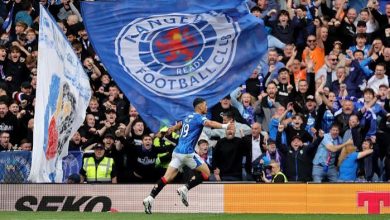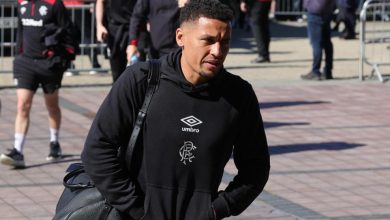
A brace from his weaker foot, an armband earned rather than given, and a manager relieved to finally shut the transfer books — Lawrence Shankland delivered exactly what Rangers needed on a chaotic night in Falkirk
On a night when plenty of his team-mates looked rattled by an error-strewn game and the noise of a transfer deadline closing in around them, Lawrence Shankland was the one figure at the Falkirk Community Stadium who never seemed to lose his head. His two goals proved decisive as Derek McInnes’s side ground out a second Scottish Premiership win of the season, arriving just days after the captain’s penalty had already delivered the first three points of the campaign at Pittodrie. In a match short on quality and littered with mistakes at both ends, it was Shankland’s composure in front of goal that separated the sides.
Two goals, both from the weaker foot
Shankland’s finishing had a certain symmetry to it. His opener whistled in off his left foot into the roof of the net — not his natural side — and his second, arriving with the contest delicately poised, was similarly dispatched left-footed into the bottom corner. For a player whose reputation was built on a natural predator’s instinct in front of goal during his time at Tynecastle, scoring both from his supposedly weaker foot said as much about his all-round game as either the technique or the timing.
The winning goal was all the more notable for what preceded it. Shortly before slotting home the decisive strike, Shankland had slid a low effort agonisingly wide with the goal gaping — the kind of miss that can derail a striker’s evening, or at least dent his confidence heading into the next opportunity. Instead, he shrugged it off and made no mistake when the next chance arrived, finding the bottom corner to settle the contest. It is precisely that kind of resilience — the ability to file away a bad miss and still back yourself for the next chance — that has made him one of the most productive forwards in the country over the past four seasons.
Falkirk manager John McGlynn, who knows Shankland’s qualities as well as anyone from his time watching him torment Scottish Premiership defences, did not hold back in his assessment afterwards. “If Lawrence Shankland is in a navy blue jersey, we win the game tonight,” McGlynn told BBC Scotland — a striking admission from an opposition manager, and one that underlined just how central the Rangers captain had been to the outcome.
From boyhood dream to Ibrox captain
Shankland’s arrival at Ibrox in the summer carried a weight of narrative that few transfers in Scottish football manage to generate. After four years established as Hearts’ talisman — during which he scored 88 goals in 171 appearances and captained the Edinburgh club to a second-placed Premiership finish, agonisingly missing out on Hearts’ first top-flight title since 1960 on the final day of the season — Shankland completed a move to the club he has supported since childhood. He had previously been linked with a switch to Ibrox as a free agent, only to sign a new contract at Tynecastle instead; it took a release clause in that deal, and a rapid week of negotiations after Hearts’ title near-miss, to finally get the move over the line. He put pen to paper on a two-year contract with the option of a further year, becoming the first major arrival of Rangers’ extensive summer rebuild.
The scale of that rebuild has been considerable. Rangers have brought in a dozen new players over the course of the summer as McInnes and his recruitment team have reshaped the squad, with Shankland’s arrival soon followed by a striking cast of new faces across the pitch, and further business — including a move for Portland Timbers forward Kevin Kelsy — still expected to follow even after Thursday’s deadline. It is a level of squad turnover that McInnes himself has openly acknowledged has made for an unsettled start to the campaign, but Shankland’s early impact offers the clearest evidence yet that at least one piece of that rebuild is beginning to click into place.
That the fit was not instant only adds to the significance of Wednesday’s performance. Shankland struggled, by his own admission not feeling overwhelmed by pressure but nonetheless finding goals harder to come by, in the opening weeks of the season, mirroring a difficult start for the team as a whole. Rangers dropped points in both of their opening league fixtures under McInnes and suffered a chastening Europa League exit at the hands of Czech side Jablonec, who forced a penalty shootout and prevailed. Against that backdrop, Shankland’s slow burn into form — three goals now in four Premiership appearances, following his matchwinning penalty at Pittodrie against Aberdeen — represents exactly the kind of upturn the club had hoped for when they moved to activate his release clause and beat off suggestions of longer-standing interest from elsewhere.
McInnes, who managed Shankland previously during his own time at Hearts before taking the Ibrox job, was fulsome in his praise after the Falkirk win. “I thought his second goal was particularly good, considering he missed the chance that he would be kicking himself with,” the manager said. “But, like all good strikers, the experience of Lawrence, the calmness of Lawrence, the quality comes up with a big moment.” He added: “I’m delighted for him because it’s not been, like for all of us, the easiest of starts. Obviously Lawrence would feel the weight of that a lot more than some others, just because of his background and how eager he is. A proper captain’s performance out there tonight.”
That reference to “background” speaks to precisely why this move carried such significance beyond the raw statistics. A boyhood Rangers supporter finally realising a lifelong ambition brings its own pressures, and McInnes’s comments suggested an awareness that Shankland has been feeling that added expectation more than most since walking through the Ibrox door. A “proper captain’s performance,” delivered on a night when performances elsewhere on the pitch were littered with sloppiness, was as much a statement of temperament as of finishing.
The numbers back up the sense that Shankland’s influence extended well beyond his two goals. No player on either side had more shots on the night, and only wide man Djeidi Gassama had more touches in the opposition box than the Rangers captain — evidence that his link-up play, not just his finishing, was central to bringing team-mates like Gassama and Kim Min-Su into dangerous areas throughout the match.
A deadline-day backdrop of transfer chaos
Shankland’s brace arrived amid a genuinely chaotic backdrop of transfer activity that threatened to overshadow the football itself. Rangers’ business on Wednesday was dominated by two contrasting stories: the club turned down a loan approach from Turkish side Besiktas for midfielder Nicolas Raskin, while simultaneously accepting a £1m loan offer from Belgian club Anderlecht for Norway international Thelo Aasgaard.
Raskin’s situation had cast a shadow over the build-up to the Falkirk fixture. The Belgian international, whose stock has soared since his performances at this summer’s World Cup, had missed Rangers’ previous two matches amid the swirling transfer speculation — an absence that was keenly felt in the Europa League exit to Jablonec, where his composure and experience in midfield were sorely missing as the tie went to a penalty shootout Rangers ultimately lost. His return to the starting line-up against Falkirk therefore carried significance well beyond one league fixture, arriving as it did on the very day his club rejected an approach to take him to Turkey.
Raskin repaid that faith immediately, playing a central role in the move that led to Shankland’s opening goal — winning possession back in his own half before instigating the attack by shifting the ball out to the left. It was a reminder, delivered inside the first moments of his reinstatement, of exactly why Rangers have consistently knocked back interest in him across this window and previous ones.
McInnes did not disguise his relief that Raskin had been able to feature at all. “I’m just glad I’m able to choose Nico tonight,” he said. “We can do with his experience in there. I thought he got better in the second half. Obviously delighted if we manage to hold onto him and it looks like we will.” Pressed further on the situation, the manager was candid about how disruptive the speculation had been to his preparation. “Obviously Nico’s had an opportunity to go today, and it wasn’t something he wanted or the club, I believe, entertained. It was hardly the ideal preparation,” McInnes admitted. “I’ve been keen to utilise Nico, but there’s been a lot going on for him. He’s been training with us every day, and I think at times the team needs more experience.”
McInnes went further still, offering a vivid illustration of just how uncertain the picture had been even hours before kick-off. “Even coming through from Ibrox at lunchtime today, at the hotel, I had Thelo behind me and Nico three rows behind me and I didn’t know who was coming and who was going. It’s far from ideal,” he said — a remarkably candid admission of a manager genuinely unsure, mere hours before a competitive fixture, which of his players would still be at the club come the final whistle.
That uncertainty resolved itself in contrasting fashion for the two players. Aasgaard’s £1m switch to Anderlecht went through as a season-long loan, with the Belgian club given the option to sign the 24-year-old Norway international permanently for a further £5m next summer. He had scored once in five appearances this season, but had fallen behind Minsu Kim in the pecking order for Rangers’ advanced midfield positions, and the move offers him a fresh chance to reestablish himself in a league where he will link up with former Rangers team-mate Oliver Antman. Signed from Luton in 2025 on a contract running to 2029, Rangers retain a stake in his long-term value even while he plies his trade in Belgium for the remainder of the campaign.
Raskin, by contrast, remains an Ibrox player — for now, at least — with McInnes cautiously optimistic that Thursday’s deadline will pass without further disruption. Restoring the armband to him in the closing stages against Falkirk, after two matches on the sidelines amid transfer talk, was as clear a signal as any that his manager considers him central to the team’s plans regardless of the noise surrounding his future.
McInnes counts down the clock
Taken as a whole, Wednesday’s events left McInnes sounding like a manager counting down the hours until he can stop fielding transfer questions altogether. “It seems to have been the longest window I can remember — so much going on,” he said. “For us now, it will do everybody good if we can get the window shut and work with what we’ve got. Players always settle a wee bit more.”
It is a sentiment that captures the wider mood around Ibrox since the turn of the summer: a club in the midst of a significant and, at times, unsettling rebuild, with McInnes attempting to build cohesion and form out of a squad still being assembled around him even as the season gets under way. “We’ve made some good signings, very young as you can see at times, but I’m confident we’ve got good talent here that can give us lots of encouragement between now and January and then see where we are,” he added — a measured, long-view assessment from a manager who knows that patience, as much as incoming quality, will be required to judge the rebuild fairly.
For now, though, the immediate evidence is encouraging. Back-to-back Premiership wins, a captain hitting form at exactly the moment his side need it most, and a key midfielder seemingly secured beyond the closing bell of the transfer window all point to a Rangers side beginning to find its footing after a difficult start to the campaign. Whether Wednesday’s “proper captain’s performance” from Shankland proves to be the springboard McInnes and his supporters are hoping for will become clearer in the weeks ahead, once the distractions of the transfer window are finally, mercifully, behind them. But after a night when so much around the fixture threatened to overshadow it, it was Rangers’ captain — calm amid the chaos, clinical with his weaker foot, and seemingly unburdened by the weight of his boyhood dream — who made sure the football did the talking.