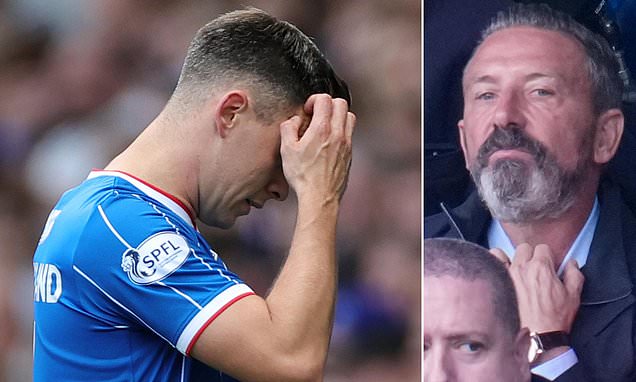
There are injuries that catch a team cold, and then there are injuries that land at the worst conceivable moment. Lawrence Shankland’s hamstring problem, sustained barely five minutes into Rangers’ 1-0 win over Motherwell at Ibrox on Saturday, falls firmly into the second category. The Rangers captain had, by his own club’s estimation, just started to look like the player McInnes signed him to be — scoring twice against Falkirk three days earlier, having already netted from the penalty spot at Aberdeen before that. Three goals in two games, the captaincy freshly on his shoulders, and a Rangers side finally finding some attacking rhythm after a stodgy start to the campaign. Then he grasped the back of his leg, signalled immediately to the bench, and was gone.
Derek McInnes didn’t dress up the severity of it afterwards. Speaking to BBC Scotland after the match, the manager said the injury looked “quite significant,” and drew an ominous parallel with the hamstring problem that sidelined Shankland for an extended spell while he was still at Hearts in January. A scan on Monday will provide more clarity, but McInnes was careful not to speculate on a timeframe until the results come back — a caution that, given the earlier comparison, will do little to settle Rangers supporters’ nerves. It’s understood the previous injury of a similar nature kept Shankland out for roughly three months, and if this one follows a comparable pattern, Rangers will be without their captain and leading forward presence for a significant chunk of the season.
The maddening part, from a Rangers perspective, is just how avoidable this kind of setback can feel when it strikes a player who was finally delivering. Shankland arrived at Ibrox from Hearts back in May and endured the kind of up-and-down start that comes with any high-profile switch across the Edinburgh-Glasgow divide, but had scored four goals in his first ten appearances and, more importantly, appeared to be building real form and understanding within McInnes’s attacking setup just as the captaincy landed on him. His brace against Falkirk and penalty at Aberdeen were treated by many observers as evidence the goals were about to properly start flowing. Instead, Rangers now face the prospect of navigating a run of fixtures — including their first Old Firm derby of the season later in September — without the very player whose form had begun to look like the answer to their early-season attacking struggles.
There’s also a squarely practical dimension to the bad timing. The summer transfer window closed just days before Shankland went down, meaning Rangers have no ability to bring in fresh attacking reinforcement to directly replace him. Whatever solution McInnes settles on, it has to come from players already inside the building
The man who actually delivered the winning goal against Motherwell offers the most straightforward answer to the immediate question of who leads the line next. Ryan Naderi came on to replace the injured captain and needed only a matter of minutes to make an impact, pouncing on a Motherwell goalkeeping error to slot home what proved to be the only goal of the game. For McInnes, that gives him what amounts to a ready-made alternative rather than another experiment to run — Naderi, now 23, already understands the specific demands the Rangers system places on its central striker, particularly the requirement to occupy opposition centre-backs, contest long balls into the front line, and create space for runners breaking beyond him. It’s a role that doesn’t necessarily reward out-and-out predatory instinct so much as intelligent movement and hold-up play, and by most assessments Naderi is equipped to perform that job without forcing Rangers to fundamentally restructure their attacking approach.
The alternative of pushing a winger into a more central role was reportedly considered and largely dismissed, since it would cost Rangers both width in attack and a clear focal point in the penalty box — a trade-off that looks worse than simply persisting with a recognised, in-form forward option in Naderi.
The more intriguing subplot is what all this means for Kevin Kelsy, the £9.5m deadline-day signing from Portland Timbers who made his own Rangers debut from the bench in the very same game Shankland went down. On the surface, timing suggests Kelsy could be fast-tracked into a leading role sooner than McInnes originally intended, given the sudden vacancy up front. But a note of caution has already crept into the conversation around his likely impact. Kelsy’s underlying numbers — 13 goals in his last 46 appearances across his career, working out to roughly one goal every 190 minutes — hint that Rangers may not have signed a natural, prolific finisher in the mould some supporters were hoping for.
That caution was echoed by former Ibrox midfielder Ian McCall, speaking on BBC’s Sportsound, who pointed out that Rangers missed a considerable number of chances against Motherwell, particularly in the second half, and suggested Shankland’s injury is a genuine concern precisely because neither Kelsy nor Naderi carry the profile of a natural, clinical finisher in front of goal. It’s a sobering assessment for a club that has just spent close to £10m to bolster its forward options, and it underlines that the goal-threat question raised by Shankland’s absence may not have a tidy, immediate answer regardless of who McInnes selects.
For all the concern around the finishing at the sharp end, there was a broader silver lining buried in the performance itself. After a run of unimaginative, uninspiring and ultimately unsuccessful attacking displays during Rangers’ early-season European qualifying exits, the win over Motherwell showed a team playing with considerably more attacking purpose and creating a healthy number of clear-cut chances — even if converting them proved to be the issue. That, at least, offers McInnes something to build on. The system appears to be generating opportunities; the question now is which combination of Naderi, Kelsy, or others can be trusted to actually put them away with Shankland unavailable.
Monday’s scan results will go a long way toward clarifying exactly how long Rangers will be operating without their captain, and by extension how much of this goal-threat puzzle McInnes needs to solve on a short-term versus long-term basis. What’s already clear is that a summer spent investing heavily in attacking reinforcements has, almost immediately, been tested by the one scenario no amount of transfer business can fully insure against — an injury to the very player those signings were meant to support, rather than replace.