Everything We Know About Lawrence Shankland’s Rangers Contract After ‘Devastating’ Injury

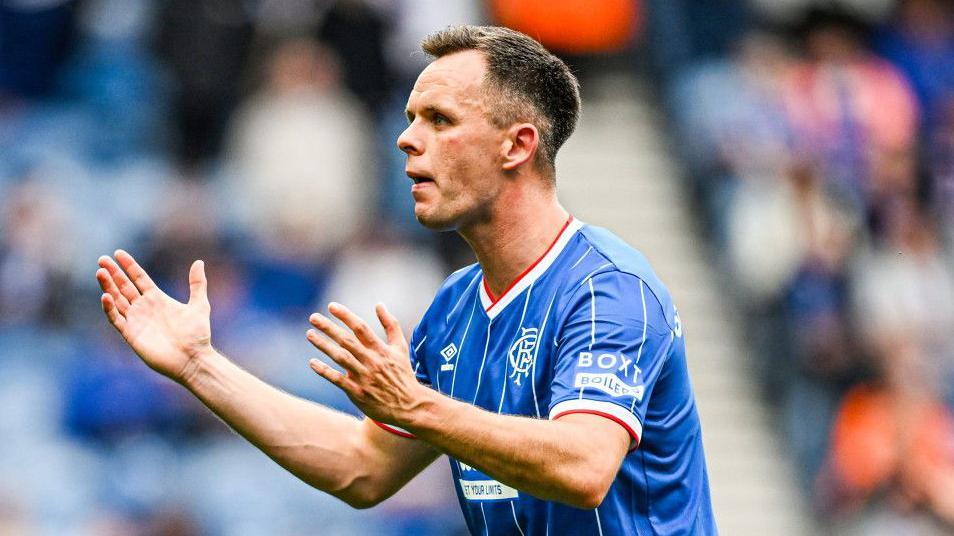
There’s a cruelty to how quickly things can turn in football, and few Rangers storylines this season illustrate it better than Lawrence Shankland’s. The Scotland international had scored three goals in his previous two matches, including a brace against Falkirk, and had only recently been handed the club captaincy by Derek McInnes — the culmination of a summer move from Hearts that, after a mixed opening spell, finally seemed to be clicking into place. Then, just eight minutes into Saturday’s 1-0 win over Motherwell at Ibrox, Shankland pulled up holding his hamstring and had to be replaced. Former Celtic captain Scott Brown, reacting on BBC Sportscene, didn’t mince his words about what the injury meant. “You can hear McInnes before, talking about how he might be out for a little while, which is obviously devastating,” Brown said. “For himself and for Scotland and Rangers. He got two goals against Falkirk and was just starting to find his feet as captain.”
With scan results and a clearer recovery timeline still pending, attention has understandably turned to the practical questions surrounding Shankland’s situation at Ibrox — starting with the terms of the contract that brought him there in the first
Shankland signed for Rangers as a free agent over the summer after his exit from Hearts, putting pen to paper on a two-year deal that includes the option of a further year. Taking the base terms alone, that ties him to Ibrox until the summer of 2028; if both parties agree to trigger the additional year, his stay in Govan could extend to 2029 at the earliest. It’s a deal that reflected genuine ambition on both sides at the time of signing — a proven Scottish Premiership goalscorer joining as a free agent, reunited with the manager, in McInnes, who had left Hearts around the same time, alongside fellow former Hearts player Cammy Devlin, who made the same move to Ibrox this summer
McInnes has been consistently candid, if appropriately cautious, in his public comments since Shankland went off. Speaking to BBC Radio Scotland after the Motherwell win, he confirmed that the club would need Monday’s scan results before drawing firm conclusions, but added: “All I can say is it does look quite significant, so it’s disappointing.” Crucially, McInnes has drawn a direct parallel with an injury from Shankland’s time at Hearts — a hamstring problem picked up against Falkirk on January 17th last season that kept him sidelined until a return against Dundee on March 21st, a lay-off of roughly two months.
If this latest injury follows a similar pattern, the numbers are stark. A comparable absence would see Shankland miss somewhere in the region of 13 matches, according to Ibrox-focused reporting following the injury — a run that would take in Rangers’ midweek trip to St Mirren, the Scottish League Cup quarter-final against Celtic at Ibrox, the first Old Firm league meeting of the season at Celtic Park, and potentially even a reunion fixture against his former club Hearts at Tynecastle at the end of October, a match now considered doubtful for his involvement given the timeline.
There remains a range of possible outcomes depending on the exact grade of the strain. A milder grade one hamstring problem could, in theory, see Shankland back within a matter of weeks; a more significant grade two or three tear would point toward the longer end of the recovery spectrum McInnes has already flagged as a realistic possibility. Monday’s scan should provide the clarity that’s currently missing.
Shankland’s injury doesn’t exist in isolation from the rest of Rangers’ squad situation, and that’s a large part of what has made the reaction to it so pointed. McInnes is already without Youssef Chermiti for an extended period following the forward’s ACL injury earlier in preseason — a setback that itself prompted the club’s deadline-day pursuit of Kevin Kelsy from Portland Timbers. With Shankland now added to the sidelined list, McInnes finds himself having lost two central strikers to significant injuries within the space of a few weeks, a coincidence he addressed candidly after the Motherwell win: “If somebody had said to me walking in the door that Youssef Chermiti and Shankland were going to be out with significant injuries, you’d have felt the weight of that. Getting Kevin was such a good bit of business and the club deserves a lot of credit for that.”
That silver lining was echoed in how the Motherwell match itself unfolded. Ryan Naderi, who replaced Shankland almost immediately, needed only a few minutes to make an impact, pouncing on a Motherwell goalkeeping error to score the game’s only goal. Kelsy also made his own Rangers debut from the bench in the same match, giving McInnes at least some evidence that his squad depth up front can absorb the blow in the short term, even if replicating Shankland’s specific goalscoring form remains a taller order.
None of this changes the underlying terms of Shankland’s deal, which remain in place regardless of injury lay-off — there is no suggestion of the contract itself being in any jeopardy, and injury absences of this kind are a standard, anticipated risk built into any professional playing contract rather than something that affects its validity. What the injury does affect is the practical question of value for money and squad planning during a period when Rangers are already stretched thin at centre-forward, and it inevitably invites scrutiny of a player who, at 31, arrived on a contract that could keep him at Ibrox into his mid-thirties, with two significant hamstring injuries now occurring within the space of roughly eight months across two different clubs.
For now, there’s no indication from Rangers that this changes anything about their long-term commitment to Shankland as captain and first-choice striker once he returns to full fitness. The club’s public messaging, echoed by McInnes’s own comments, has focused entirely on managing the immediate absence and the squad’s response to it, rather than any reconsideration of the player’s long-term role.
Monday’s scan looms as the pivotal moment in this story, expected to provide Rangers with a firm recovery timeline rather than the estimated range McInnes has offered so far. Until then, the club faces a genuinely difficult run of fixtures — St Mirren away, a League Cup quarter-final against Celtic, and the first Old Firm league derby of the season — that could shape not just Rangers’ campaign, but also the pressure McInnes himself is under, without the captain who had only just started to look like the attacking focal point his side had been missing.