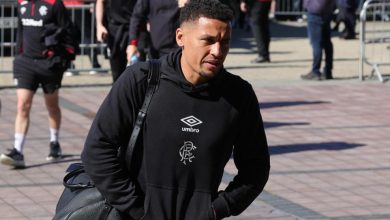
Of all the sub-plots running through Derek McInnes’ first months back at Ibrox, none has proven quite as puzzling — to supporters, to pundits, and seemingly at times to the player himself — as the case of John Souttar. A defender who signed a contract extension in February, who travelled to a World Cup with Scotland just months ago, and who has 132 appearances for the club to his name, finds himself frozen out so completely that he didn’t even make the plane for pre-season training. Half a season later, after a transfer push that quietly collapsed, he’s still there, still training, and still nowhere near a matchday squad. It’s the kind of situation that doesn’t have an obvious modern parallel at a club of Rangers’ size, and it says a great deal — about McInnes, about Souttar, and about the pressures shaping Ibrox this season — that nobody outside the training ground fully understands how it happened.
To understand how strange this situation is, it helps to rewind to February, when Souttar put pen to paper on fresh terms that tied him to Rangers until 2027, with an option for a further year after that. That’s not the kind of deal a club hands to a player it’s planning to discard within months. New contracts are signals of faith, evidence that the football operations department sees a future for a player in its plans. For Souttar, who had endured a difficult run of form in the second half of that season and had fallen out of the regular starting XI under his old manager, the extension looked like a vote of confidence at a time when his place in the team was anything but guaranteed.
Then came the summer. Souttar was named in Scotland’s squad for this year’s World Cup, though he didn’t play a single minute across the tournament — itself perhaps an early signal that his standing, even at international level, had begun to slip. He returned to Rangers’ Auchenhowie training base afterward for what should have been a normal pre-season buildup, arriving back around the same time as new signing Lawrence Shankland and academy graduate Findlay Curtis. Rangers, meanwhile, had appointed McInnes as their new head coach, a move greeted with something close to universal approval among the club’s support — reports at the time pointed to an approval rating in the high nineties, an almost unheard-of level of goodwill for any managerial appointment at a club as demanding as Rangers.
It’s against that backdrop of optimism that the Souttar situation first turned strange. When the first-team squad flew out to Spain for an intensive pre-season training camp, Souttar wasn’t on the plane. Neither was Brazilian forward Danilo, whose omission was far easier to explain — a player who had struggled with persistent injuries and become surplus to requirements after Rangers strengthened their forward line with Shankland, Youssef Chermiti and Bojan Miovski. Souttar’s absence carried no such obvious explanation. He’d signed a new deal five months earlier. He’d represented his country at a World Cup that summer. And now, with a new manager just settling into the job, he was being left behind before a ball had even
McInnes has never pretended Souttar features in his plans, but he’s also never offered a detailed, specific football rationale for the decision — at least not one that’s found its way into the public domain. What he has said, repeatedly and in slightly different forms, is that the situation involved matters beyond simple team selection. Asked directly about it after the transfer window closed, McInnes described a scenario where Souttar was dealing with “a lot of things going on for him,” and explained that it had been made clear a move away might be the best option — a plan that, in the end, simply didn’t materialise.
That kind of language tends to invite more questions than it answers, and Rangers supporters have not been shy about asking them. Some have speculated about circumstances in Souttar’s personal life; the more prominent independent Rangers commentary has been careful to note that such rumours are unfounded and should be treated with real caution, since there’s no actual evidence behind them beyond fan speculation. What can be said with more confidence is that whatever changed for Souttar between February’s contract extension and July’s exclusion from the Spain trip, it happened on McInnes’ watch and appears to have been McInnes’ call. The one constant that shifted in that window was the manager himself — Danny Rohl departed for RB Salzburg, and McInnes arrived in his place
That timing matters. It’s not unusual for a new manager to reshape a squad according to his own footballing principles, moving on players who don’t fit a preferred system or standard of performance. What’s unusual here is the totality of the exclusion. Other members of what Rangers fans have come to refer to as the club’s informal “bomb squad” — academy product Ross McCausland, defender Clinton Nsiala, and until his exit, Danilo — have still found their way into matchday squads on occasion, even while clearly not first-choice options. Souttar has not. He has been present for training throughout, by all accounts professional and uncomplaining about it, but has been absent from essentially everything else connected to first-team football at the club. It’s a more complete freeze-out than most fringe players experience, and that scale is part of what has kept the story alive
For a period over the summer, the situation had a relatively straightforward explanation on the surface, even if the underlying cause remained murky: Souttar was being moved on, and the exclusion from Spain was simply the practical first step in that process. Reports throughout July and August consistently linked him with a return south of the border, with interest reported from Sheffield United among other English clubs, largely at Championship or League One level. There was even a period where Leicester City’s interest was floated, with a connection to former Rangers manager Russell Martin, who had taken over there and would have known Souttar’s qualities from his time in Scottish football.
None of it came off. When the Scottish transfer window shut on 3 September, Souttar was still a Rangers player, his proposed exit having failed to materialise into an actual transfer. There remained, in theory, a window of opportunity via other countries whose transfer deadlines fall later in the year, and McInnes himself acknowledged as much — but the most realistic route, a move to England, had already closed by that point, since the English window had shut earlier. Whatever leverage existed to force through a deal before the Scottish deadline evidently wasn’t enough to get a transfer over the line, whether because of valuation disagreements, personal terms, wage demands, or simply a lack of a club willing to commit at the level Rangers wanted.
McInnes’ response to the failed move was notably measured rather than triumphant or frustrated. Asked directly whether Souttar might now return to first-team contention, he stopped short of a firm yes, saying only that the situation needed to be “addressed” now that the transfer window had closed without a resolution, and promising a further update in the days that followed. It was the language of a manager working through a genuinely unresolved problem, not one delivering a verdict
What makes the Souttar saga particularly uncomfortable for Rangers and for McInnes personally is the state of the defence around it. By virtually every account from inside and outside the club, Rangers’ backline has struggled significantly through the early part of this season — struggles severe enough that one prominent piece of independent Rangers commentary described the current defensive record as the worst the club has produced since periods of genuine crisis nearly a decade and a half ago, and again during a difficult defensive spell a few seasons back. When a team is shipping goals at that kind of rate, and an experienced, 29-cap international central defender is sitting unused in the stands or nowhere near the matchday squad at all, supporters are entitled to ask why.
The statistics circulating around some of the alternatives haven’t helped ease that scrutiny. Emmanuel Fernandez, one of the centre-backs McInnes has preferred over Souttar, has reportedly struggled for defensive output this season, with figures in the region of half a tackle and just over one interception per match — numbers that, whatever context surrounds them, don’t paint the picture of a defender dominating games at the back. Ben Godfrey, brought in on loan with an option to make the move permanent, has provided competition but has also had his own fitness interruptions, missing time through injury before returning to the side. Olwethu Makhanya, signed from Major League Soccer side Philadelphia Union, rounds out the options McInnes has preferred to lean on ahead of Souttar.
None of that guarantees Souttar himself would have solved Rangers’ defensive issues had he been involved — a player who was, by most assessments, out of form and out of favour even before McInnes’ arrival, and who hasn’t played competitive first-team football in the best part of a year, doesn’t return automatically ready to be a difference-maker. But the optics of the situation — an established international sitting completely outside the picture while the defence in front of him struggles — are difficult for any manager to fully insulate himself from, however sound the underlying reasoning might be.
There are practical reasons to think a reintegration, at least to some degree, makes sense for both parties. Souttar remains, on paper, one of the more experienced defensive options within the Rangers squad — 132 appearances for the club, 255 in the Scottish Premiership across his career, and continental experience spanning 19 Europa League appearances and a further dozen in Champions League qualifying rounds. That’s a level of big-match exposure that not every player in the current squad can match, and in a title race and European campaign where squad depth tends to matter as much as a strong first XI, having a recognised, well-drilled option available in reserve is rarely something a manager wants to simply discard, particularly for reasons that remain publicly unexplained.
There’s also a football logic that becomes more compelling with each passing week that Rangers’ defensive record fails to improve. If Fernandez continues to struggle for defensive output and Godfrey’s fitness remains anything less than guaranteed, the argument for at least having Souttar available as an option — even a fourth-choice one, even purely for squad numbers and emergency cover — becomes harder to dismiss on football grounds alone. Managers who leave established internationals out of matchday squads entirely, week after week, for reasons connected to something other than form or fitness, invite exactly the kind of scrutiny McInnes is currently receiving over this issue.
Equally, there are reasons McInnes might feel justified holding his position regardless of how uncomfortable it looks from the outside. If the situation genuinely does involve matters beyond pure football — whatever those may be — then results-driven pressure to reverse the decision is exactly the wrong reason to do so. A manager who caves to public pressure and brings a player back into the fold purely because the alternative options have hit a rough patch of form risks undermining the standards he’s trying to set from day one in the job, especially if his original assessment of the situation, whatever it was rooted in, hasn’t actually changed.
There’s also a broader message at stake about how McInnes wants his squad to operate. He’s previously spoken, in the context of deadline-day business, about wanting players who want to be at Rangers for the long haul rather than those with one eye on the exit door — comments that, while made about a different player entirely, hint at a manager who places real value on commitment and fit within the group, not just raw ability. Whether or not that framework applies directly to the Souttar situation, it suggests McInnes is someone willing to prioritise squad culture and his own judgment over short-term optics, even when that approach draws criticism.
The most likely near-term outcome is a gradual, rather than immediate, thaw — should one happen at all. McInnes has signalled he intends to address the situation now that the transfer window has closed without a deal, which suggests some kind of conversation or reassessment is coming, even if the specifics remain unclear. A dramatic reversal, with Souttar restored straight to the starting XI, seems unlikely given how completely he’s been excluded up to this point; football rarely works that cleanly, and a manager rarely wants to signal that his earlier judgment was simply wrong. A more probable path, if reintegration does happen, would involve Souttar working his way back through the training-ground ranks and perhaps into a matchday squad in a substitute role before any return to regular starting duties, giving both player and manager a chance to reset the relationship without an abrupt, headline-grabbing change of course
The alternative, of course, is that nothing changes at all — that Souttar remains outside first-team contention through the autumn, continuing to train professionally while his path back to regular football, whether at Rangers or elsewhere, waits for the next transfer window in January. Given the situation has already run for the best part of two months without meaningful resolution, and given how little has been said publicly about the actual root cause, it would be no great surprise if this saga continues to simmer rather than resolve cleanly.
Whatever the true explanation behind Souttar’s exile — and it remains, even now, something closer to informed speculation than established fact for anyone outside Ibrox’s inner circle — the situation has become a genuine test of Derek McInnes’ management, separate from results on the pitch. New managers are afforded latitude to reshape a squad in their own image, and every head coach inherits players who don’t fit the system, the standards, or the culture they’re trying to build. But the completeness of Souttar’s exclusion, combined with the defensive struggles that have followed and the collapse of the very transfer that was supposed to provide a clean resolution, has turned a routine squad decision into one of the more closely watched sub-plots of McInnes’ early Ibrox tenure.
For a manager who arrived to near-universal approval from a fanbase desperate for stability and success, how he handles this — whether he brings Souttar back into the fold, finds him a path away from the club in January, or simply continues as things stand — will say as much about his man-management as any tactical decision he makes between now and the turn of the year. In a results business, that’s rarely the kind of story a manager wants running in parallel with his day job, but it’s the one Rangers currently find themselves inside all the same.