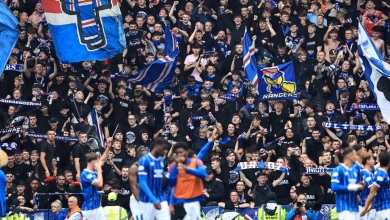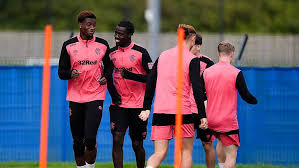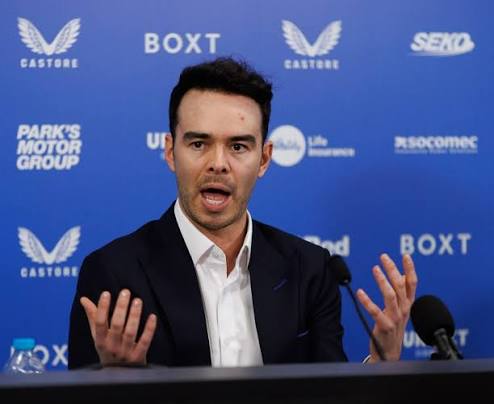
Derek McInnes had plenty to smile about on Wednesday night. A dramatic, last-gasp 1-0 win over St Mirren extended Rangers’ winning run to four Premiership games in a row and set the club up perfectly for a run of two Old Firm derbies in the space of eight days. But amid the celebrations at Ibrox, a smaller and altogether more intriguing story emerged from the opposition dugout — one that offered a fascinating glimpse into the kind of recruitment battles being fought behind the scenes at Rangers, long before deadline day headlines and record transfer fees ever enter the conversation.
A Milestone Night for a Teenager, and a Twist Nobody Expected
St Mirren’s visit to Ibrox was always going to be remembered for Bojan Miovski’s stoppage-time chip, the goal that continued Rangers’ resurgence under McInnes and sent the home support into raptures. But for neutrals with an eye on Scottish football’s next generation of talent, the more captivating subplot came from the away bench. With the game finely poised, St Mirren turned to Marcello De Barros, a 15-year-old defender making his William Hill Premiership debut in the most unforgiving of settings — a live Old Firm-adjacent atmosphere at Ibrox against a Rangers side chasing a fourth straight win.
It did not end the way De Barros would have scripted it. Miovski’s late intervention denied St Mirren a share of the points and handed Rangers all three, meaning the teenager’s first taste of top-flight football ended in defeat. But regardless of the result, making a senior Premiership appearance before turning 16 is the kind of moment that will stay with a young player for the rest of his career, and De Barros will have plenty of reason to remember his introduction at Ibrox — even before the story took its unexpected twist over the following days.
It has now been revealed that Rangers themselves had previously tried to sign De Barros. Trusted academy-focused source RFC Youths reported on social media platform X that Rangers made an attempt to bring the Brazilian-Scottish defender to Ibrox, though the exact timing of that approach was not disclosed. The account, which is followed by official Rangers partners including Four Lads and Heart & Hand as well as respected Scottish football journalist Chris Jack, carries considerable credibility when it comes to matters concerning the club’s youth recruitment. According to that report, De Barros ultimately turned down the opportunity to join Rangers, choosing instead to remain with St Mirren and continue his development in Paisley.
Who Is Marcello De Barros?
The wider context around De Barros makes Rangers’ interest, and his subsequent decision to reject it, considerably easier to understand. Born in December 2010, De Barros became St Mirren’s youngest-ever first-team player when he came off the bench in a Premier Sports Cup victory over Dumbarton in July, aged just 15 years and 218 days. That milestone alone would have been enough to generate headlines, but his rise has been even more eye-catching than a single record appearance suggests. Described in scouting circles as one of the most technically gifted youngsters to emerge from St Mirren’s academy in years, De Barros is a left-sided centre-back of half-Brazilian, half-Scottish heritage who has already represented Scotland at youth international level, having earned recognition at Under-16 level for his performances in the Paisley club’s development squads.
His talent had not gone unnoticed beyond Scotland’s borders either. De Barros previously spent time on trial with Arsenal, a clear indication of the level of interest his early performances were generating even before his senior breakthrough. That kind of external interest from one of the Premier League’s traditional powerhouses only added to the sense that St Mirren were sitting on a special talent, and it explains why Rangers moved to try to secure his signature for their own academy set-up. Reports at the time suggested the club’s then-incoming head of academy scouting was closely tracking the teenager as one of his very first priorities in the role, viewing De Barros as exactly the kind of gifted, locally developed prospect Rangers wanted to build their revamped recruitment strategy around, rather than continuing to rely solely on established first-team signings from abroad.
Despite that interest, and despite the lure of one of Scottish football’s biggest academies, De Barros chose a different path. Rather than dropping down into a bigger club’s youth ranks with no guarantee of an accelerated route to first-team football, he opted to stay at St Mirren, where his rapid progress meant a route to regular first-team involvement was already opening up in a way it likely would not have at Ibrox. That decision has been vindicated in the clearest possible way: within a matter of months of turning down Rangers, he was making his Premiership debut, at Ibrox of all places, against the very club that had wanted to sign him.
Why Staying Made Sense
There is a broader story in Scottish football about smaller clubs increasingly able to compete with bigger rivals for academy talent, not through financial muscle but through the promise of a faster pathway into senior football. De Barros’ situation is a near-perfect illustration of that dynamic. Scottish football’s youth regulations were updated for the 2026-27 season to allow players as young as 15 to feature in first-team competition, a change mirrored in SPFL League Cup regulations, and clubs across the country have shown early signs of taking advantage. St Mirren’s De Barros became the division’s youngest-ever player when he featured against Dumbarton, while Dundee United’s Lorenzo Sassetti broke a similar record a week or so later, becoming the youngest player in that club’s history at 15 years and 162 days old when he made his own debut against The Spartans.
That willingness among smaller Premiership clubs to hand out senior opportunities to teenagers stands in sharp contrast to what a player might realistically expect at a bigger academy. At a club the size of Rangers, an elite prospect typically has to work through several tiers of youth football, loan spells, and reserve team football before even being considered for a matchday squad, let alone senior minutes in the top flight. St Mirren, by comparison, could offer De Barros something no amount of reputation or resources at Ibrox could guarantee: an immediate, fast-tracked route into senior competitive football, playing regularly rather than waiting years for a chance that might never come.
That trade-off — prestige and resources against genuine first-team opportunity — is one that has shaped the career paths of numerous young Scottish talents in recent years, though usually in the opposite direction, with players leaving Scottish clubs early for the financial security and facilities on offer south of the border. Billy Gilmour’s departure from Rangers for Chelsea shortly after his sixteenth birthday remains one of the clearest examples of that trend, and more recent moves — Josh Adam from Celtic to Manchester City, Ben Doak from Celtic to Liverpool, Rory Wilson from Rangers to Aston Villa, and Dylan Reid from St Mirren to Crystal Palace — all point to a familiar pattern of Scottish clubs losing their brightest teenage prospects to clubs able to offer significantly greater financial packages. De Barros’ decision to stay with St Mirren rather than move to a bigger Scottish rival, even temporarily, suggests he and his representatives have prioritised playing time and development over reputation at this early stage of his career — a call that, on the early evidence of his Ibrox debut, appears to be paying off.
Why McInnes Has No Room for Him Right Now
Even setting aside De Barros’ own decision to remain in Paisley, there is a strong argument that a move to Ibrox would not have served him particularly well in the short term, given the situation Derek McInnes finds himself managing this season. Rangers’ summer spending has been extensive for the second year running, following a similarly busy transfer window last year under previous football operations staff. Reports throughout the window referenced Rangers making around a dozen new additions across the past two summers combined, with chairman Andrew Cavenagh publicly committing significant resources to backing his manager. At the club’s August shareholder meeting, Cavenagh confirmed the club held “a bias to Scottish players and people with SPFL experience” when discussing further incoming transfers, while also stressing that more depth was still needed even after nine signings had already been completed by that point in the window.
That level of financial commitment, impressive as it is, comes with an obvious consequence: a squad built through heavy investment in proven, established talent leaves very little room for academy prospects to break through, however promising they might be. McInnes, tasked with delivering results and silverware after a difficult start to the campaign that included a winless opening stretch domestically and elimination from both Europa League and Conference League qualifying, is simply not in a position to gamble minutes on unproven teenagers, regardless of their long-term potential. The pressure to justify a summer outlay that has, by some reports, pushed toward double figures in new arrivals for the second consecutive year means every matchday squad selection is currently being made with results in mind first and development second.
The closest Rangers currently have to a academy graduate given regular first-team opportunity is Findlay Curtis, whose continued involvement under McInnes stands as something of an exception to the wider pattern this season. Elsewhere, McInnes’s options in the position that would have suited De Barros — left-back, having been used there in Rangers’ academy set-up and comparable defensive roles at St Mirren — are already well stocked at senior level. James Penrice and Tuur Rommens represent established, senior options in that role, while Ashton Scally is understood to be highly rated within the club’s own academy pipeline and viewed as next in line among Rangers’ home-developed defensive prospects. With that queue already formed, there was realistically little pathway available for De Barros to force his way into first-team contention at Ibrox any time soon, even had he chosen to sign.
A Small Story With a Bigger Point
On the surface, a report about a transfer approach for a 15-year-old that ultimately came to nothing might seem like a minor footnote compared with the headline business Rangers have conducted this summer — deals worth millions for the likes of Kevin Kelsy, Minsu Kim and Badredine Bouanani, alongside a striker signing that broke the club’s transfer record for the second time in successive windows. But stories like De Barros’ matter because they say something about the wider recruitment landscape both at Ibrox and across Scottish football more broadly. Rangers’ interest in identifying and pursuing one of the country’s most talked-about teenage prospects speaks to a deliberate recruitment strategy focused on building depth from within Scotland’s own academies, rather than relying purely on established signings from abroad — a strategy that appeared to be a genuine priority as the club overhauled its scouting department earlier in the year.
At the same time, De Barros’ choice to reject that interest and remain with St Mirren underlines just how competitive the market for Scotland’s best young talent has become, even among clubs of vastly different resources. It is no longer a given that a teenager will jump at the chance to join one of the Old Firm clubs the moment interest is shown; increasingly, players and their families are weighing up the realistic route to regular senior football just as heavily as reputation and history. For a club like Rangers, operating under the twin pressures of results now and sustainability for the future — pressures chairman Andrew Cavenagh has been explicit about since taking charge of the club’s new ownership project — that shift in the balance of power presents a genuine recruitment challenge that money alone cannot solve.
Will Rangers Try Again?
The most obvious question raised by this episode is whether Rangers will renew their interest in De Barros further down the line, once his development at St Mirren has progressed even further and his stock has risen accordingly. On the balance of the evidence, that looks unlikely, at least in the immediate future. De Barros is settled and thriving in Paisley, has already broken his own club’s youngest-player record and followed it up with a senior Premiership debut, and shows no obvious signs of wanting to disrupt that trajectory by moving to a bigger club where first-team opportunities would be far harder to come by. Rangers, for their part, already appear well stocked in the position he plays, with both experienced senior options and a highly regarded academy alternative in Ashton Scally waiting in the wings.
That said, Rangers’ scouting department is understood to keep detailed track of Scotland’s most promising academy talents regardless of previous rejections, and a player of De Barros’ evident quality is unlikely to disappear entirely from Ibrox’s radar. Football has a habit of circling back to conversations that once looked closed, particularly when contracts near expiry or when a player’s development plateaus at a smaller club and a bigger move starts to make more sense for all parties. For now, though, Marcello De Barros’ immediate priority will simply be building on his eye-catching senior debut, continuing his progress with St Mirren, and giving Rangers even more reason to keep a close eye on a player they once wanted, but who chose a different path entirely — one that, on this early evidence, appears to be working out rather well for him.
A Squad Built for Now, Not for Youth Development
Zooming out further, the timing of this revelation lands at an interesting moment for Rangers’ broader recruitment philosophy. Last summer, under previous football operations lead Kevin Thelwell, the club made 12 new additions to the first-team squad, a spending spree that ultimately delivered only a third-place finish in the William Hill Premiership — a result widely regarded as underwhelming given the scale of investment involved. This summer, under new ownership and with Cavenagh publicly setting the tone from the top, Rangers have gone again, with reports throughout August tracking the club toward a similar double-figure tally of incomings. Goalkeeper Ivor Pandur arrived on a four-year deal from Hull City, Lawrence Shankland was prised away from Hearts to give McInnes a domestic reference point up front, and further additions in Ben Godfrey, Vanja Dragojevic and others followed as the rebuild gathered pace. By the time the shareholder meeting rolled around in August, Cavenagh was fielding questions about a squad that, despite nine new arrivals already in the door, still had supporters and journalists alike unconvinced that enough had been done, particularly in defence and central midfield.
That backdrop is crucial to understanding why a player like De Barros, however highly regarded, was never going to be a priority once the serious business of first-team recruitment took over. Rangers rejected a reported £22million bid from Galatasaray for Youssef Chermiti during the same window, a sign of just how highly the club’s existing attacking assets are valued, while simultaneously pushing through additional signings in Couhaib Driouech and others as the deadline approached. Set against that scale of ambition and expenditure, the club’s interest in a 15-year-old still years away from first-team contention was always likely to be a secondary consideration — one handled by academy scouts working in parallel to the headline-grabbing business being done by the senior recruitment team, rather than something that would ever compete for attention with a marquee striker signing or a club-record defensive addition.
It also explains, in a roundabout way, why De Barros’ decision to stay at St Mirren was probably the correct one regardless of how the Rangers approach was structured or when it was made. A club spending in the region of what Rangers have spent across the past two transfer windows combined is, almost by definition, a club prioritising the here and now over long-term academy development. Chairman Cavenagh’s own comments about wanting to build “a Scottish core” under McInnes were framed specifically around proven SPFL performers rather than teenage prospects still working their way through underage football, underlining that the club’s immediate priorities lay elsewhere even as scouts continued to track De Barros’ progress in the background.
What This Means Going Forward
None of this is to suggest Rangers were wrong to show interest in De Barros in the first place — quite the opposite. Identifying and pursuing the country’s most promising academy talent, even when a deal does not materialise, is exactly the kind of groundwork a well-run recruitment department should be doing, and the fact that Rangers were reportedly among the first clubs to move for him speaks well of the scouting network McInnes and his staff have inherited and continued to build upon. What the episode does illustrate, though, is the widening gap between a club’s academy ambitions and the realities of a first-team squad under pressure to deliver silverware immediately, backed by tens of millions of pounds of fresh investment.
Ultimately, the De Barros story serves as an interesting counterpoint to the dominant narrative surrounding Rangers this season: a club spending heavily, chasing silverware, and increasingly reliant on the transfer market to solve its problems in the short term. It is a reminder that, even amid multi-million-pound deals for the likes of Kelsy and Kim, the club’s recruitment department is still paying close attention to Scotland’s grassroots talent pool, still trying to compete for the country’s best emerging prospects, and occasionally coming up short against clubs willing to offer something money cannot always buy — genuine, immediate opportunity.
For McInnes, the priority right now remains firmly on results rather than long-term academy planning, and rightly so given the stakes of the week ahead, with two Old Firm derbies to navigate in quick succession. But stories like this one are worth watching regardless, because they offer a rare window into the less glamorous, longer-term side of a football club’s operations — the recruitment battles fought and occasionally lost long before a player’s name ever appears on a first-team teamsheet, and the quiet decisions being made by teenagers and their families that could, in time, shape the balance of power in Scottish football for years to come.