Rangers Listen to Bullish Fans’ Graphic Celtic Message as Old Firm Wounds Finally Heal

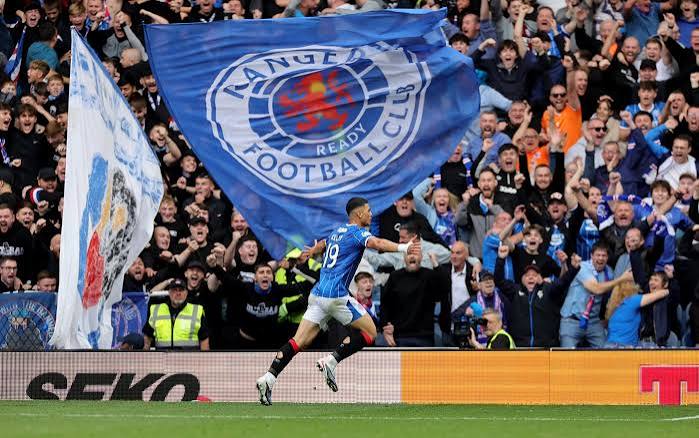
For a while now, Rangers have seemed almost committed to convincing the world they were a struggling football team. A miserable double European exit, a stuttering start to the Premiership season, and a manager facing genuine questions about his suitability for the job had combined to create an image of a club in crisis. On Sunday afternoon, in front of a bouncing, all-blue Ibrox, that pretence could no longer be maintained. Derek McInnes finally got the result his fledgling reign had been crying out for, and the manner of it — emphatic, controlled, and delivered against Celtic of all opponents — means far more to the direction of Rangers’ season than three points and a place in a cup semi-final ever could on their own.
An Opening Goal Worth the Wait
If there was a single moment that captured the shift in mood inside Ibrox, it came midway through the first half when Dan Neil rifled Rangers into the lead. The goal itself was a genuine thing of craft: James Penrice, pushed forward into an unfamiliar midfield role as part of McInnes’s tactical reshuffle, found Ryan Naderi with a pass down the left, and the German-Bulgarian forward did brilliantly to get in front of Cameron Carter-Vickers before slipping the ball into the path of Kevin Kelsy. What followed had the look of a passage of play that could have gone several ways — Kelsy squared to Neil, who still had plenty to do, and there was a passing thought that the Venezuelan might have been better served picking out Kim Min-su, unmarked to his right. Instead, Neil trusted his own technique, drilling a low, hard finish past the exposed Sam Johnstone from the edge of the box. It was a goal that, in isolation, looked like the work of a team playing with total conviction — a stark contrast to the hesitant, error-strewn version of Rangers that had characterised so much of the opening weeks of the season.
The goal arrived at a good moment tactically too. The game had not yet settled into any discernible pattern, but there was already mounting evidence that Celtic goalkeeper Sam Johnstone, deputising in just his second appearance for the club, was struggling to find his composure. Liam Scales had already been forced into a goal-line clearance after Johnstone came for a corner and failed to gather it, the ball dropping invitingly for Kim Min-su. Rangers had sensed blood in the water before Neil’s opener arrived, and once it did, the confidence flowing through the home side became increasingly visible with every passing minute.
Kelsy’s Turn, Then Neil’s Encore
Rangers doubled their advantage on the hour mark in a passage of play that showcased exactly the kind of interplay McInnes will have been demanding in training. Naderi’s headed flick from another Penrice delivery fell perfectly for Kelsy, who might have been forgiven for snatching at the chance given the significance of the occasion and his own difficult early weeks in Scottish football. Instead, he executed a genuinely difficult finish with real composure, guiding the ball inside Johnstone’s near post with a controlled near-post volley that briefly had to survive a VAR check for offside before the goal — and the celebrations — could be confirmed for a second time. For a player still finding his feet following a big-money summer move, there could hardly have been a more perfectly timed introduction to life as an Old Firm goalscorer.
Neil completed the rout with fifteen minutes remaining, again finding the target from the edge of the box after Carter-Vickers’s attempted clearance dropped invitingly into his path. It was a fitting way to bookend what had, by that point, become one of the most complete individual derby performances Ibrox has witnessed in years. When Neil was withdrawn with five minutes left to a standing ovation from the home support, there was little doubt about who had been the outstanding performer on the pitch — he had been confirmed as the sponsors’ man of the match unusually early, a small but telling detail given how well several of his teammates, Kelsy included, had also played.
The Weight Neil Has Been Carrying
There is a broader story behind Neil’s performance that deserves attention. Handed the captaincy in the enforced absence of the injured Lawrence Shankland, the 24-year-old — a detail worth restating given how much responsibility he has already shouldered in his short time in Scotland — has had to balance the burden of leading his teammates through a genuinely difficult opening period at the club with the separate challenge of adapting his own game to a new league and a new level of scrutiny. It has not always looked, in the words of one closely-watching observer, like life at Ibrox would come easily to him. Sunday’s performance put those doubts to bed in the most emphatic fashion imaginable, delivering not just two well-taken goals but a complete captain’s display that dictated the tempo of the biggest fixture of the season so far.
Naderi’s own contribution deserves recognition too, not least because his involvement in Sunday’s derby had been in doubt right up until matchday. It emerged afterwards that the forward had been a pre-match concern due to a dead leg, with McInnes later revealing he would have hated to see a player pull out of an Old Firm fixture over what was, in the end, a relatively minor complaint. Naderi assured his manager he was fit to play on the morning of the match, and he repaid that faith in spectacular fashion, playing a central role in the build-up to two of Rangers’ three goals. Elsewhere, Kim Min-su endured a torrid opening spell of his own, fluffing a series of set-piece deliveries early on, but recovered sufficiently as the match progressed to avoid becoming a talking point of the afternoon for the wrong reasons.
A Season That Had Been Crying Out for This
To understand why Sunday mattered so much, it is worth remembering exactly where Rangers’ season stood heading into the fixture. McInnes’s summer had been dominated by an extensive rebuild backed heavily by chairman Andrew Cavenagh, but results on the pitch had done little to reflect that investment. The club suffered elimination from Europa League qualifying at the hands of Jagiellonia Bialystok before an even more chastening exit from Conference League qualifying to Czech side Jablonec, a tie Rangers had led 1-0 from the first leg only to concede a stoppage-time-adjacent equaliser in normal time and ultimately lose on penalties after both Findlay Curtis and James Penrice missed from the spot. McInnes described himself afterwards as “mortified” and took full personal responsibility for a defeat one pundit branded an “all-time low” for the club, with question marks over his position mounting rapidly as Rangers found themselves without European group-stage football for the first time in almost a decade.
Domestic form offered only marginal reassurance in the immediate aftermath, with a stumbling start to the Premiership campaign doing little to ease the pressure. It has taken a run of four consecutive league wins — over unglamorous but nonetheless important opposition in Aberdeen, St Mirren and Falkirk among others — to begin steadying the ship, but as Sunday’s coverage made clear, one-goal margin victories over that calibre of opposition were never going to be enough to fully silence the doubts. This was, in the words of one assessment, “the big one” McInnes really wanted, and quite possibly the one he genuinely needed, given how precarious the mood around his tenure had become only a fortnight earlier.
A Ghost Finally Exorcised
There was a psychological dimension to Sunday’s victory that ran deeper than simply ending a poor run of European and domestic form. Rangers had gone three matches without victory in this specific fixture stretching back to March, when they infamously surrendered a two-goal lead at home to Celtic in a 2-2 draw that came to be remembered as a damaging missed opportunity rather than a battling comeback conceded. That result, layered on top of subsequent Old Firm disappointments, had begun to generate the kind of narrative every football club dreads — the suggestion that there was something approaching a mental block affecting Rangers specifically in this fixture, an inability to see out big moments against their fiercest rivals when it mattered most.
Sunday put those fears to rest in the most convincing manner possible. There was no repeat of the fragility that had crept into previous meetings, no hint of the nervous energy that had allowed Celtic back into games Rangers had previously appeared to have under control. Instead, this was described by more than one seasoned observer as among the most deserved and comprehensive Old Firm victories Rangers have produced in recent times — a performance built on relentless physical intensity, aggressive pressing, and a clear tactical identity that finally looked like the product of a settled, confident group of players rather than one still searching for its footing.
The Tifo That Set the Tone
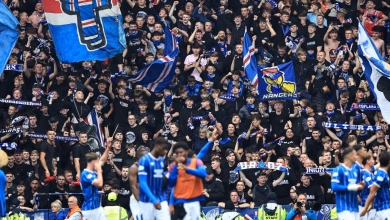
Even Rangers’ pre-match choreography seemed to sense the significance of the occasion. The home end unveiled an elaborate tifo depicting Ian Ferguson and Mike Galloway, two combative midfield figures synonymous with the fierce Old Firm battles of the 1990s, accompanied by the rallying message “Fight and never fear.” It was a fitting visual statement of intent from a fanbase desperate for their team to reclaim some of the aggression and physical dominance that had characterised Rangers’ most successful eras against Celtic, and on this occasion at least, the players on the pitch more than lived up to the message their own supporters had put up around them.
The atmosphere inside Ibrox reflected that same sense of pent-up anticipation finally being released. With away supporters absent under the ongoing league-wide ban stemming from the disorder that marred the corresponding fixture back in March, all 51,212 tickets for the maximum permitted capacity were occupied by home fans, and the noise generated was, by several accounts, genuinely deafening at points during the contest. There was some relief, too, that the pre-match anxieties over a repeat of previous trouble did not materialise — beyond a minor flashpoint on the far touchline in front of the Sandy Jardine Stand involving players rather than supporters, the afternoon passed without any of the disorder that has so dominated discussion of this fixture over the past six months.
McInnes Enjoys the Moment
For a manager who has cut a notably composed, understated figure during even his most difficult moments in charge, McInnes allowed himself a rare public display of celebration at full-time, briefly conducting the celebrating home crowd in the manner of a football manager finally able to enjoy a hard-earned release of tension. It was, by his own admittedly reserved standards, a fairly muted show of emotion compared to a lighter moment captured on camera midweek against St Mirren, when he was filmed clapping along good-naturedly to music playing over the stadium speakers while the game itself was still ongoing. Sunday’s celebration carried rather more weight given the context, and it will not have escaped notice among Rangers supporters that their manager, so recently under genuine pressure following the club’s European misfortunes, appeared to have been afforded something close to full forgiveness by full-time — with the notable and pointed exception, in the eyes of some, of the Jablonec debacle that continues to linger as an uncomfortable footnote to an otherwise improving campaign.
A Miserable Afternoon in the Away Dugout
At the opposite end of the emotional spectrum, Martin O’Neill endured one of the most chastening afternoons of his second spell in charge of Celtic. Almost nothing his side attempted came off, with Kasper Hogh’s most notable contribution reportedly being a simple pass back to Callum McGregor from the kick-off, and Benjamin Nygren at one stage misplacing a pass so badly that it ended up cannoning off an advertising hoarding rather than finding a teammate. O’Neill made an enforced change at the interval, introducing Haissem Hassan in place of Sebastian Tounekti, who it later emerged had experienced what his manager diplomatically described as a “little problem” overnight that ruled him out of the starting eleven. If anything, Celtic’s performance deteriorated further after the interval rather than improving, compounding what was already shaping up to be one of the most one-sided derby afternoons either club has experienced in recent memory.
McInnes’s Wider Reign in Context
It is worth stepping back to consider just how quickly the mood around McInnes’s Ibrox tenure has fluctuated across barely a month of football. His appointment in the summer arrived with a mandate to build on the previous season’s disappointments, backed by significant financial investment in a squad overhaul that touched almost every area of the pitch. Yet by the final week of August, that same rebuild was being described in some quarters as “struggling to get off the ground,” with the club’s early European exits prompting Sky Sports pundit Kris Boyd to brand the Jablonec defeat “embarrassing” and openly question where it left McInnes as a manager. At that point, McInnes had won just two of his opening seven games in charge, drawing two and losing three, and the pressure heading into a subsequent trip to face his old club Aberdeen in the league was already considerable.
What followed was a gradual rebuilding of both results and confidence rather than any single transformative moment prior to Sunday. Four consecutive Premiership wins, three of them built on defensive solidity rather than attacking flourish, provided the platform from which McInnes could approach the Celtic fixture with something resembling genuine conviction rather than simply hope. But as this newspaper and others noted repeatedly in the build-up, one-goal wins over Aberdeen, St Mirren and Falkirk — however valuable in accumulating points — were never going to be sufficient evidence on their own that the underlying problems exposed by the European exits had been properly addressed. Sunday’s performance, by contrast, offered something considerably more convincing: a display built on the same defensive principles that had underpinned the recent winning run, but married to a level of attacking intensity and quality that had been notably absent during the club’s difficult August.
A Fixture Rangers Had Started to Fear
The significance of ending that three-match winless run in this specific fixture cannot be overstated in the context of a club whose entire season, fairly or not, will often be judged disproportionately by results against Celtic. Old Firm form has a habit of taking on outsized psychological importance regardless of how either side is performing in all other competitions, and the manner of Rangers’ capitulation from two goals ahead back in March had left a discernible scar on the fanbase’s confidence heading into further meetings between the sides. Each subsequent Old Firm disappointment compounded that anxiety, to the point where, as one report bluntly put it, supporters had genuinely begun to wonder whether there was some deeper psychological issue at play whenever the two clubs met.
Sunday’s afternoon offered the clearest possible rebuttal to that theory. Far from wilting under the pressure of the occasion, as had so often been the pattern in recent meetings between the sides, Rangers played with a freedom and conviction that suggested a squad finally comfortable in its own identity under McInnes. Whether that transformation proves durable across the reverse fixture and beyond remains to be seen, but for one afternoon at least, the ghosts of previous Old Firm disappointments were laid convincingly to rest.
The Bigger Picture Heading Into Next Weekend
Whatever satisfaction Rangers and their supporters take from Sunday’s result, both the manager and his players will be acutely aware that the true test of whether this represents a genuine turning point, rather than a single, isolated afternoon of inspired form, comes immediately. The two sides meet again in the Scottish Premiership at Celtic Park next Sunday, with away fans once again banned from attending under the same arrangement that emptied Ibrox of Celtic support this weekend. Rangers will travel across Glasgow with, in the words of one assessment, their chests rightfully puffed out after such a dominant derby win — but doing so away from home, in front of a Celtic crowd desperate to see their side respond to Sunday’s humiliation, will represent an altogether different and considerably more difficult challenge.
For McInnes, the trick now is replicating Sunday’s intensity and conviction in a fixture where everything — home advantage, wounded pride, and the psychological urgency of a team that has just suffered its first domestic defeat of the season — will be stacked against his players. Few will bet against Rangers approaching that challenge with considerably more confidence than they could have mustered only a fortnight ago, but as McInnes himself knows better than most managers in Scottish football, the mood around Ibrox can shift rapidly depending on results. For now, though, Sunday’s afternoon belongs to Rangers, to Dan Neil, and to a supporter base finally given a genuine reason to believe that the corner may at last be turning under their new manager.