Martin O’Neill’s ‘shameful’ dig at RANGERS chants just exposed a dark secret that has fans calling for blood – the shocking truth will leave you speechless!


Sunday’s Premier Sports Cup quarter-final at Ibrox should, by rights, have been remembered purely as a footballing statement from Derek McInnes’s Rangers. A 3-0 win over Celtic, their fiercest rivals, in the first Old Firm derby of the season, McInnes’s first taste of the fixture as manager, and a performance good enough that even Martin O’Neill had little option but to admit his side had been comprehensively second best. That should have been the whole story. Instead, in the days since, the conversation has shifted towards something far less comfortable, after respected Scottish football columnist Graham Spiers used his platform to call out what he described as sectarian abuse directed at O’Neill from sections of the Ibrox crowd during the celebrations.
It’s worth being precise about what’s actually being reported here, because this is not a story about football tactics or refereeing decisions, and it deserves to be treated with the seriousness that subject matter demands rather than dressed up as another piece of matchday controversy. Spiers, writing in the aftermath of the game, stated plainly that in the midst of what he called a thoroughly deserved victory, Rangers supporters directed sectarian abuse towards O’Neill, a 74-year-old football manager who was simply standing in his technical area watching his team lose a derby by three clear goals. Spiers didn’t dress the language up or soften it. He described the treatment of O’Neill in blunt terms and made clear he saw it as entirely separate from the normal, acceptable heat of a Glasgow derby.
That distinction matters and is worth sitting with, because it’s the whole crux of the point Spiers was making. Nobody serious about Scottish football is arguing that Old Firm fixtures should be sanitised affairs, stripped of passion, needle or hostility between the two sets of supporters. Rangers had every right to celebrate a huge derby win. Their fans were entitled to enjoy seeing their biggest rivals knocked out of a cup competition, and giving an opposition manager stick from the stands, in the ordinary, universal sense that exists in football grounds everywhere, is simply part of the fabric of a fixture like this one. Spiers was explicit that he wasn’t objecting to any of that. What he was calling out was specifically sectarian in nature, a different and much darker category of abuse entirely, one that has a long, well-documented and deeply uncomfortable history in Scottish football specifically tied to this fixture, rooted in religious and sectarian division rather than ordinary footballing rivalry.
Spiers’ voice carries particular weight on this subject, and it’s worth explaining why, because his intervention wasn’t simply another pundit reaching for a hot take in the aftermath of a big result. He is, by his own long-stated background, a boyhood Rangers supporter, which matters here because it removes any easy dismissal of his comments as an outsider or a Celtic-aligned voice looking to score points against Rangers fans in the wake of a heavy derby defeat for their rivals. Spiers has also built a track record over many years of speaking out specifically about sectarianism connected to the Ibrox club, and by all accounts has done so at real personal cost, having faced considerable criticism and backlash from sections of the Rangers support on previous occasions when he’s raised similar concerns. That history lends his comments a credibility that a more casual or partisan observer simply wouldn’t carry. This isn’t someone parachuting into the conversation opportunistically after a defeat; it’s someone with a long, consistent and evidently uncomfortable public position on this exact issue, willing to keep raising it even when doing so brings him grief from within his own footballing community.
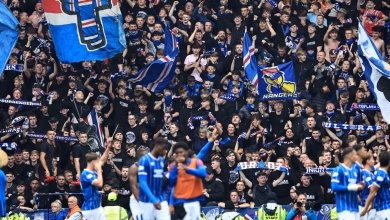
There’s also something particularly stark about the timing and circumstances Spiers highlighted in his comments. This abuse wasn’t reported as happening amid the frustration of a defeat, or in some tense, ill-tempered passage of play where emotions boiled over in the heat of competition. It came, as Spiers pointedly noted, during a celebration, in the middle of Rangers enjoying arguably their best afternoon of the season, comfortably beating their biggest rivals and sending them out of a cup competition in the process. That context is worth dwelling on because it complicates any suggestion that this kind of behaviour might be explained away as some kind of heat-of-the-moment reaction to a tense sporting occasion. A crowd celebrating a comprehensive, one-sided victory doesn’t have the same excuse of raw emotional volatility that might at least contextualise, even if not excuse, abuse hurled amid a controversial defeat or a moment of on-field conflict. Directing sectarian abuse at an opposition manager in the midst of a celebratory rout suggests something more embedded and habitual in parts of the support than a one-off emotional lapse.
None of this is a new conversation in Scottish football, and it would be dishonest to pretend otherwise. Sectarianism tied to the Old Firm fixture has been a persistent, well-documented issue for decades, addressed at various points by governing bodies, broadcasters, campaign groups and successive Scottish governments, none of whom have managed to eliminate it entirely from the terraces despite years of dedicated effort and various legislative attempts. It’s a conversation that resurfaces reliably around this fixture, often prompted by specific chants, specific incidents, or specific interventions like the one Spiers has made this week. That familiarity doesn’t make each fresh instance any less serious or any less worth calling out clearly when it happens, but it does mean this latest episode sits within a long and difficult institutional history rather than existing as some isolated, unprecedented event.
It’s also worth being honest about how this kind of story tends to get received depending on which club’s supporters are involved, because Spiers made a version of this exact point himself. There’s often a tendency, across football generally and certainly within the specific tribalism of the Old Firm rivalry, for conversations about supporter conduct to become instantly filtered through a partisan lens, with each set of fans quick to point out instances of bad behaviour from the other side while downplaying or contextualising equivalent behaviour from their own support. Spiers explicitly rejected that kind of selective framing in his comments, making clear that he saw no reason for this particular conversation to be softened, qualified or deflected simply because it was Rangers supporters and not Celtic ones being criticised on this occasion. Both Celtic being comprehensively outplayed and Rangers fans engaging in sectarian abuse can be true and worth stating plainly at the same time, without one fact being used to excuse or distract from the other, and that’s essentially the position Spiers took.
For Rangers as a football club, incidents like this create a genuinely difficult and recurring challenge, one that isn’t unique to Ibrox but that the club, like Celtic, has had to navigate repeatedly over the years. Clubs have limited direct control over what individual supporters chant or shout from the stands in the moment, and the vast majority of any large matchday crowd is not engaged in this kind of behaviour at all. But that reality doesn’t remove the responsibility clubs carry to take visible, consistent action when incidents are reported, whether through their own supporter conduct policies, cooperation with police investigations where relevant, or public condemnation when credible allegations are raised by informed observers like Spiers. How Rangers choose to respond, or decline to respond, to this specific set of comments in the coming days will likely be watched closely, both by their own supporters and by wider observers of Scottish football, given how publicly and specifically the allegation has now been made by a figure with Spiers’ standing and history on this subject.
There’s a broader footballing backdrop to all of this too, even though it’s very much secondary to the substance of Spiers’ comments. This was already a heavily charged fixture before a ball was kicked, arriving as the first Old Firm derby of the season and coming with no away fans permitted inside Ibrox at all, a direct consequence of the disorder that marred last season’s Scottish Cup quarter-final between the two sides, when fans from both clubs ended up on the pitch following Celtic’s penalty shootout win. That absence of away supporters was meant, at least in part, to reduce the risk of exactly the kind of ugly scenes that have periodically accompanied this fixture down the years. It’s a pointed irony, then, that even with Celtic’s own fans locked out of the ground entirely, this latest controversy has emerged not from any confrontation between rival sets of supporters but from abuse directed by home fans at an opposition manager standing alone in his technical area. It’s a reminder that removing away fans from a fixture, however well-intentioned as a crowd-safety measure, does nothing in itself to address underlying issues within a home support if those issues genuinely exist.
O’Neill himself, for what it’s worth, has not been reported making any public comment specifically addressing this incident in the aftermath of the game. His own public remarks in the days since the defeat have been focused squarely on football, taking a fairly firm line with journalists pushing a narrative about Celtic’s mentality, insisting instead that Sunday’s result came down to basic technical failings, too many misplaced passes under pressure, rather than any deeper psychological issue within his squad. He’s also spoken about the fixture’s history from his own long experience of it, recalling a heavy defeat from decades earlier during a previous spell in Scottish football and drawing on that memory as a lesson in resilience for his current group ahead of the return fixture at Celtic Park next weekend. Whether he addresses the sectarian abuse allegation directly himself, either in a press conference or through the club, remains to be seen, but managers on the receiving end of this kind of treatment don’t always choose to give it further oxygen publicly, sometimes preferring to let others, like Spiers, do the calling out while they keep their own focus fixed on football matters.
What happens next is genuinely hard to predict with any certainty. Incidents like this sometimes prompt formal responses, whether from the clubs themselves, the Scottish FA, police authorities if any specific chants or behaviour meet the threshold for investigation, or wider campaign groups working on sectarianism in Scottish football. Other times, in the absence of video or audio evidence specific enough to act on, they generate exactly this kind of media conversation and public reckoning without any formal consequence following at all, fading from the news cycle once a fresh story takes over. Given how quickly Scottish football moves from one talking point to the next, and with Celtic already turning attention towards a midweek fixture before hosting Rangers in the Premiership next Sunday, there’s a real risk this conversation gets crowded out relatively quickly by pure football matters, results, team news and the usual rhythm of a season, however serious the underlying issue Spiers has raised.
That would be a shame, because voices like Spiers’, speaking from within the Rangers-supporting community itself and with a long, consistent history on this exact issue, are precisely the kind of internal accountability that tends to carry more weight and provoke more genuine reflection than criticism arriving from outside a club’s own fanbase. Whether that reflection actually translates into any meaningful change in matchday conduct at Ibrox going forward is impossible to say from the outside, and Scottish football’s history on this particular issue doesn’t offer much reason for optimism that a single column, however pointed, changes deeply embedded behaviour among a small but persistent section of any club’s support. But raising it clearly, without qualification or deflection, is at minimum a necessary first step, and Spiers deserves credit for doing exactly that in the full glow of what was otherwise one of Rangers’ best afternoons of the season