Rangers’ starting 11 vs Celtic predicted and the one major question mark for McInnes


Sunday’s trip to Parkhead arrives with almost as many selection uncertainties as storylines swirling around it, and Derek McInnes will have decisions to make that go well beyond simply naming the same eleven that thumped Celtic 3-0 last weekend. Picking a Rangers side for this fixture is, in the words of those closest to the squad this week, “a tricky business” — not because Rangers lack options, but because two separate fitness question marks have emerged in the days since that cup win, and neither has been fully resolved heading into kick-off.
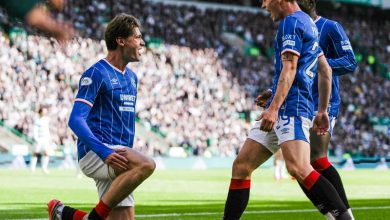
Rangers travel to Celtic Park on the back of one of the most complete derby performances the club has produced in years. Dan Neil struck twice and Kevin Kelsy added a third as Rangers dismantled their rivals in last Sunday’s Premier Sports Cup quarter-final at Ibrox, a result that sent Rangers through to the last four of that competition and, more importantly for McInnes personally, delivered his first meaningful piece of silverware pathway momentum since taking the job. The manner of the win — aggression, discipline, and clinical finishing, according to those who watched it closely — has completely reshaped the mood around Ibrox after a difficult start to his tenure that included failing to win either of his first two league matches in charge and suffering unexpectedly early European exits against Jagiellonia Białystok and, on penalties, Jablonec.
Since those low points, Rangers have won four straight league games, closing what was once a much larger gap to Celtic in the Premiership table down to five points. Celtic, meanwhile, arrive at Sunday’s rematch off the back of a considerably tougher week: a 3-1 Europa League defeat away to Ferencvaros on Thursday means Martin O’Neill’s side head into the second Old Firm meeting of the season having lost three genuinely significant fixtures already this campaign — including the second leg of a Champions League play-off in Linz — conceding 11 goals across those three matches. It’s an unusually bruising run for a team that still sits top of the Premiership on 18 points from six games.
On paper, the simplest and most defensible selection call for McInnes would be to simply pick the same team that started at Ibrox last weekend. Rangers won convincingly, the shape worked, and there’s an obvious managerial logic in not tinkering with a winning formula, especially against the same opponent just seven days later. As has been noted by those close to the squad, if everyone were fit and available, there would be a sound case for exactly that approach.
The trouble is that “everyone fit and available” is precisely the condition Rangers can’t currently guarantee. Two separate issues have emerged since last weekend’s win, and together they inject real uncertainty into what would otherwise be a straightforward selection exercise.
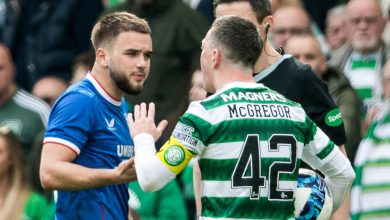
The headline concern remains Ryan Naderi, whose punishing weekend didn’t end when the final whistle blew at Ibrox. The German-Bulgarian forward was caught late and high by Celtic’s Mika Baur in the 64th minute of last week’s game, a challenge that saw the free-kick controversially awarded against Naderi rather than in his favour, despite replays suggesting he had won the ball first. Naderi tried to continue but was withdrawn not long afterwards, and the full picture of the damage became clear as the week progressed.
McInnes has since described the striker’s ankle as being “a mess,” language blunt enough to make clear this isn’t a knock that can simply be strapped up and played through. Given that description, the expectation among those tracking Rangers’ build-up is that Naderi is unlikely to start even if he’s ultimately cleared to be involved in some capacity from the bench. That’s a significant blow: with Lawrence Shankland already sidelined by a hamstring problem requiring surgery, and Youssef Chermiti ruled out for the season with a ruptured ACL, Naderi has been Rangers’ most consistent attacking focal point over the past several weeks, and replacing his combination of work-rate, physicality, and finishing isn’t a straightforward swap.
The situation has been complicated further by the fact that the incident that caused the injury has become a genuine off-field story in its own right. Rangers chief executive Jim Gillespie has been in contact with SFA head of referee operations Willie Collum specifically over the Baur challenge, with McInnes admitting he wasn’t happy the incident went unreviewed. That backdrop means Sunday’s fixture carries an added layer of tension even before a ball is kicked — Rangers effectively playing at the ground of the club whose player they believe caused a significant injury to their most in-form forward, with the governing body’s handling of the incident still an open question.
**Issue two: the mystery second doubt**
If Naderi’s situation is at least reasonably well understood, the second fitness concern is anything but. McInnes has confirmed that a further, unnamed player is “a wee bit of a doubt” for Sunday, but chose not to reveal who after Rangers’ final training session on Saturday. That deliberate vagueness — whether a genuine reflection of a late fitness call still being made, or a touch of pre-derby gamesmanship designed to deny Celtic any specific tactical information — leaves selection-watchers guessing right up until the team sheets are confirmed.
It’s worth noting that this isn’t the only fitness subplot bubbling under the surface at Ibrox this week. Rangers’ wider injury list remains lengthy: alongside Shankland and Chermiti, Tuur Rommens continues to be sidelined by a groin issue, Daisuke Yokota is working his way back from groin surgery, and further knocks affecting Johnston, Emenalo and Osmand round out a squad that, while performing well collectively, isn’t short of individual absentees. Whether the unnamed “second doubt” comes from within that existing group or represents a fresh concern altogether is one of the more frustrating unknowns heading into derby day.
Assuming Naderi is left out of the starting XI, as currently expected, the most likely consequence is a shift away from the two-striker approach that worked so effectively in the cup tie. Rather than replicate that shape without their most physical presence, the expectation is that McInnes will move Kevin Kelsy into a more central, lone-striker role, flanked by Djeidi Gassama and Kim Min-su, both tasked with progressing possession into the final third and supporting Kelsy rather than operating as auxiliary strikers themselves.
Kelsy’s own situation adds intrigue here. Signed for a reported £9million from Portland Timbers on transfer deadline day, he made his first Rangers start in last weekend’s cup win and scored to complete the 3-0 scoreline — but that goal came off the bench rather than from the start, and doubts remain about how ready he is to lead the line unsupported against a Celtic defence that will be desperate to atone for last week’s showing. If Kelsy is asked to do exactly that on Sunday, it represents a significant step up in responsibility for a player who has barely had time to settle into Scottish football.
On the flanks, one of the more interesting selection debates concerns the right-hand side of Rangers’ attack. Badredine Bouanani, on loan from Stuttgart, has shown flashes of the kind of technical quality that could unlock a well-organised Celtic backline, and there’s clearly a case — and a “clamour,” according to those close to the squad — for starting him. Against that, Findlay Curtis offers something more dependable in terms of tracking back and contributing defensively, a quality that may carry extra weight away from home in a fixture where Celtic’s home support will be looking to overwhelm Rangers from the opening whistle. Which of the two starts may end up being the single clearest indicator of whether McInnes is setting his team up primarily to attack or primarily to contain.
Defensively, the expectation is for Rangers to set up in a more conventional back four rather than repeating the hybrid system that saw James Penrice operate in a quasi-midfield role during last weekend’s win. That earlier selection decision had actually drawn some criticism in the build-up to the Ibrox game, before the 3-0 scoreline emphatically silenced any doubters. Reverting to a more orthodox setup at Parkhead reflects both the different demands of an away fixture and, potentially, a desire for greater defensive solidity given the uncertainty already introduced by the two attacking doubts.
Centre-back Olwethu Makhanya, whose form since arriving from Philadelphia Union for a modest £3million has been one of the more eye-catching stories of Rangers’ season, looks set to continue in the heart of the defence alongside Emmanuel Fernandez, with the pairing having anchored a defensive record that’s improved sharply over recent weeks — Rangers had shipped six goals in their opening four games of the season before this pairing began working together regularly. Full-back positions remain subject to the fitness of Tuur Rommens, whose groin issue may again open the door for Penrice to deputise at left-back in a more traditional role this time, while James Tavernier or Ridvan Yilmaz-type options continue to rotate on the opposite flank depending on fitness and form.
If there’s one area of the pitch where continuity looks close to guaranteed regardless of the other selection dilemmas, it’s central midfield. Dan Neil and Nicolas Raskin have rapidly built what’s been described as a genuinely solid understanding in the middle of the park, and their combined effort in bullying Celtic’s midfield during last weekend’s win was central to Rangers’ dominance of the game’s territorial battle. Both look set to continue in those roles at Parkhead, tasked with repeating that same physical and technical superiority against a Celtic midfield that will be desperate to reassert control after being so comprehensively outplayed there just a week earlier.
There’s also a suggestion that, even accounting for the uncertainty around his involvement, Naderi’s mobility and defensive work rate could see him utilised in a deeper role if he is deemed fit enough to feature at all — dropping in alongside Neil and Raskin to add an extra body in midfield rather than leading the line, a compromise that would allow Rangers to have his contribution available without asking an ankle described as “a mess” to withstand the rigours of a central striking role in a hostile away derby.
Beyond the eleven individual names on the team sheet, it’s worth remembering just how much is riding on Sunday’s result. A Rangers win would move McInnes’s side to within two points of Celtic in the Premiership table after seven matches — an extraordinary turnaround given where his tenure stood only a matter of weeks ago — and would represent a first double over Celtic in his short time in charge, a result that would go a long way toward cementing his position after such a shaky start. A Celtic win, by contrast, would push the gap back out to eight points and pile fresh, uncomfortable pressure back onto O’Neill after what’s already been described as a genuinely difficult week for his side.
The atmosphere adds a further dimension. As with last weekend’s cup tie, there will be no travelling Rangers support inside Celtic Park, with away fans absent from Old Firm fixtures for the remainder of the season amid an ongoing ticket allocation dispute between the clubs. That means Rangers will be asked to deliver another composed, controlled performance entirely on hostile territory, without the visible and audible reassurance of their own support inside the stadium — a test that, according to McInnes himself, will likely require “a bit more” from his players than what got the job done at Ibrox.
Historical context only sharpens the stakes further. Excluding penalty shootouts, Celtic have won only two of the last eleven Old Firm derbies, a striking underlying trend given they had claimed victory in eight of the previous ten meetings before that run began — evidence, on the numbers alone, of a fixture that has swung markedly in Rangers’ favour in recent times, even through periods when Celtic have otherwise dominated domestically
Ultimately, whatever names end up on the team sheet, the underlying managerial approach seems unlikely to change dramatically. Martin O’Neill himself, when asked whether he expected Rangers to largely repeat the approach that worked so well last weekend, put it simply: there’s little reason for a manager to change a winning formula. That expectation from the opposition dugout lines up closely with what those closest to the Rangers squad are predicting — McInnes setting his team out with the clear intention of winning the game outright and pressing home the advantage of what currently looks like a vulnerable moment for Celtic, rather than approaching Parkhead cautiously simply because of the away-day setting.
Whether that means the exact same starting eleven as last weekend, or a reshaped front line built around Kelsy as a lone striker with Naderi withdrawn to the bench or missing out entirely, may not become clear until team sheets are exchanged shortly before kick-off. What does seem clear, based on everything said publicly by both McInnes and those around the squad this week, is the underlying intent: Rangers arrive at Parkhead not to protect a result from a week ago, but to try to extend it into a genuine early-season statement — a first double over Celtic that would mark the clearest possible sign yet that McInnes’s rocky start to life at Ibrox is now a thing of the past.