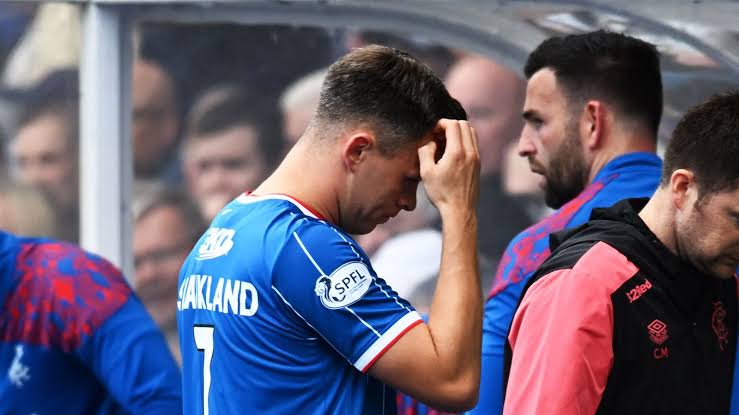
Rangers have been dealt one of the more damaging fitness blows of their season, with manager Derek McInnes confirming that captain Lawrence Shankland will be sidelined for up to four months after suffering a hamstring tear. The timing, following what had finally looked like a turning point in the striker’s form, has been described by pundits as a “massive” setback — both for Shankland personally and for a Rangers side only just beginning to find consistency after a turbulent start to the campaign.
Shankland was forced off early during Rangers’ 1-0 win over Motherwell, with Naderi coming on to score the game’s only goal after capitalising on an error from Motherwell goalkeeper Alex Paulsen. It wasn’t immediately clear on the day how serious the issue was, but scans in the days that followed confirmed a tear, with McInnes telling reporters ahead of Wednesday’s match against St Mirren that the best-case recovery timeline was around three months, with four months representing the more pessimistic estimate. Given the severity of the tear, McInnes also indicated that surgery is likely to be required to aid the recovery process, a detail that further extends the uncertainty around exactly when the captain might return to first-team action.
The injury carries international consequences as well as club ones. Shankland’s spell on the sidelines will rule him out of Scotland’s upcoming Nations League fixtures, costing him the opportunity to make an early impression on new national team boss Sebastien Pocognoli during the Belgian’s first matches in interim charge. That’s a particularly frustrating blow given Shankland’s standing within the national set-up: he was part of Scotland’s squad at the recent World Cup, continuing a run of form at international level that had made him one of the more dependable figures in the Tartan Army’s forward line in recent years.
What makes the timing especially painful for both player and club is that Shankland had only just rediscovered his scoring touch in a Rangers shirt after a difficult opening period following his move from Hearts. He found the net in back-to-back Premiership victories over Aberdeen and Falkirk immediately before the Motherwell injury, contributions that had been central to two hard-fought wins and had started to ease some of the broader concerns about Rangers’ sluggish start under McInnes. Those goals had arrived at a moment when McInnes himself had come under considerable public scrutiny, following results that saw him fail to win either of his opening two league matches in the role, before enduring further embarrassment in Europe with exits at the hands of Jagiellonia Białystok and, on penalties, Jablonec.
Against that backdrop, Shankland’s return to form wasn’t just a personal milestone — it was read by many as a sign that Rangers’ season, and McInnes’s early tenure specifically, might finally be turning a corner. Saturday’s win over Motherwell, in isolation, did little to dispel concerns about the team’s cutting edge: Rangers managed only a single goal from an expected-goals reading of 4.28, a statistic suggesting they created more than enough opportunities to have won more comfortably but struggled to convert them without their most reliable finisher on the pitch for the full ninety minutes. That underlying numbers gap is likely to be repeated, and possibly worsened, across the coming months without Shankland available to convert the chances Rangers’ improved play has increasingly been generating.
Shankland’s injury doesn’t arrive in isolation — it compounds a forward-line crisis that had already been building at Ibrox. Youssef Chermiti, another of Rangers’ key attacking options, is already ruled out for the remainder of the season having suffered anterior cruciate ligament damage in a match against Hibernian last month. That injury alone had already forced Rangers into the transfer market mid-season, resulting in a reported £9million move for Venezuelan international Kevin Kelsy from Portland Timbers — a deal struck specifically to offset the loss of Chermiti’s goal threat.
With Shankland now added to the injury list alongside Chermiti, Rangers find themselves without both of the strikers who might reasonably have been considered their first-choice pairing heading into the season, leaving Kelsy as the most senior recognised forward option available to McInnes in the short-to-medium term. That’s a significant weight to place on a player who arrived via a mid-season transfer and has had minimal time to adapt to Scottish football, a new club, and an unfamiliar style of play. Former Rangers goalkeeper Cammy Bell, speaking on the BBC’s Scottish Football Podcast, was candid about the scale of the challenge now facing Kelsy, noting that his underlying scoring numbers — 13 goals across his last 46 appearances before his move, working out at roughly one goal every 190 minutes — suggest Rangers may not have signed an out-and-out, prolific finisher in the mould of the player he’s now being asked to replace. Bell added that the club would ideally have preferred to give Kelsy time to settle into Scottish football and life at Ibrox before being thrust into a leading role, but that circumstances have now made that a luxury Rangers can’t afford; as Bell put it, Kelsy is likely to be the one who has to “step up to the plate,” given that Shankland can no longer be relied upon in the interim.
Former Rangers midfielder Andy Halliday, working on BBC Sportsound, offered a similarly pointed assessment of what’s been lost, suggesting that had Shankland remained on the pitch throughout the Motherwell game, he would likely have added further goals to his tally given the pattern of Rangers’ chance creation that day — an observation that speaks to just how influential the captain’s movement and composure in front of goal have become for the side since he found his scoring touch.
The bad news didn’t end with Shankland. Winger Daisuke Yokota, who had come on as a substitute during the Motherwell win, will also miss Rangers’ following match against St Mirren due to a groin injury — meaning McInnes heads into that fixture without two of the attacking players who featured most recently in a winning side. It’s a reminder that Rangers’ squad depth, while bolstered by the mid-season Kelsy signing, remains stretched thin in specific areas, particularly further forward, where injuries to Shankland, Chermiti, and now Yokota leave the manager with a genuinely reduced pool of attacking talent to call upon.
There was, at least, a rare piece of positive fitness news elsewhere in the squad. Left-back Tuur Rommens, who has been out of contention for some time, returned to training in the same week and is expected to be available for selection again later in the month — a small mitigating factor for McInnes as he otherwise contends with a lengthening list of attacking absentees.
To fully appreciate why this injury has been described in such stark terms by those close to the club, it’s worth setting Shankland’s importance in a wider context. His move to Rangers had been framed, at the time it was completed, as a genuinely significant piece of business — a proven, prolific domestic goalscorer with a track record of decisive contributions in big matches, arriving to solve exactly the kind of finishing problem that had dogged the club in previous seasons. That signing had been talked up as potentially “huge” for Rangers’ ambitions under McInnes, given the expectation that Shankland would play a central role in the team’s attacking approach.
For much of the opening weeks of the season, that promise had gone largely unfulfilled, with Shankland, like the team more broadly, taking time to find his feet. The goals against Aberdeen and Falkirk represented the first real signs that the £3-4 million-plus outlay on bringing him to Ibrox (structured, as with several of Rangers’ recent signings, to represent value relative to his output) was starting to pay off. Losing him to a serious injury at precisely the moment that investment appeared to be bearing fruit is, by any measure, an unwelcome development for a club still trying to establish momentum under a new manager.
It also arrives at an awkward juncture in terms of squad-building strategy more broadly. Rangers’ recruitment approach this season — visible in moves for players like Olwethu Makhanya and Emmanuel Fernandez at the back, each arriving for modest fees before delivering outsized defensive contributions — has generally been built around identifying value in less obvious markets and trusting individual quality to shine through once given first-team opportunities. Shankland’s arrival, while considerably more orthodox in profile than those defensive gambles, was intended to provide the more reliable, proven goal threat that a value-driven recruitment model doesn’t always guarantee. His injury undercuts exactly that intention at the worst possible moment, right as his form had started to validate the decision to bring him in.
In practical terms, McInnes now faces a genuinely difficult few months of squad management. With Shankland ruled out for a period that could stretch as far as four months, and with surgery potentially adding further delay to his rehabilitation, Rangers are effectively looking at a return date somewhere between late in the calendar year and the turn of the new one — a period that will encompass a heavy run of fixtures across the Premiership, cup competitions, and continental football.
The most immediate consequence is likely to be reduced attacking output in the short term, particularly given the underlying expected-goals numbers from the Motherwell match suggesting Rangers are creating opportunities faster than they’re currently able to convert them without their most clinical finisher on the pitch. Kelsy’s transition into a lead striking role, thrust upon him earlier than either he or the club would have preferred, becomes the most pressing subplot of Rangers’ coming weeks. Whether he can adapt quickly enough to Scottish football’s physical demands and the increased goalscoring burden now falling on his shoulders may end up being the single biggest factor determining how much ground, if any, Rangers lose in both the Premiership table and any cup ambitions during Shankland’s absence.
There is also a broader squad management question for McInnes to address: with Chermiti already gone for the season and Shankland now facing a lengthy layoff, does Rangers’ hierarchy look to bolster the striking department further in the January transfer window, assuming suitable options and finances allow? Given the club’s evident willingness to move quickly in the market when injuries have struck already this season — as shown by the swift £9million capture of Kelsy following Chermiti’s injury — it wouldn’t be a surprise if January brings further activity specifically targeted at addressing the same problem, particularly if Kelsy’s early performances in a lone central role suggest the position needs additional reinforcement rather than simply patience
For a Rangers side that has shown signs of finding its feet after a rocky opening to McInnes’s tenure, the Shankland injury represents perhaps the sternest test yet of just how resilient that improvement really is. Results built partly on goals from a captain rediscovering his best form are inherently more fragile than those built on broader team performance, and the coming months will reveal whether Rangers’ recent progress reflects genuine structural improvement under McInnes or was, in part, propped up by one player’s timely return to scoring ways.
What’s clear, in the immediate aftermath of the news, is that this is a significant setback rather than a minor inconvenience. A club captain, an established international, and — by his own recent form — arguably Rangers’ most reliable source of goals is now unavailable for a period that could extend deep into the season’s most congested and consequential fixture list. How McInnes navigates the gap he leaves behind, and whether Kelsy and the rest of the forward line can compensate in the interim, may end up shaping the entire complexion of Rangers’ campaign well before Shankland is fit to return.