Football’s oldest and most combustible rivalry produced yet another dark chapter in March, when a Scottish Cup quarter-final between Rangers and Celtic at Ibrox ended not with a simple celebration or commiseration, but with supporters fighting on the pitch, a member of Celtic’s backroom staff attacked, a player pushed, and a governing body launching a formal investigation. What follows is an account of exactly what happened, how both clubs and the authorities responded, and the deeper context that explains why a routine cup tie could spiral so quickly into disorder
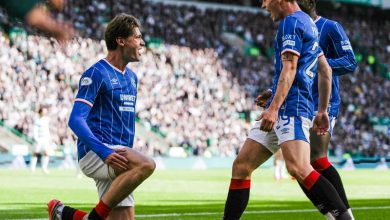
On the pitch, the match itself had been a tight, tense affair typical of fixtures between these two sides. Ninety minutes plus extra time produced no goals, sending the tie to a penalty shootout in front of a sold-out Ibrox crowd that included a 7,500-strong away allocation housed in the Broomloan Stand — itself a notable detail, given the return of away fans in full capacity to that section of the ground for this fixture. Celtic ultimately prevailed 4-2 on penalties, securing their place in the next round of the Scottish Cup and sending their travelling support into understandably ecstatic celebration.
It’s worth stressing that nothing about the atmosphere before or during normal play suggested the scenes that would follow. This was, by most accounts, simply a hard-fought, cagey derby that had gone all the way to spot-kicks — the kind of dramatic conclusion that would ordinarily be remembered for its sporting tension rather than for what happened once the football itself had finished.
The trouble began in the moments immediately after Celtic’s shootout victory was confirmed. Jubilant away supporters spilled onto the Ibrox turf to celebrate with their players — a scene that, in isolation, is not unusual in football, where pitch invasions following significant results, while against ground regulations, are often more chaotic than genuinely dangerous. What happened next at Ibrox, however, escalated well beyond that familiar pattern.
As Celtic’s players and supporters celebrated on the pitch, large numbers of Rangers fans breached stewarding and barrier lines to confront them directly. What followed was described by multiple outlets as fans throwing missiles and fireworks at one another and continuing to exchange physical blows even once police and stewards had managed to form a human barrier across the width of the pitch in an attempt to separate the two groups and restore control. It took a sustained effort from law enforcement and stadium staff to fully clear the playing surface and bring the situation back under control.
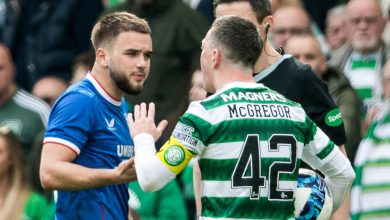
The disorder was not confined to anonymous clashes between opposing sets of fans. In one of the more serious individual incidents, Celtic defender Julian Araujo was pushed by a Rangers supporter amid the chaos. Separately, and more seriously still, a member of Celtic’s backroom staff was physically attacked during the disorder, prompting several Celtic first-team players to run toward the scene to intervene. Among them was forward Tomas Cvancara, who was later interviewed on television still wearing his kit, visibly marked with bloodstains from his involvement in the incident — a detail that, more than almost anything else from the day, crystallised just how far the situation had escalated beyond a standard, if unwelcome, pitch invasion.
Police confirmed that a man was apprehended in connection with the incident involving the Celtic staff member, one of a number of arrests made in the immediate aftermath of the match as officers worked to identify and detain those responsible for the worst of the violence
The scale of the disorder prompted swift and unambiguous condemnation from the game’s authorities. The Scottish Football Association confirmed it would launch a formal investigation into the incidents, to be carried out in line with its Judicial Panel Protocol — the established disciplinary mechanism used to examine serious breaches of conduct connected to Scottish football matches. In its initial statement, the SFA specifically condemned what it termed the “behaviour from supporters entering the field of play,” making clear that action against those responsible, and potentially against the clubs themselves depending on the investigation’s findings, would follow.
Police Scotland’s response was similarly direct. Chief Superintendent Kate Stephen, addressing the scenes publicly in the aftermath, described the behaviour of a number of supporters at the fixture as “shameful,” stating plainly that it needed to be condemned by everyone connected to football and by wider society more broadly. She confirmed that a number of arrests had already been made in the hours following the match, and that Police Scotland would continue working closely with both clubs and the Scottish FA to conduct what she described as a robust investigation into everything that had occurred on the pitch at the conclusion of the fixture.
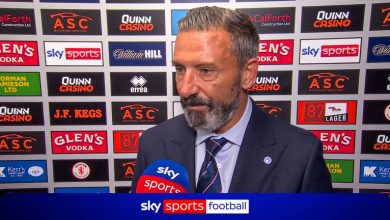
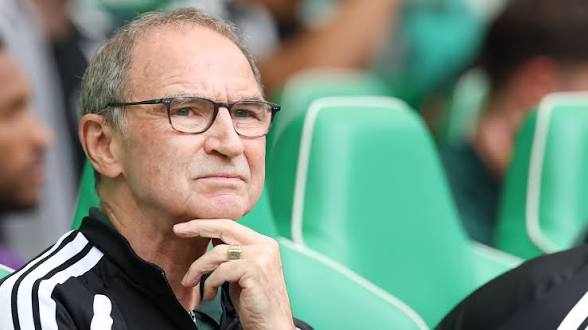
In the immediate, still-raw aftermath of the match, the two managers offered noticeably different accounts of what they had witnessed and how they intended to respond. Celtic boss Martin O’Neill, whose side had just won the tie, didn’t attempt to minimise the seriousness of what had happened. Speaking shortly after the final whistle, he acknowledged that fans had “spilled over” into what he called “big scenes” that had occurred “all over the place” around the stadium. Crucially, he was careful to state explicitly that he wasn’t seeking to diminish the seriousness of the incident in any way, adding that he intended to reflect further on what had happened before offering fuller comment in due course — a measured response that avoided inflaming an already tense situation while still acknowledging the gravity of events.
Rangers head coach Danny Rohl, by contrast, gave an account suggesting he had personally witnessed comparatively little of the worst disorder. Speaking to Premier Sports shortly after the pitch had been cleared, Rohl explained that he had exited the dugout quickly once the shootout concluded, heading straight down the tunnel, and as a result wasn’t entirely sure what had occurred on the pitch behind him in the aftermath. It’s a response that reflects the fairly common reality of a football match’s technical area during a chaotic post-match scene — managers and coaching staff are often among the first to leave the immediate vicinity of the pitch, and Rohl’s account suggests he was simply not positioned to observe the worst of what unfolded once he’d made his way back toward the dressing rooms.
In the days that followed the match, Rangers moved to address the situation formally through an official club statement — a response that went considerably further than a simple expression of regret. The statement confirmed that the club had spent the intervening days in discussions with its own staff, supporter groups, and the relevant external authorities, and pledged to continue working closely with Police Scotland, Glasgow City Council, the Scottish FA, and the Safety Advisory Group responsible for overseeing matchday security arrangements at Ibrox.
Most strikingly, the statement addressed a specific and deeply sensitive allegation that had surfaced in the aftermath of the disorder: reports that some supporters present at the match had mocked the Ibrox disaster of 1971 during the chaotic scenes. That disaster, in which 66 supporters lost their lives in a crush on stairway 13 at the stadium following an Old Firm match, remains one of the most painful chapters in the club’s history and in the history of British football safety more broadly, directly contributing to the wider safety reforms that reshaped stadium design and crowd management across the sport in the decades that followed. Rangers described themselves as left “appalled” by reports of such mockery occurring at their own ground, language that reflects both the gravity of the specific allegation and the club’s evident determination to distance itself from any suggestion of tolerating that kind of behaviour among even a small minority of its support.
Rangers went further still, explicitly calling for an independent review into the issues that had led to the disorder — a request that goes beyond the SFA’s own Judicial Panel Protocol investigation and suggests the club itself recognises that deeper structural or operational failings may have contributed to how the situation was allowed to escalate as far as it did. Such a review would presumably examine stewarding numbers and positioning, segregation arrangements between home and away supporters, the adequacy of barriers and fencing around the pitch perimeter, and the speed and effectiveness of the response once trouble first began.
None of this occurred entirely without historical context. The Old Firm is among the oldest football rivalries in the world, with the two clubs’ first meeting dating all the way back to 1888. Over more than a century of derbies, the fixture has come to be shaped as much by the deep political and religious divisions running through Glasgow and Scottish society more broadly as by footballing rivalry alone — a dynamic that has, at various points across its long history, spilled over into serious disorder among supporters, on top of the periodic flashpoints on the pitch itself.
It’s also a rivalry that has already been the subject of serious safety scrutiny once before, and the timing of allegations regarding mockery of the 1971 disaster makes that history impossible to ignore. The Ibrox disaster remains a defining moment not just for Rangers as a club, but for stadium safety standards across British football, and any suggestion that supporters might use that tragedy as a taunt during a moment of celebration or confrontation strikes at something considerably more serious than ordinary football rivalry or banter, however heated.
Set against that backdrop, the events of this particular Scottish Cup quarter-final represent a genuinely serious episode rather than a routine, if regrettable, pitch invasion of the kind football has periodically seen in celebratory circumstances elsewhere. The combination of an attack on a backroom staff member, a player being physically confronted, missiles and fireworks being exchanged between rival groups, and allegations of disaster-related mockery collectively pushed this incident into territory that both clubs and the sport’s governing bodies clearly recognised demanded a formal, structured response rather than a simple statement of regret.
As things stand, the situation remains under active investigation on multiple fronts. The Scottish FA’s Judicial Panel Protocol process will examine the conduct of those involved and could, depending on its findings, result in sanctions against individuals identified through video evidence and police cooperation, and potentially against the clubs themselves if failures in stewarding or crowd management are found to have contributed to the scale of the disorder. Police Scotland’s own investigation continues in parallel, working through evidence gathered on the day, including footage from the match broadcast and from supporters and bystanders, to identify further individuals responsible for specific acts of violence, including the attack on Celtic’s staff member and the confrontation involving Julian Araujo.
Rangers’ call for an independent review, meanwhile, suggests the club anticipates a broader set of recommendations may be needed beyond whatever sanctions emerge from the SFA’s disciplinary process — potentially covering physical security infrastructure at Ibrox, segregation policy for future Old Firm fixtures, and stewarding protocols specifically designed to prevent home supporters from being able to breach barriers and reach the pitch in the way that occurred on this occasion.
For a rivalry already carrying the weight of more than 130 years of history, and a stadium carrying the memory of one of football’s gravest tragedies, the events of this Scottish Cup quarter-final serve as an uncomfortable reminder that, for all the genuine sporting drama the Old Firm regularly produces, the fixture’s capacity to descend into serious disorder has not been eliminated by modern stewarding, segregation, and policing measures. Both clubs, along with the SFA and Police Scotland, have said their respective investigations into the day’s events remain ongoing, with further details expected as those processes conclude in the weeks ahead.