McInnes and Fotheringham clash on the touchline as Rangers complete Old Firm double

Football matches are rarely remembered solely for what happens on the pitch, and Sunday’s Old Firm derby at Celtic Park will be no exception. Alongside Ryan Naderi’s decisive first-half goal and Rangers’ second win over Celtic in the space of a week, the abiding image from this fixture may end up being a considerably more heated one: Derek McInnes and Celtic assistant Mark Fotheringham, locked in an animated shouting match on the touchline, both shown yellow cards by referee John Beaton before the game had even reached the ten-minute mark.
It’s the kind of moment that tends to generate outsized reaction on social media, where framing quickly escalates — “disgusting scenes,” claims of managers “losing control,” suggestions of a genuine “fight.” The reality, as with so much Old Firm-adjacent content that circulates in the hours after a derby, is a good deal less dramatic than the most sensational framing suggests, even if it’s a genuinely interesting story in its own right.
The flashpoint arrived early, in the fourth minute of the match, and it began with an incident on the pitch rather than a pre-existing grievance between the two coaches. Emmanuel Fernandez, Rangers’ young centre-back who has enjoyed a breakout campaign since his own modest-fee arrival at Ibrox, was shown a yellow card by referee John Beaton for cynically pulling back Camilo Duran as Celtic attempted to break forward. It was, by most independent assessments, a fairly clear-cut and deliberate foul, the kind of professional stopping of a promising attack that referees are instructed to punish firmly — and Fernandez arguably escaped more serious sanction, given some debate over whether the challenge had denied Celtic a clear goalscoring opportunity that could have warranted a more severe punishment.
What happened next is where the story becomes considerably more interesting than a standard early booking. Rather than accepting the decision or simply reacting with frustration at his own player’s error, McInnes was seen directing his anger elsewhere entirely — toward the fourth official, in animated discussion that appeared to reference the overall pattern of decisions being made rather than the specific Fernandez incident itself. That exchange with the fourth official escalated further, drawing in Mark Fotheringham, Celtic’s assistant manager, who became embroiled in an increasingly heated verbal exchange with McInnes in the technical area.
Martin O’Neill, watching the situation develop from the Celtic dugout, moved to intervene, attempting to physically usher his assistant away from the confrontation before things escalated any further. That intervention arrived just before referee John Beaton himself made his way over to the touchline, ultimately producing yellow cards for both McInnes and Fotheringham in what became one of the more talked-about individual moments of the entire ninety minutes.
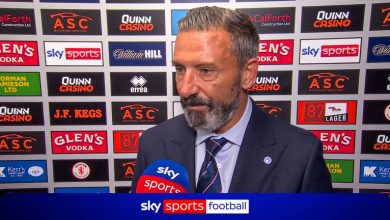
Asked to account for his part in the incident after the final whistle, McInnes offered an explanation that was notably candid, if somewhat difficult to fully square with the specifics of what had actually happened on the pitch. “It was 3-1 against me [in fouls] — and there was only two bookings,” he said, framing his frustration as a broader complaint about perceived inconsistency in how fouls were being punished across both sides, rather than addressing directly why his own player’s clear, cynical foul had specifically provoked such a strong reaction from him.
It’s a somewhat unusual line of justification when examined closely. McInnes wasn’t disputing that Fernandez’s foul deserved a yellow card — by most reasonable interpretations of the laws of the game, it clearly did. His frustration instead appeared rooted in a broader sense that Rangers were being treated more harshly overall in terms of disciplinary decisions relative to the number of fouls being committed by each side — a fairly common manager’s complaint in high-stakes matches, even if the specific timing of his outburst, immediately following his own player’s blatant foul, made the framing somewhat awkward in the eyes of some observers.
That awkwardness didn’t go unnoticed by those analysing the game afterwards. Several prominent former players and current pundits pushed back on McInnes’s framing of events, pointing to what happened just minutes later in the same half as evidence that, if anything, the balance of decisions had actually favoured Rangers rather than working against them.
Roughly twelve minutes after the initial Fernandez booking, the same player was involved in a further coming-together with Celtic’s Benjamin Nygren — a challenge that, in the view of several respected analysts, could easily have resulted in a second yellow card and, consequently, Fernandez’s dismissal from the pitch. Former Celtic goalkeeper Pat Bonner was among those who felt referee John Beaton had let Fernandez off lightly on that occasion, suggesting the official had effectively “bottled” what should have been a clear-cut decision to send the defender off. Chris Sutton and Scott Arfield, working separately as pundits, both reached a similar conclusion, agreeing that Fernandez had been fortunate to remain on the pitch following that second incident.
Taken together, that sequence of events — an early booking for a clear foul, followed by an escape from a second yellow that many neutral observers felt should have been given — makes McInnes’s post-match complaint about fouls and bookings considerably harder to fully accept at face value. If anything, the balance of contentious decisions across those two specific incidents appears to have worked in Rangers’ favour rather than against them, given that Fernandez remained available for the rest of the match rather than leaving Rangers to play the majority of the game with ten men.
What gives Sunday’s confrontation an extra layer of intrigue is that this wasn’t the first time McInnes and Fotheringham have clashed on a touchline. The two men have genuine history, stretching back to McInnes’s time managing Hearts prior to his move to Rangers. Back in January 2026, during a match at Tynecastle between Hearts and Celtic, McInnes reacted furiously to an early Celtic goal, storming into the Celtic technical area in a moment of visible frustration that drew considerable attention at the time. That 2-2 draw ended up being a significant result in the context of Hearts’ title challenge that season, keeping Naismith’s side six points clear of Celtic at a crucial stage of the campaign — but the touchline incident itself became something of a subplot in its own right.
In the aftermath of that Tynecastle flashpoint, McInnes later revealed that Fotheringham had personally telephoned him to apologise for his own behaviour during the incident — a detail that suggested the two coaches had, at that point, found a way to move past the disagreement and repair any lingering tension between them. Whatever peace was made in the aftermath of that January incident, however, appears to have been tested once again by the unique pressure and intensity of an Old Firm derby, with old tensions clearly resurfacing in a considerably more high-profile setting at Celtic Park.
It’s worth noting how this kind of recurring rivalry between opposing coaching staff, distinct from the players on the pitch, often develops in football — particularly in fixtures as fraught and emotionally charged as this one. Managers and assistants who have crossed paths at previous clubs frequently carry forward specific grievances or points of friction, and the compressed, high-stakes atmosphere of a derby fixture like this one provides exactly the kind of pressure-cooker environment in which those underlying tensions are liable to boil over once again, even when a genuine effort at reconciliation had seemingly been made in the past
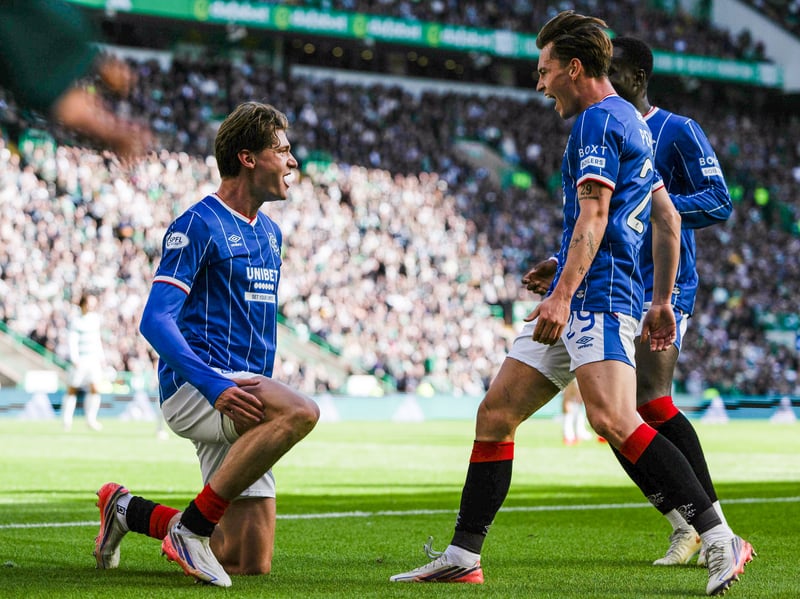
For all the attention the touchline row generated, it’s worth stressing that it had no discernible impact on the eventual outcome of the match. Rangers went on to win 1-0, courtesy of Ryan Naderi’s 33rd-minute finish after Kim Min-su’s shot was only parried into his path by Celtic goalkeeper Viljami Sinisalo. That result completed a double over Celtic within the space of a single week, following last weekend’s considerably more emphatic 3-0 win in the League Cup quarter-final at Ibrox.
The victory extended what’s become an increasingly notable personal record for McInnes specifically in Old Firm fixtures. Across his career as both a player and a manager spanning some three decades in Scottish football, McInnes has now gone five games unbeaten in matches against Celtic in this fixture specifically — an achievement that places him in select company among managers who have taken charge of Rangers in the modern era, and which matches a record previously set by Graeme Souness by winning his first two Old Firm derbies as Rangers manager.
The wider context of Rangers’ current form only adds to the significance of the result. Sunday’s win extended Rangers’ run to six consecutive victories across all competitions, and left McInnes’s side sitting second in the Scottish Premiership table on 16 points from seven matches, just two points behind Celtic at the summit. Given how difficult McInnes’s start to the season had initially looked — failing to win either of his opening two league fixtures and suffering early European exits against Jagiellonia Białystok and, on penalties, Jablonec — the current run represents a remarkable turnaround in fortunes, one that’s arguably been overshadowed in the immediate aftermath by the touchline incident with Fotheringham rather than being given the full attention it might otherwise deserve.
It’s worth pausing to consider why an incident like this one — a genuine but relatively contained flashpoint involving raised voices, animated gesturing, and a physical intervention from a third party to separate the two coaches — so easily gets inflated into claims of managers “losing control” or engaging in a “disgraceful fight” once it starts circulating on social media. Old Firm fixtures carry an unusually high level of emotional investment among supporters on both sides, and any moment of visible tension between figures connected to either club tends to be amplified rapidly, often stripped of the specific context that would allow for a more measured assessment of what actually happened
In this case, the verified account — sourced from match reports across multiple outlets, video footage broadcast live by Sky Sports Scotland, and McInnes’s own post-match comments — describes a heated verbal confrontation, defused relatively quickly through the intervention of the fourth official and Martin O’Neill, resulting in two yellow cards and nothing more severe. There’s no indication in any credible reporting of physical contact between the two men, no suggestion that either was sent to the stands or removed from their technical area, and certainly no evidence supporting characterisations of the incident as an outright “fight.” It was, in the words of one outlet’s headline, closer to “derby theatre” than genuine chaos — a spicy, memorable moment befitting the intensity of the fixture, but one that ultimately resolved itself within a matter of minutes and had no bearing on the eventual result.
It’s also worth situating Sunday’s incident within a broader pattern that’s become increasingly familiar in Scottish football in recent seasons: heightened scrutiny of touchline conduct, and a growing tendency for confrontations between coaching staff to become significant media stories in their own right, separate from the action on the pitch itself. Refereeing decisions and touchline conduct have been recurring flashpoints across Scottish football throughout this campaign, with various officials — including John Beaton himself in other fixtures — having faced public criticism from managers on both sides of various rivalries for perceived inconsistency in how decisions are applied.
Given that backdrop, an incident like the McInnes-Fotheringham clash arrives into an already charged media environment where any hint of controversy involving officiating or touchline behaviour tends to generate outsized attention relative to its actual significance. That’s not to dismiss the incident entirely — genuine tension between two coaches with real, documented history clearly played out in front of live television cameras, and it’s a legitimate story worth covering accurately. But the gap between what actually happened (a heated argument, quickly separated, resulting in two bookings) and how it’s sometimes been characterised online (chaos, a fight, a manager losing control) illustrates just how quickly measured, verified reporting can be overtaken by more sensational framing once a story begins circulating on social media, particularly in the emotionally charged aftermath of a fixture as significant as an Old Firm derby.
For Rangers, the immediate aftermath of Sunday’s win offers little reason for concern regarding the touchline incident itself — a yellow card carries no suspension implications for a manager in Scottish football, and McInnes will simply take his place in the technical area as normal for Rangers’ next fixture once the season’s international break concludes. The more significant story from Rangers’ perspective remains the run of form itself: six wins in a row, a double over Celtic completed within a week, and a genuine sense of momentum building around Ibrox after such a difficult start to the season.
For Celtic and Martin O’Neill, the touchline incident adds one further uncomfortable subplot to what’s already been described as one of the most difficult weeks of his time in interim charge — following the cup exit to Rangers, the Europa League defeat to Ferencvaros, and now this second consecutive defeat to their fiercest rivals in the league. Whether the Fotheringham incident becomes a genuine point of ongoing tension between the two coaching staffs, in the way the earlier Tynecastle flashpoint briefly appeared to before apparently being resolved through a phone call, remains to be seen — but it’s a subplot that seems likely to resurface whenever these two clubs, and these two specific coaches, next find themselves sharing a touchline.
For now, the accurate account of Sunday’s incident is a relatively simple one: a heated, quickly-defused confrontation between two coaches with genuine prior history, playing out under the intense pressure of Scottish football’s biggest fixture, resulting in two yellow cards and nothing more — dramatic derby theatre, certainly, but a considerable distance from the “disgusting,” “disgraceful” chaos some more sensational framing has suggested.