Ibrox View: Rangers new signing won’t be happy with McInnes after surprise snub last night

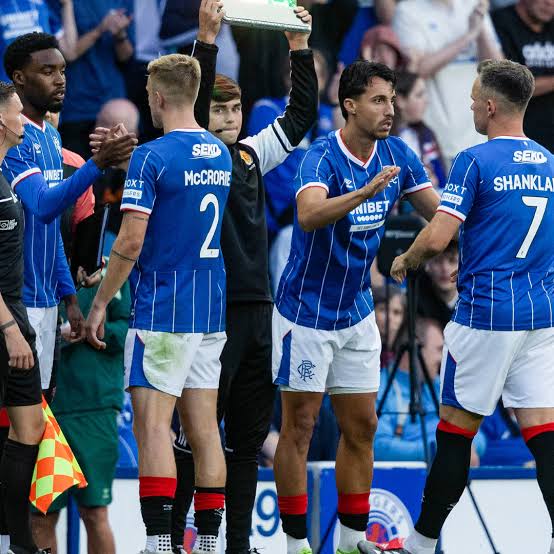
Vanja Dragojevic came to Ibrox in the summer with a reputation as one of the most exciting young defensive midfielders to come out of Serbia in years. Four months on, he spent Thursday night watching from the bench as his country lost a game they really should not have lost — and the uncomfortable question being asked in Belgrade and Glasgow alike is whether it’s his club form, or his lack of it, that put him there.
Serbia were beaten 2-1 by Greece in Belgrade in their opening UEFA Nations League A fixture, a result that will sting given the hosts led inside four minutes through Andrija Zivkovic before goals from Christos Tzolis and a stoppage-time header from substitute Anastasios Douvikas turned the game on its head. Greece dominated for long spells, finishing the match with 61 per cent of the possession and a 26-9 advantage in shots, and Veljko Paunovic’s side were ultimately picked apart having failed to build on that early lead.
Dragojevic never got off the bench. For a player who arrived at Rangers with two senior caps to his name and genuine hopes of building a long-term international career, that will not have been an easy watch — and it is Derek McInnes, in some quarters, who is being pointed to as the reason why
Rangers moved for Dragojevic in July, seeing off interest and prising him away from Partizan Belgrade in a deal worth in excess of £4million, with add-ons reportedly pushing the total closer to £4.6million and a 10 per cent sell-on clause retained by the Serbian club. It was a deal McInnes had to work for. An initial £3.8million bid was knocked back by Partizan, prompting Rangers to briefly shift their attention to Tromso’s Jens Hjerto-Dahl before returning with an improved offer that got the deal over the line.
The pedigree behind the transfer was obvious. Dragojevic had come through the Partizan academy, spent time on loan at second-tier Teleoptik, and by the age of just 19 was wearing the captain’s armband for a Partizan side that finished third in the Serbian SuperLiga. In his final season in Belgrade he made 54 appearances in defensive midfield, captained the side in 34 of them, and contributed four goals and four assists — numbers that made him one of the most sought-after young holding midfielders anywhere in the Balkans.
McInnes was fulsome in his praise when the deal was announced. To captain a club the size of Partizan at such a young age, he said, told you everything you needed to know about the character of the player Rangers were bringing in. Dragojevic, for his part, spoke of the “winning mentality” at Ibrox being compatible with his own, and of having tracked Rangers’ interest for months before the move materialised.
Since then, the reality of life in Govan has been considerably tougher than anyone at Partizan might have predicted. Dragojevic has made just seven appearances for Rangers across all competitions, and only one of those has come in the Scottish Premiership. For a player signed as a long-term successor in the middle of the park, that is a strikingly small return four months into the job — and it is that lack of game time, more than anything else, that appears to have cost him his place in Paunovic’s squad on Thursday.
The uncomfortable truth for Dragojevic is that Rangers’ central midfield has become one of the most competitive areas of Derek McInnes’s squad, and not through any fault of the Serbian’s own application. Nicolas Raskin and Dan Neil have established themselves as McInnes’s first-choice midfield partnership through the club’s outstanding recent run of form, with Neil in particular enjoying a career-best spell that included a man-of-the-match brace in Rangers’ 3-0 League Cup demolition of Celtic and a follow-up display in the derby rematch at Parkhead that saw pundits queue up to praise his development into a leader in McInnes’s team.
Raskin, too, has been central to everything positive Rangers have done since the turn of the season, despite a summer in which his long-term Ibrox future was repeatedly called into question. Besiktas twice tried to prise him away on deadline day — first with a loan-with-option offer, then with a straight €12million bid — and neither materialised. Raskin has since admitted to being “mentally ready” to leave and voiced his disappointment that no exit was sanctioned, but on the pitch none of that speculation has affected his level. If anything, his performances since the window shut have strengthened McInnes’s hand in resisting any winter sale.
Then there is Cammy Devlin, signed on a free transfer from Hearts in the summer as one of nine incoming players in McInnes’s squad rebuild. The Australian international has offered a different profile to Raskin and Neil — a more combative, box-to-box option — and has done enough in his own appearances to further complicate the picture for anyone else hoping to break into the middle of the park.
Add all of that together and it is not difficult to see why Dragojevic, for all his talent, has struggled to force his way into contention. McInnes has options in central midfield that he simply did not have in August, and results have given him little reason to break up a partnership that has delivered back-to-back Old Firm wins and pushed Rangers to within two points of Celtic at the top of the Premiership table.
On the surface, then, the case against McInnes looks straightforward: a talented young player was allowed to stagnate on the fringes of a Rangers squad, and it has now cost him his place in his country’s plans. It is the kind of story that fits neatly into a season already shaped by questions over the treatment of young or unsettled players at Ibrox — Nicolas Raskin’s summer saga, John Souttar’s contract stand-off, Clinton Nsiala’s frozen-out status, Bojan Miovski’s mysterious lack of an agent. Dragojevic, on this reading, is simply the latest name to be added to that list.
Except the picture is considerably more complicated than a simple story of a manager freezing out a talented kid, and it starts with Paunovic’s own selection history. Dragojevic won his first two senior caps for Serbia earlier this year, both of them in friendlies — against Mexico and Cape Verde — played in the build-up to a World Cup that Serbia ultimately failed to qualify for. He is, in other words, still a fringe figure at international level in his own right, someone Paunovic has given a look at rather than someone with an established place in the side.
That context matters enormously when weighing up Thursday’s squad selection. Paunovic named a considerably more experienced group for these Nations League fixtures than the one he had available for those pre-World Cup friendlies, recalling the likes of Dusan Tadic after more than two years away from the squad and pairing him with the Milinkovic-Savic brothers, Filip Kostic, Andrija Zivkovic, Nemanja Gudelj and Sasa Lukic. Serbia’s issue in Belgrade was not a shortage of central midfield options — if anything, the problem was the concession of two goals from a position of control against a Greek side that dominated the ball for long periods. Dragojevic finding himself down the pecking order in a squad stacked with senior figures returning from injury and international exile is not, on its own, proof that his omission was some kind of injustice.
Then there is the small matter of form, which is where McInnes’s harshest critics on this one will find the least ammunition. Dragojevic’s underlying numbers from his most recent extended run of games — Rangers’ UEFA Conference League play-off tie with Jablonec, arguably the least demanding fixture he has featured in all season — make for uncomfortable reading. According to data from FotMob, he completed just 68.2 per cent of his passes across those matches, with only a third of his attempted long passes finding their target. His duel success rate sat at 28.6 per cent, and he averaged fewer than one tackle per game. Those are not the numbers of a player being unfairly overlooked. They are the numbers of a young midfielder who, when finally afforded an opportunity against what was statistically the weakest opposition Rangers faced all season, did not take it.
It is worth remembering, too, the standard Dragojevic is being judged against domestically. Raskin and Neil are not simply blocking his path out of favouritism or reputation — they have been directly responsible for some of the best individual performances by any Rangers midfielder in years during a run that has taken McInnes’s side from crisis to genuine title contenders. Displacing that partnership was always going to require Dragojevic to seize any chance that came his way. On the Jablonec evidence, he has not yet done so.
It is also worth setting Thursday’s story against where Rangers, and McInnes specifically, currently sit. This time last month, McInnes’s position at Ibrox was under genuine scrutiny. Back-to-back European exits — to Jagiellonia Bialystok in the Europa League and Jablonec in the Conference League — had raised serious questions about his suitability for the job, with pundits and former players openly discussing the security of his position given the scale of investment ownership had put into his squad. Andy Walker’s warning that McInnes simply “had to deliver,” and reports suggesting the manager was facing “four huge games” that would define his early tenure, framed a period in which every selection decision was liable to be picked apart.
Since then, the picture has transformed. A six-game winning run, a first Old Firm double over Celtic in the space of eight days, and a Premiership table that now shows Rangers just two points off top spot have fundamentally changed the conversation around McInnes. Former Rangers midfielder Andy Halliday summed up the shift succinctly on BBC Scotland’s Sportsound, pointing out that barely a month ago McInnes was under real pressure and is now being talked about as the manager who could deliver Rangers’ first title since 2021.
That context is relevant to the Dragojevic story for a simple reason: a manager under this little pressure, with a team playing with what McInnes himself has called “real attacking verve,” has very little incentive to disrupt a winning formula for the sake of accelerating one player’s development, however promising that player’s underlying profile might be. Whatever sympathy there is for Dragojevic’s situation, McInnes is coaching a Rangers team that currently has the best defensive midfield partnership in the country, by results if nothing else, and no manager in world football breaks up a winning team on reputation alone.
None of that means Dragojevic’s situation isn’t a difficult one, or that his frustration — reported or otherwise — isn’t understandable. Being left out of a matchday squad by your club is one thing; watching that translate into being overlooked by your country, in a competition as significant as the Nations League, is a considerably harder blow for a 20-year-old to take, particularly one who arrived in Scotland with the profile of a captain and a first-team certainty rather than a fringe squad player.
The path back for Dragojevic is not complicated in theory, even if it is proving difficult in practice. He needs minutes, and he needs to perform when he gets them. Rangers’ fixture list eases up domestically once the current run of Old Firm and Premiership tests is complete, and with no European football to contend with this season following those summer exits, McInnes does have more scope than most of his rivals to rotate his midfield without disrupting continuity in must-win matches. Cup competitions, in particular the Scottish Cup once it resumes, represent a realistic route to consistent game time for a player in Dragojevic’s position.
There is also an argument that patience remains the correct approach for all parties. Dragojevic is 20 years old and moved from a Serbian SuperLiga side, however well he did there, into arguably the most pressurised dressing room in Scottish football, at a time when his new manager was fighting for his own job and could not afford to gamble minutes on bedding in a raw midfielder. The adjustment period he is going through — from captaining Partizan to fighting for scraps behind Raskin, Neil and Devlin — is not unusual for young players moving into a title race at a massive club, even if it makes for an uncomfortable few months personally.
Paunovic, for what it’s worth, has not shut the door. Dragojevic remains part of a Serbia squad picture that includes some of the biggest names in the country’s football, and a strong end to the season at club level — starts, telling performances, goal involvements — would put him firmly back in the frame for the November international window. The message from Serbia, implicitly at least, is the same one coming from Ibrox: perform for your club first, and the international recognition will
So does Derek McInnes deserve the blame Dragojevic’s snub is being framed around? The honest answer is: only partially, and probably less than the headline suggests. McInnes has built his midfield around what has worked, and what has worked has been spectacularly effective — a title challenge that looked fanciful a month ago now looks entirely realistic, built in no small part on the platform Raskin and Neil have provided in the middle of the park. Asking a manager to disrupt that for a player whose own numbers, when given a chance, have not been convincing is asking McInnes to prioritise long-term development over short-term results at precisely the moment his job depended on the opposite.
At the same time, it would be naive to pretend Dragojevic’s situation reflects perfectly on Rangers’ squad management. A £4million captain of a major European club, signed with genuine ambition attached to the deal, has made a single Premiership appearance in four months. That is a slow burn by any standard, whatever the mitigating circumstances around McInnes’s early-season pressure and the form of the players ahead of him. If Dragojevic is still primarily a bench option come the turn of the year, questions about whether Rangers have got the balance right between squad depth and player development will only grow louder — both in Glasgow and in Belgrade.
For now, though, the fairest reading of Thursday night is that Dragojevic was left out of a Serbia squad because he has not played enough football to justify inclusion, and he has not played enough football because two other midfielders are currently playing some of the best football in Scotland. McInnes’s hands are, to a significant extent, tied by his own team’s success. Whether that remains the case into the winter, and whether Dragojevic can force the issue before then, will go a long way to determining how this story is remembered — as a temporary setback in an otherwise promising Ibrox career, or the first sign that a big-money signing is being left behind by circumstances beyond his control.