Rangers Will Win the League “At a Canter” — Inside the Argument That Ibrox’s Title Is Already as Good as Won


Derek McInnes has been Rangers manager for less than two months and, according to one of Scotland’s most senior football columnists, he has already all but won the league. It is the kind of claim that would ordinarily be laughed out of the room in late September, with 35 league games still to play and a title race that, on paper, involves eleven other clubs. But after Rangers beat Celtic twice inside eight days — first in the Premier Sports Cup, then in the league at Parkhead — the argument that the destination of the 2026-27 Premiership is already settled has moved from fringe punditry into the mainstream.
It is a bold call, and its author knows it. Writing in his column, the Mail Sport journalist behind the piece — syndicated widely under the Daily Record banner — conceded up front that he was working from instinct rather than certainty. “You can say it’s a knee-jerk reaction, or simply a case of me talking through another part of my anatomy, but I have formed a hard and fast opinion after last Sunday’s one-sided Old Firm game,” he wrote. “Rangers will win this season’s Premiership title in a canter.”
What makes the piece worth dwelling on is not the prediction itself — bold title claims in September are a Scottish football tradition almost as old as the Old Firm derby — but the specific, almost mathematical logic behind it. This is not a columnist getting carried away by two wins over Celtic. It is an argument that the rest of the league, considered rival by rival, simply does not have the players to make a fight of it. Whether that holds up over 30-odd remaining fixtures is another question entirely, and it is one this piece will come back to. But first, the case for the prosecution.
The columnist’s method is blunt. Rather than looking at league position or recent form club by club, he asks a single question of each of Rangers’ ten other Premiership rivals: does this squad, player for player, have anything close to the quality Derek McInnes can call upon at Ibrox? His answer, repeated for emphasis, is “none of them.”
Dundee United and Hibernian are dismissed almost instantly. United held Rangers to a draw at Tannadice on the last day of July, and Hibs beat Rangers at Ibrox on a Sunday afternoon so fraught that, in the columnist’s words, “the home crowd verged on apoplexy.” But isolated results, he argues, are not the same as sustained title credentials, and anyone treating either club as a genuine contender “possesses a truly unique state of mind.” The most withering line in the piece is reserved for Hibs, whose players were, by the time of writing, “celebrating a draw with Aberdeen which averted a seventh consecutive defeat at Easter Road for the first time in the club’s 151-year long history.” That is not the form of a title challenger; it is the form of a club that had just sacked its manager.
That reference lands because it is true. David Gray, the former Hibs captain who took permanent charge at Easter Road in June 2024, was sacked on 16 September 2026 after a 1-0 home defeat to bottom-placed Kilmarnock — Hibs’ sixth successive league loss at Easter Road, equalling a club record that had stood since 1920. Executive chairman Ian Gordon called it a decision “we have not taken lightly,” but with Hibs ninth in the table on six points from six games, and out of Europe after a Conference League play-off exit to Gent, the writing had been on the wall for weeks. John Potter took interim charge for the visit of Aberdeen, and it was that fixture — a draw that snapped the losing run — which the columnist cited as evidence of quite how low the bar had fallen. Aberdeen manager Stephen Robinson’s response to the point, framed as evidence his side were “two points off fourth place,” was dismissed in the column as “a carefully constructed manipulation of statistics for public consumption,” given Aberdeen sit just three points above bottom club Kilmarnock, who themselves drew at Pittodrie earlier in September to boos at both half-time and full-time.
Kilmarnock’s season, on this evidence, needs little further comment: bottom of the table, the club that beat Hibs to cost Gray his job, and a home draw with Aberdeen greeted by their own supporters with jeers rather than relief.
That leaves, in the columnist’s telling, only two clubs worth taking seriously: Hearts and Motherwell. Both get more considered treatment, and both are ultimately found wanting.
Motherwell’s case is built on a promising start undone by a alarming recent slide. Alfred Johansson, who replaced the well-regarded Jens Berthel Askou in the Fir Park dugout, began the season well enough to generate genuine optimism — but the columnist notes Motherwell have shed nine points from their last three league games, a collapse severe enough that “fans [are] questioning his credentials.” The verdict is stark: if Johansson’s side take nothing from their next four matches before Celtic visit Fir Park after the October international break, “Alfred’s most pressing objective will be to keep his job,” rather than chase down Rangers.
Hearts, by contrast, are treated with something closer to respect — but ultimately dismissed on historical rather than statistical grounds. Wouter Vrancken’s side have dropped five of a possible six points to Falkirk and Kilmarnock, results that have “quieten[ed] title talk” around the Belgian head coach, but the columnist’s real objection to Hearts as contenders is deeper and more damning: “in the context of winning the championship, [they] have been so near and yet so far for 40 years.” His prediction is that Hearts finish second while Celtic “try to extricate themselves from every form of self-inflicted harm” — but that the Tynecastle club lack “the killer instinct to get across the line” when a title is actually on. It’s an argument rooted less in this season’s form table and more in four decades of Hearts falling agonisingly short, a psychological deficit as much as a footballing one — and it is exactly the kind of claim that will infuriate Hearts supporters who feel Vrancken’s project deserves to be judged on its own merits rather than the ghosts of sides gone by
The most eye-catching part of the column, though, is what it says about Celtic — and crucially, the case rests on more than results. “Not just because Celtic have cobbled together a squad of ill-fitting players and descended into the kind of internal mess from which they will only recover if they can find new ownership,” the columnist writes, is Rangers going to win the league; it’s because nobody else can either. The framing matters: this is presented as a club-wide crisis, not a dip in form that a January transfer window can fix.
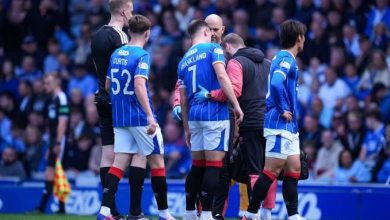
The context bears that reading out. Celtic went into the September international break having lost the first Old Firm derby of the season 3-0 in the Premier Sports Cup quarter-final at Ibrox, then lost again 1-0 in the league at Parkhead six days later, Ryan Naderi’s 33rd-minute strike the difference in a game that also saw an Olwethu Makhanya effort controversially disallowed for handball. Two defeats in eight days to their oldest rivals have reduced Celtic’s advantage at the top of the table to a matter of scheduling rather than superiority — after seven league games Celtic sit top on 18 points, Rangers second on 16, but the psychological gap after back-to-back Old Firm losses tells a different story than the two-point margin suggests.
Off the pitch, the unrest long predates this run of results. Supporter protests against the club’s ownership structure have flared repeatedly through 2026, most visibly when fans threw tennis balls onto the Celtic Park pitch during a Europa League play-off defeat to Stuttgart in February — a demonstration Martin O’Neill, in his second spell in charge, criticised at the time for undermining the team (“anyone who thinks this is a good idea should have their head examined”), even while he separately floated the idea of Scottish football’s giants moving into a form of British league merger to close the financial gap with Europe’s elite. The Affiliation of Registered Celtic Supporters Clubs has published statements calling for boardroom change, and as recently as this month O’Neill has publicly acknowledged supporter “frustration” at a team that dominates possession without penetration, while his defender Cameron Carter-Vickers has had to speak up for a manager increasingly discussed as vulnerable. One recent piece on a leading Celtic-focused site went so far as to accuse the board of “cowardice” for offering O’Neill only “soft words” of backing rather than a genuine plan to fix a squad it says was inadequately recruited over the summer.
Put those threads together — two Old Firm hidings in a week, a manager under visible pressure, supporters in open conflict with ownership, and a recruitment drive widely judged to have fallen short — and the columnist’s “internal mess” framing is not simply punditry for effect. It reflects a club that, by its own supporters’ and manager’s public admissions, is fighting battles far removed from the league
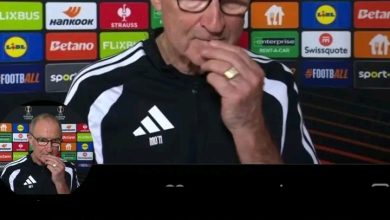
None of this analysis, of course, explains why Rangers specifically are equipped to capitalise — only that the pack behind them looks weak. But McInnes’s own recent history at Ibrox has been added by the columnist as the flourish that turns “Celtic are struggling” into “Rangers are running away with it.” The piece closes on a pointed historical comparison: McInnes has now won his first two Old Firm derbies in charge, a feat last managed by Graeme Souness 36 years earlier — a manager, the column notes with a wry dig at McInnes’s changed appearance since his playing days, who was in charge “when the now bearded and slightly wizened looking McInnes was still a fresh faced teenager.” The conclusion follows: “His first league title, 20 years after becoming a manager, is nailed on.”
That framing glosses over a rockier start to McInnes’s Ibrox tenure than the recent run suggests. Rangers exited both the Europa League and Conference League qualifying rounds this summer, losing to Jagiellonia Białystok and then Jablonec, results serious enough that pundits including Andy Walker and Aiden McGeady openly questioned whether the club’s roughly £35m summer outlay — one of the heaviest in Scottish football history, headlined by a club-record fee for striker Kevin Kelsy — would be enough to save McInnes’s job if domestic form did not immediately improve. Football Insider went as far as framing a run of “four huge games” against Motherwell, St Mirren, and the League Cup and league derbies against Celtic as a referendum on his position. McInnes has answered those questions as emphatically as any manager could: a run that has now stretched to six league and cup games unbeaten, capped by back-to-back wins over Celtic, the second of them at Parkhead.
The Kevin Kelsy signing — Rangers’ second-most expensive in their history at £9.5m from Portland Timbers — has begun repaying its outlay, with his first goal for the club arriving in the derby win at Ibrox after a difficult adaptation period. Dan Neil, signed as a free agent from Sunderland and installed by McInnes in the captain’s armband ahead of more experienced options, delivered a man-of-the-match brace in the Parkhead league win, a statement of trust from the manager repaid within weeks. James Penrice, an initial injury-cover loan signing from AEK Athens whose progress has already prompted talk of triggering his £800,000 permanent option, has become a fixture in McInnes’s revamped back-three system. Not every summer arrival has settled quite so quickly — Badredine Bouanani has struggled for rhythm in his early Rangers appearances, and Vanja Dragojevic has found first-team opportunities hard to come by behind an in-form midfield trio — but the overall trend, results-wise, is unmistakable.
There are, it should be said, genuine problems for McInnes to navigate that the “canter” framing skates past. Lawrence Shankland, one of the summer’s marquee signings, suffered what Rangers fear could be a significant grade 2c hamstring tear early in the win over Motherwell — a recurrence of the injury that cost him three months at Hearts in January, with some reports suggesting an absence of up to four months. Youssef Chermiti is already out with an ACL injury. Ben Godfrey, the club’s big-money loan arrival from Atalanta, has barely featured because of a hamstring problem picked up in the season opener. That is a threadbare-looking forward and defensive line for a club being told its title is already won, and it is precisely the kind of squad depth question that separates a two-horse-race favourite from a genuine
It would be remiss to present the “canter” thesis as though it were unchallenged, because it very much is — including from voices sympathetic to Celtic who have made exactly the opposite point in response to this same column. One rebuttal, published within hours under the header “Celtic Fans Should Be Delighted He’s Done It Again,” argues that the very certainty of the prediction should reassure Celtic supporters rather than alarm them, on the grounds that sweeping September title calls in Scottish football have a poor record of ageing well. “Two derby victories do not decide a 38-game league championship,” the response argues. “Form changes. Injured players return. January transfer windows happen. Managers come and go. Teams expected to win drop points in matches nobody expected them to lose. Rangers themselves have already demonstrated that this season” — a reference to the Jagiellonia and Jablonec European exits that so nearly cost McInnes his job within weeks of taking it.
That counter-argument has real weight. A club carrying four separate injury concerns in attack and defence, playing in four competitions, and managed by someone still finding his feet after a difficult start is not the profile of a side that has the league won with 30-odd games to play — whatever the state of the pack behind them. Nine points from three games can vanish for Motherwell just as easily as it can be lost by Rangers; Hearts’ 40-year title drought is a historical curiosity, not a law of physics; and Celtic, even in visible disarray, retain a squad including recent Champions League European talent that a “cobbled together” characterisation may undersell, not least the £11m club-record Kasper Høgh and the £6m Camilo Durán, both of whom remain firmly first-choice options up front regardless of O’Neill’s difficulties.
The fixture list over the coming weeks will go a long way to confirming or undermining the column’s thesis. Rangers return from the international break to face Kilmarnock at Ibrox — precisely the kind of bottom-half fixture the columnist argues McInnes’s squad should now win comfortably — before a trip to Dundee and a home game against St Mirren. Beyond the league, McInnes faces an immediate reunion with his old club Aberdeen in the Premier Sports Cup semi-final at Hampden, a tie drawn alongside an Edinburgh derby between Hearts and Hibernian in the other half. A McInnes side who beat both Celtic and their old employers inside the space of a month would do more to cement the “canter” narrative than any September column possibly could; a slip against a club he managed for eight years, by contrast, would hand critics of the thesis exactly the ammunition they are waiting for.
Celtic’s own run of fixtures offers them a chance to answer their critics before the sides meet again. A trip to Fir Park to face a Motherwell side already low on confidence, then a home game against Hearts, represent the kind of matches a genuine title-holding squad should be winning regardless of the state of the boardroom. Failure to do so would only deepen the sense, already gathering around Martin O’Neill, that fixing Celtic’s problems now requires more than simply waiting for form to turn — and would lend retrospective weight to a column that, for all its knee-jerk framing, was built on more than just two derby scorelines.
Strip away the certainty of the headline, and what the column actually documents is a legitimate and significant shift in the balance of Scottish football’s traditional two-horse race, even if “nailed on” oversells it. Rangers have won back-to-back Old Firm derbies for the first time since Souness’s early spell in the job, sit within two points of top spot with games in hand on rivals still finding their level, and can point to a settling group of summer signings finally delivering the performances McInnes’s spending was supposed to buy. Behind them, the rest of the division genuinely does look as weak as the column suggests: a manager already sacked at Hibs, Aberdeen and Kilmarnock scrapping in the bottom half, Motherwell’s promising start unravelling, and Hearts burdened by history even as their underlying form holds up better than most.
Whether that adds up to a title “won in a canter” is a different question from whether Rangers are now favourites — and on the evidence of the last fortnight, McInnes’s side clearly are. The next month, with Rangers due to face Aberdeen in the League Cup semi-final and a run of league fixtures against sides in various states of crisis themselves, will offer a clearer answer than any September column can. But for the first time in years, the idea of an Ibrox title procession is being discussed not as fantasy, but as the more likely outcome — and that alone tells its own story about the state Celtic currently find themselves in.