Rangers Fear Significant Lawrence Shankland Hamstring Injury After Motherwell Win

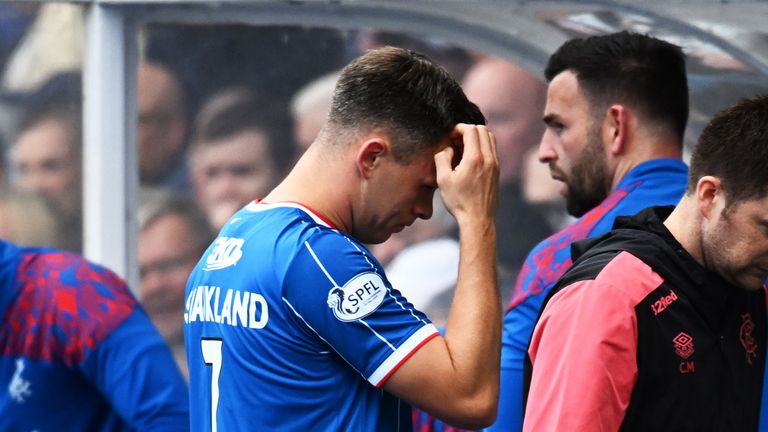
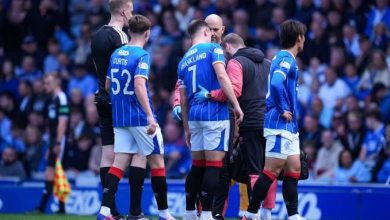
It took barely five minutes of Rangers’ 1-0 win over Motherwell at Ibrox for the afternoon to turn from a routine home victory into a genuine selection crisis. Lawrence Shankland, the club’s captain and record summer signing, pulled up in visible discomfort during his very first sprint of the match and had to be replaced almost before the game had properly begun — and the look on Derek McInnes’s face as his captain limped down the tunnel told its own story before a single scan had even been taken.
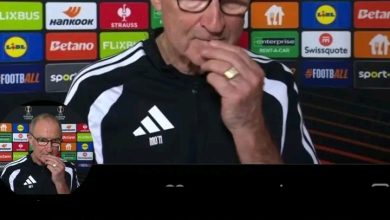
McInnes wasted no time in setting expectations after the final whistle, telling reporters bluntly that it looked like “a significant hamstring injury” and that Shankland could be “out for a while.” It was a notably candid assessment from a manager who might, in other circumstances, have been tempted to play down the severity of an injury to his captain until scan results came back. Instead, McInnes went straight to the detail that mattered most: this felt eerily familiar to a problem Shankland had already suffered once before.
“It’s similar… he has a similar feeling to the hamstring injury he had at Hearts last January when he was out for three months,” McInnes said, “so obviously we don’t want to speculate too much, but he says it feels similar to in the same area, so we’ll get him scanned on Monday.” The reference point was not an encouraging one. That earlier injury, sustained in a Hearts shirt in January, had ruled Shankland out from 17 January until 21 March — a lay-off of exactly the kind of length that would have serious implications for a Rangers side just beginning to find its rhythm in a title race.
What made the recurrence particularly frustrating, both for McInnes and for Shankland himself, was how innocuous the moment looked when it happened. Shankland had barely been involved in the game before pulling up, with McInnes explaining that “it was his very first sprint after two and a half minutes standing about [due to VAR] breaking down.” There was no crunching tackle, no awkward landing, no obvious mechanism of injury beyond the sudden acceleration itself — precisely the kind of freak, low-impact moment that makes recurring hamstring problems so difficult for players and medical staff to fully guard against. McInnes did at least point to the positive precedent of Shankland’s recovery from the original injury, noting that “he came back really smoothly last time and got to the World Cup,” in reference to Shankland’s participation for Scotland in the tournament in the United States over the summer.
Rangers moved quickly to get clarity on the extent of the damage, sending Shankland for a scan on the Monday following the Motherwell game. The results confirmed the worst of McInnes’s fears: a grade 2c tear in the hamstring, officially described as measuring around 2cm — serious enough that the club immediately arranged a follow-up scan with a specialist in London to help determine the best course of treatment.
The central decision facing Shankland and Rangers’ medical staff was whether to proceed with surgery or allow the injury to heal naturally, and McInnes was refreshingly transparent about the trade-offs involved in that choice. “We’ve had confirmation he has had a grade 2c tear in his hamstring, very similar to the one he did at Hearts in January,” he explained. “He is now getting a follow-up scan with a specialist in London to determine if he has surgery or allows it to heal naturally. If he has the surgery, it’s an extra three to four weeks, but it lessens the risk of it maybe happening again.”
It’s a decision with real consequences either way. Opting against surgery would, in theory, get Shankland back on the pitch marginally sooner, but with an increased risk of exactly the kind of recurrence that has now struck twice in the space of eight months. Choosing surgery extends the timeline by three to four weeks but offers greater long-term security against a third breakdown — a trade-off that becomes more significant the more times a player’s hamstring has already given way. Given that this is now the second serious tear in the same area within less than a year, and that Shankland turned 31 earlier this year, there will be plenty within Rangers’ medical department advocating for the more cautious option, whatever the short-term cost to McInnes’s attacking options.
The scale of the potential absence has been laid out in stark terms by reporting around the injury, with some outlets suggesting Shankland could be sidelined for as long as four months depending on which treatment path is chosen. Ibrox News mapped out exactly what that could mean in practical terms: a run of matches through October and into the new year, with Shankland potentially missing Rangers’ clashes with Dundee United, Hibernian, St Johnstone, Hearts, Kilmarnock and Dundee in December alone, as well as a potential League Cup final should Rangers reach it. November offers some respite in fixture terms, with an international break reducing Rangers’ schedule to three league matches against St Mirren, Motherwell and Falkirk, but even a best-case recovery timeline points to a possible return around the Dundee United fixture on 9 January — a date that would still see him miss the second Old Firm league meeting of the season on 3 January. A more realistic target for his comeback, on that reading, may be the Scottish Gas Cup third round on 16 January.
For context, that is almost the entirety of the run-in to the turn of the year, spanning both domestic cup competitions and a period that will likely prove decisive in Rangers’ title challenge given how tightly the Premiership table has been contested with Celtic in recent weeks. Losing a club captain and record signing for that stretch, regardless of the quality of the squad around him, represents a genuinely significant blow to McInnes’s plans for the season.
Shankland’s importance to this Rangers side goes well beyond simple goal output, though the goals matter too. He arrived at Ibrox in the summer as one of the most sought-after strikers in Scottish football, having established himself as one of the country’s most reliable finishers during his time at Hearts, and was immediately handed the captaincy — a statement of intent about the role McInnes envisioned for him both on and off the pitch. Losing a captain to injury carries a different weight to losing any other individual player, particularly for a squad that has already been forced to cope with a wave of other significant absences this season.
That broader context is precisely what made McInnes’s reaction to the injury so pointed when discussing his summer recruitment. Reflecting on the timing of Kevin Kelsy’s arrival from Portland Timbers, which had already been completed before Shankland’s injury but which took on added significance once the extent of the problem became clear, McInnes admitted: “I think obviously if somebody had said to me walking in the door that Chermiti and Shankland were going to be injured with significant injuries, you know, you’d have felt the weight of that.” It’s a rare moment of a manager acknowledging just how thin his margins had become — Youssef Chermiti already sidelined with a long-term knee injury before Shankland’s hamstring problem struck, leaving Rangers’ forward options stretched to breaking point within the space of a few weeks. Daisuke Yokota’s own groin injury, which ruled him out of the subsequent match against St Mirren, compounded the picture further still, giving McInnes three separate significant absences in his attacking department inside a matter of weeks.
With Shankland sidelined, McInnes turned first to Ryan Naderi as his replacement against Motherwell, and the manager was full of praise for how the forward adapted to the responsibility thrust upon him at short notice. “And I was delighted for Ryan,” McInnes said. “The good thing with Ryan, even when he’s not his best, he puts himself about, he lets centre-halves know he’s there. He presses brilliantly, which is great when you’re playing against a team like Motherwell.” It was a pragmatic, if not spectacular, alternative — exactly the kind of honest, high-effort covering option McInnes needed to see from his bench in the immediate aftermath of losing his first-choice striker.
Longer term, the timing of Kelsy’s arrival from Major League Soccer side Portland Timbers has taken on considerably greater significance than it might otherwise have carried. McInnes handed the young forward his debut off the bench in the subsequent match against St Mirren, and has been explicit about how much more important that signing now looks given the scale of the injury problems elsewhere in the squad. Rangers will also welcome back Bojan Miovski into contention, following a deadline-day move away from the club that ultimately failed to materialise — an outcome that, while awkward at the time, now gives McInnes an additional senior forward option he might otherwise have been forced to do without altogether.
Shankland’s injury cannot be viewed entirely in isolation from the broader pattern of misfortune that has hit Rangers’ forward line this season. Between Chermiti’s long-term knee problem, Yokota’s groin issue and now Shankland’s hamstring recurrence, McInnes has been forced to manage a genuinely depleted attacking department at exactly the point in the season when consistency matters most — with St Mirren to face in midweek before a hugely significant Old Firm double-header in the Premier Sports Cup and Premiership arrives on the horizon.
It is a run of misfortune that has already shaped decision-making elsewhere at the club, with reports elsewhere this season indicating Rangers have kept the door open to emergency free-agent solutions, including veteran midfielder Ryan Jack, specifically because of how thin the squad’s depth was exposed to be once injuries began to bite. Whether a similar contingency conversation now needs to happen in attack, on top of the reinforcements already arriving in Kelsy and the returning Miovski, may become clearer once Shankland’s scan results in London confirm the treatment path
The knock-on effects of Shankland’s injury extend beyond Ibrox and into the international game as well. He has already been ruled out of Scotland’s upcoming Nations League fixtures, denying new head coach Sebastien Pocognoli the services of one of his most experienced forward options as he takes charge of the national team for the first time. It’s a reminder of just how far the consequences of a single, low-impact training-ground-style moment — a routine sprint, barely two and a half minutes into a match — can ripple outward, costing both club and country a key player at a pivotal moment
For now, the situation remains one of watching and waiting. The follow-up scan in London will determine whether Shankland goes under the knife or attempts to manage the recovery without surgical intervention, a decision that will shape not just his own timeline back to fitness but McInnes’s entire approach to squad rotation and recruitment planning for the remainder of the year. What is already clear is that Rangers will be without their captain for a significant stretch of the season, at a time when they can least afford further disruption to a forward line already missing key personnel.
McInnes’s honesty in the immediate aftermath of the injury — refusing to sugarcoat the situation, drawing the direct comparison to Shankland’s previous three-month lay-off, and openly acknowledging the toll that losing both Chermiti and Shankland to significant injuries within weeks of each other has taken — suggests a manager clear-eyed about the scale of the challenge in front of him. Having already navigated Rangers through a difficult start to the season and back into genuine title contention, McInnes will now have to do so again with his captain unavailable for what could be the best part of four months. On the evidence of how his side has responded to setbacks already this year, few at Ibrox will be writing off their chances just yet — but the margin for further misfortune, in a title race already this tightly contested, has just grown considerably smaller.