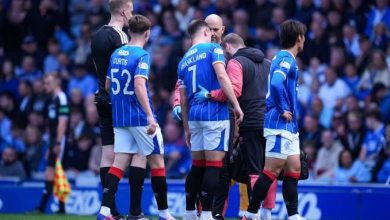
Alan Hutton has delivered one of the bluntest verdicts yet on the state of Scottish football’s biggest rivalry, declaring that not a single Celtic player would currently get into Derek McInnes’s Rangers side on current form. Speaking in an interview picked up from Record Sport via Footballpredictions.com, the former Rangers full-back was asked to pick a combined Old Firm XI and gave an answer that flipped a debate which, for much of the past decade, has tended to run the other way.
“To be totally honest and only going on form at this moment in time, I would say no Celtic players get into the Rangers XI,” Hutton said. He was careful to frame it as a snapshot rather than a permanent judgement, adding immediately: “If you’d asked me this question a month ago, it would have been a lot different, because Celtic started the season well, Rangers didn’t.”
That caveat is worth taking seriously, and it also happens to be true. Celtic began the campaign well clear of Rangers, and it has taken a dramatic swing in form — headlined by back-to-back Old Firm wins for McInnes’s side, the 3-0 League Cup quarter-final win at Ibrox and the follow-up 1-0 league victory at Celtic Park — to turn a month-old consensus on its head. Hutton’s comments echo similar sentiments expressed by Ally McCoist in the wake of the derby double, when the pundit pointed to a visible confidence gap opening up between the two dressing rooms.
Hutton’s explanation for the shift centres on the contrasting outcomes of two heavy summer rebuilds. McInnes brought in fourteen new players following his appointment, and while Hutton admits the scale of that turnover initially worried him, he now believes the transition is bedding in at exactly the right moment. “There were a lot of new players that were trying to bed in,” he said. “It’s taken the new signings a little bit of time [at Rangers], and I always thought there would be such a big transition from last year, especially with the manager and then I think it’s fourteen players that have come in.”
He went on to name the individuals he believes are now driving the improvement, pointing specifically to the impact of Rangers’ new arrivals: “I was a little bit worried at the start of the season, but now I’m looking at it with the likes of Kim Min-su, Makhanya, Penrice. Shankland was scoring goals before his injury.” Dan Neil is credited elsewhere in the coverage as another of the new arrivals who has made an instant impact alongside Makhanya, Kim Min-Su and Penrice.
Celtic’s summer, by contrast, has become a case study in outlay not yet matching output. The Parkhead club spent a reported £31.6million on six new arrivals — Camilo Duran, Kasper Høgh, Mika Baur, Haissem Hassan, Joel van den Berg and Jordan Lotomba — but the marquee name among them has struggled badly for form. Høgh, Celtic’s record signing, has gone seven games without a goal, a statistic that has become a shorthand for the wider malaise Martin O’Neill’s side have found themselves in since the derby double.
What makes Hutton’s verdict notable is that it is not simply a reaction to two derby results in isolation, but a form-based reading of both squads at this specific moment. Rangers’ summer arrivals — Makhanya at centre-back, Kim Min-Su alongside him, Penrice at wing-back, Neil in central midfield — have each been credited individually with strong starts to their Ibrox careers, to the point where several of them have already attracted transfer interest from elsewhere in Europe. Lawrence Shankland, meanwhile, was among the division’s most productive forwards before a hamstring injury interrupted his campaign, giving McInnes a front line that had already proven its output even before results turned in Rangers’ favour.
Celtic’s summer investment has ot translated into the same immediate returns, at least not yet. A £31.6million outlay spread across six positions was designed to refresh a squad that had dominated Scottish football for the best part of a decade, but the early data — Høgh’s scoreless run chief among it — suggests the new arrivals are still finding their level, just as McInnes’s group was earlier in the season. Hutton’s argument, in effect, is that Rangers’ summer of change has completed its bedding-in process a matter of weeks before Celtic’s, and that the timing of that gap happens to have coincided with two derby matches that have reshaped the psychological balance of the rivalry
For context, it is worth noting how unusual this framing is. Combined Old Firm XI debates have, for most of the past ten years, tended to be dominated by Celtic players, reflecting the Parkhead club’s sustained period of domestic success and Rangers’ comparatively unsettled managerial history in the years following their return to the top flight. Hutton’s willingness to flip that picture entirely — naming zero Celtic players as worthy of the current Rangers side — is as much a statement about how far the pendulum has swung in the opening weeks of Derek McInnes’s tenure as it is a comment on any individual player’s form.
Whether that verdict survives the coming weeks is, by Hutton’s own admission, an open question. Celtic have both the resources and the recent history to respond, and a Høgh goal or two could quickly change the terms of the conversation. But for now, with Rangers unbeaten in six matches and Celtic still searching for an answer to two derby defeats in eight days, Hutton’s blunt assessment captures just how sharply the balance of the Old Firm rivalry has moved since the summer began.