Rangers v St Johnstone red card gets universal verdict as pundit insists referee was ‘conflicted’

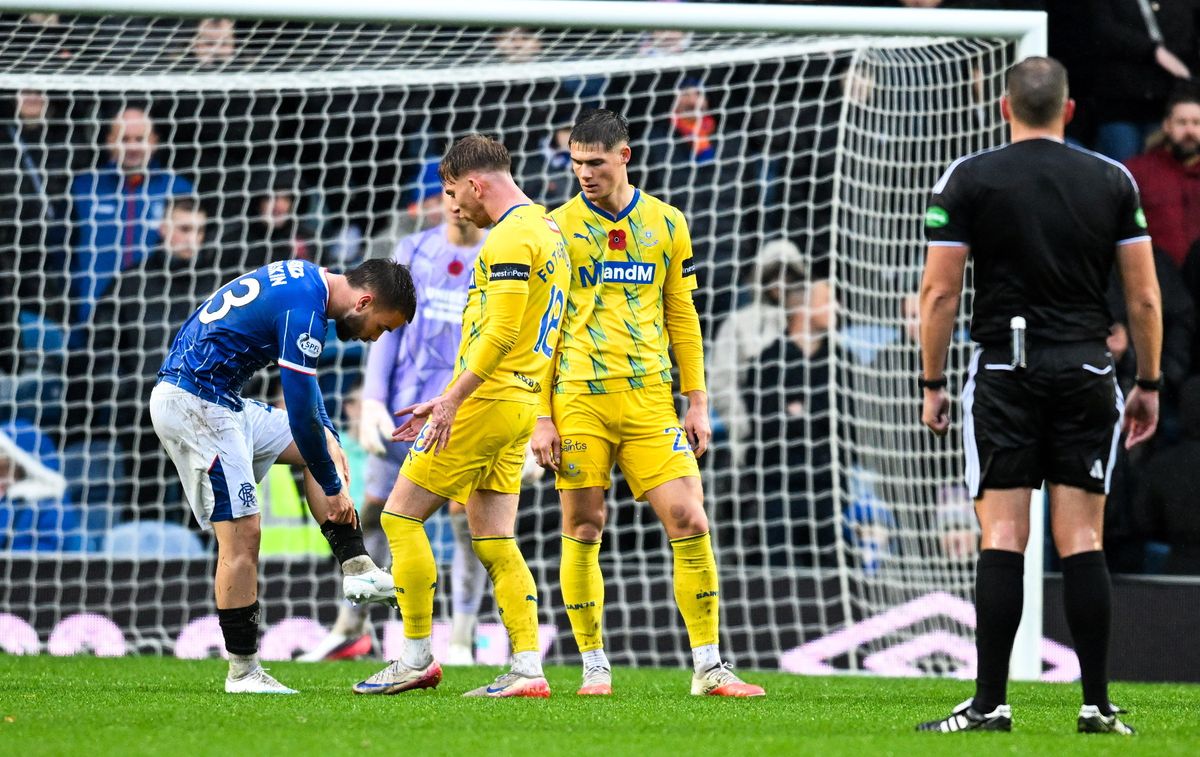
Most red cards are over in seconds. The referee sees a challenge, reaches for his pocket and the argument starts. The sending-off of Kai Fotheringham at Ibrox on Saturday was different, because the argument began before the card was shown and has continued ever since. In the 74th minute of Rangers’ 4-0 win over St Johnstone, with the home side three goals clear, the visiting midfielder challenged Nicolas Raskin near the touchline. The referee consulted VAR, walked to the pitchside monitor, took his time and then produced a straight red. St Johnstone’s manager said he had no complaints. Two television pundits thought the decision was wrong, and one of them suggested that the referee had looked conflicted. It is a good test case for how modern officiating works, and it deserves a closer look.
The incident itself was straightforward to describe and hard to judge. Fotheringham went to ground, won the ball and then caught Raskin on the follow-through above the ankle, as James McFadden put it on BBC Sportscene. The reports describe it as a studs-up challenge, and the Scotsman says the video assistant ruled that the high tackle was grounds for dismissal. The referee reviewed the incident again before sending the player off, and the whole process took long enough for the delay to become a talking point. By the time the card appeared, the match had effectively been decided, and the practical consequences for Rangers were nil.
That context matters, because it shapes the way the debate is conducted. If a red card is awarded at 0-0 in the first half, it changes the match and everyone has a stake in the outcome. When a team is already losing 3-0, the card is less consequential for the result, and the argument becomes almost purely about principle. That is not necessarily a bad thing. It allows pundits and supporters to discuss the decision without the distortion of partisan interest, and it lets us focus on the question that really matters, which is whether the officials applied the law correctly. The answer is more nuanced than either side of the argument suggests.
Begin with McFadden’s view, which was delivered with some sympathy. He said he felt for the player, and he accepted that the challenge looked like a red card on first viewing, since a tackle that catches an opponent above the ankle on the follow-through is often judged serious foul play. But he went on to question why the referee had taken so long, arguing that the length of the delay told him the official was conflicted. Steven Thompson, who was alongside him, went further. He said that for him there was no endangering of a player and no malice in the tackle. Both men therefore concluded that a yellow card, or even no card at all, would have been a fairer outcome.
There is a respectable case to be made for that position. Football has always recognised a difference between a tackle that is mistimed and one that is malicious, and many supporters instinctively feel that the punishment should reflect the player’s intention. Fotheringham won the ball, according to McFadden’s own description, and the contact with Raskin came afterwards, on the follow-through. A midfielder who goes for the ball in good faith and then catches his opponent by accident is not what most people think of when they imagine a dirty tackle. If the law were applied purely on the basis of intent, the red card would look harsh.
The difficulty is that the law is not written that way. Serious foul play is defined by what a challenge does, not by what the player meant to do. A tackle that endangers the safety of an opponent, or that uses excessive force, must be sanctioned with a red card, regardless of whether the player intended harm. Referees are trained to assess factors such as the speed of the challenge, the point of contact, whether studs are showing and whether the opponent’s leg was exposed. Malice is not part of the test, and the lawmakers deliberately removed intent from the equation because it is almost impossible to judge from outside a player’s head. Seen in that light, a studs-up challenge that catches an opponent above the ankle falls squarely within the definition, even if the player is not a dirty one.
That is why McFadden himself conceded that the challenge would normally be an easy red. His objection was about the process, not the substance. He felt that the referee’s hesitation suggested a lack of confidence, and he drew the conclusion that the decision must be shaky. It is a natural inference, and it is one that many viewers will have shared. But there is a good reason to be careful about reading too much into a delay. When a referee is sent to the pitchside monitor, the sequence involves several steps, including looking at multiple angles, listening to the video assistant and speaking to the match officials. Even a clear decision can take a minute or two, and the length of the pause does not necessarily reveal what the referee is thinking.
It is also worth remembering that the system is designed to encourage precisely this kind of careful review. Earlier this week, the head of refereeing, Willie Collum, admitted on the VAR Review Show that officials had been too quick in dealing with incidents involving Rangers and Celtic, and that a longer check should have been carried out. The lesson drawn from those mistakes was that VAR teams must take time over significant decisions. In the Fotheringham case, the officials did exactly that. The video assistant recommended a review, the referee watched the footage and he took the time to reach a considered judgement. It would be an odd outcome if officials were criticised for being too hasty one week and too slow the next.
The involvement of the video assistant is another factor. In Scotland, as elsewhere, VAR can recommend a pitchside review when it believes that the on-field decision was a clear and obvious error, or when a serious incident was missed entirely. In this case, the referee had not sent the player off at first, which means the video assistant must have concluded that the original decision was wrong. That is a high threshold, and it suggests that the officials in the VAR room saw something that was clear to them. The referee then had the chance to look at it himself, and he agreed. Two sets of officials, one in the room and one at the monitor, came to the same conclusion, and that is not the sign of a shaky decision.
The reaction of St Johnstone’s manager is perhaps the most telling piece of evidence. Simo Valakari said that he had no complaints with the decision. Managers do not often accept red cards against their own players, particularly when they are in the middle of a heavy defeat, so the comment carries weight. It suggests that, from the visiting dugout, the challenge looked like a red card, and that the manager did not think there was a good case for challenging it. That does not make the decision right, because managers can be wrong, but it does indicate that the incident was not one of those obvious injustices that provoke instant outrage. If anything, it points to a decision that most of the people closest to the game found understandable.
The difference between the pundits and the manager may come down to perspective. Former players tend to judge challenges according to what feels fair in the heat of a match, and they remember what it is like to be on the receiving end of a card that seemed harsh. Managers and referees, by contrast, are more likely to focus on the letter of the law and on the risk of injury. Both viewpoints are valid, but they lead to different conclusions. A player who has spent years going into tackles will naturally feel that a bit of contact on the follow-through is part of the game, while a referee who has seen what a studs-up challenge can do to a leg will be less forgiving.
That is the heart of the matter. The modern game has become more protective of players, and the reasons are good ones. Studs-up challenges can cause serious injuries, including broken legs and torn ligaments, and the authorities have decided that the risk is too great to tolerate. Referees are therefore instructed to act firmly when a challenge involves studs, a high point of contact or excessive speed, even if the player does not appear to have meant any harm. The result is that some challenges that would have been tolerated twenty years ago now attract a red card, and supporters who grew up with the old standard sometimes find the change hard to accept.
There is also the question of consistency, which is often the real source of complaint. If a challenge like Fotheringham’s is punished with a red card at Ibrox, then the same standard should apply to similar challenges at every ground in the country. The difficulty is that referees do not see identical incidents, and small differences in the angle, the speed or the surface can lead to different decisions. VAR was introduced to reduce that variation, and in many cases it has succeeded, but it cannot eliminate it entirely. When pundits complain that a decision was inconsistent with others they have seen, they are often making a fair point, but it is one that applies to the system as a whole rather than to this particular card.
It is worth thinking about what the decision means for St Johnstone. The club will be without Fotheringham for at least the next three league matches, a significant loss for a team that has been competitive in recent weeks and that relies on its midfielders for energy and creativity. They could appeal on the grounds of wrongful dismissal, but with their own manager saying that he has no complaints, it is hard to see how they could make a convincing case. The more likely outcome is that Fotheringham accepts the suspension and returns when it is over, wiser for the experience. For a young player, a red card is a lesson, and the best response is to learn from it and move on.
For Rangers, the incident is largely a footnote. They were already comfortably ahead, and the extra man made little difference to the scoreline, although the substitutes Djeidi Gassama and Tochi Chukwuani combined for the fourth goal in the closing minutes. Raskin, the victim of the challenge, continued playing, and there is no suggestion in the reports that he was injured. The main significance for the home side is that the win moved them within one point of Celtic, and that is where their attention will be focused. A red card in a 3-0 game is rarely a talking point for the winners, and McInnes will be more interested in what his team did with the chances it created.
The broader lesson concerns the way we talk about referees. It is easy to criticise an official who takes a long time, or who appears uncertain, or who changes his mind. But the opposite, an official who makes snap decisions without reflection, is just as problematic. The best referees are those who gather the evidence, think carefully and then act decisively, and the monitor review is a tool that helps them do that. If a referee looks conflicted, it may simply mean that he is taking his responsibilities seriously. A card that is shown after careful thought is more likely to be right than one that is shown in a hurry, and the supporters who wait for the outcome should be prepared to accept that.
That said, the pundits’ concerns should not be dismissed. McFadden and Thompson are experienced professionals who have seen thousands of challenges, and their instinct that the tackle lacked malice is a fair observation. There is a legitimate debate to be had about whether the law should give more weight to intent, or whether referees should have more discretion to show yellow cards for challenges that are reckless but not dangerous. Those are questions for the lawmakers, and they deserve a serious answer. But until the law changes, officials must apply it as it is written, and the evidence suggests that they did so in this case.
In the end, the Fotheringham red card is a good illustration of how difficult refereeing has become. The officials were criticised for being too quick on one occasion and too slow on another, and they were second-guessed by pundits, supporters and managers alike. They made a decision that most of the people involved, including the St Johnstone manager, accepted, and that fits the letter of the law. That does not mean it was beyond argument, but it does mean that the verdict was not as one-sided as the headlines might suggest. The pundit who said that the referee seemed conflicted was describing a perception, not a fact, and the fact is that the card was shown after a proper process.
For supporters, the best approach is probably to treat the incident with a sense of proportion. A red card in a 4-0 game is not a scandal, and the decision was supported by two sets of officials and accepted by the player’s own manager. It may have been harsh in terms of intent, but it was defensible in terms of the law. The debate will continue, because that is what football debates do, but it should not distract from the story of the afternoon, which was a comprehensive victory for a Rangers team that is playing with growing confidence. The red card, in the end, was a side issue, and it will be forgotten by the time the next round of fixtures arrives