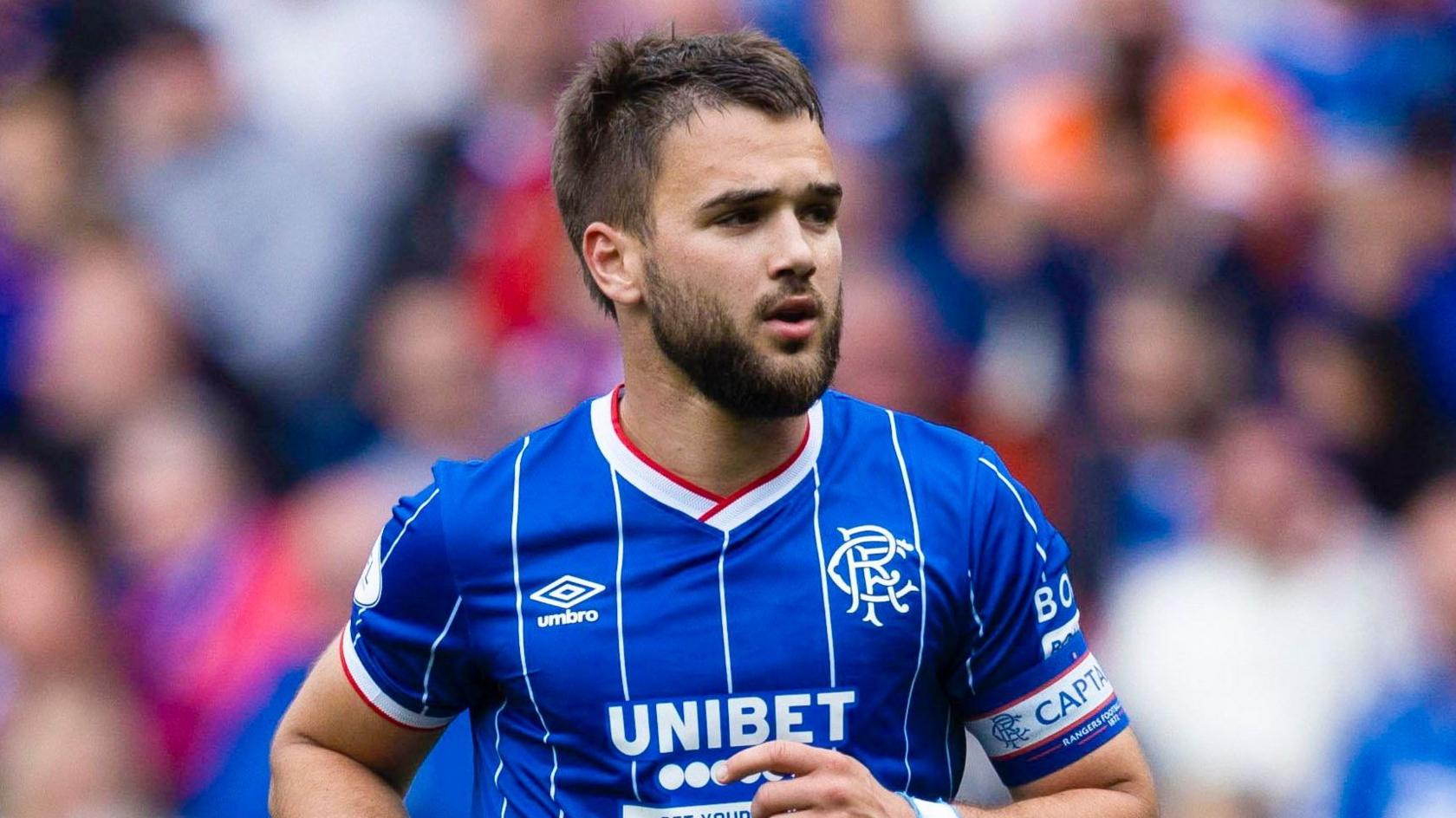
Transfer sagas usually have a clean shape: interest, negotiation, resolution. The story of Nicolas Raskin and Besiktas has none of that. It has been running for the best part of a year, resurfacing every time a window opens, and each instalment seems to leave Rangers with the same question. Hold firm and keep a player who has made no secret of wanting to move, or take the money and lose a midfielder many consider the best in the squad?
With January approaching, the question is live again. Besiktas are reported to be close to reaching an agreement with Rangers to sign Raskin, with Turkish outlet Fanatik putting the fee at €17m. That claim should be treated with caution, as should every number in this saga, but it shows how quickly the temperature has risen.
The Belgian arrived at Ibrox in January 2023. Rangers paid £1.5 million plus add-ons to sign him from Standard Liege. He was 21, a combative, technically assured central midfielder with a taste for driving forward, and one of those signings who looked like a bargain almost immediately.
Over the following years he became a fixture in the middle of the park, a player who could break up play, carry the ball through pressure and pick a pass. He is now 25, and the reporting around his future describes him as a midfielder of a calibre Rangers would not want to lose for free. That phrase hints at a wider issue: the contract situation, which gives the whole saga its urgency.
His profile has risen well beyond Scotland. Former Belgium international Philippe Albert was blunt about it. He said Raskin has proven he is a class above and the best player at Rangers, and was baffled he was still at the club despite interest from top European divisions, including the Premier League. Whatever you make of that verdict, it explains why so many clubs have been circling.l
Besiktas are not newcomers to this chase. They tried to land the midfielder in the January 2026 window, but Raskin reportedly preferred a move to one of Europe’s top five leagues. That detail is crucial to understanding everything that followed. Raskin’s ambitions were never purely about leaving Rangers. They were about where he went next, and a Turkish move did not tick that box.
If January was the opening exchange, the summer was a full-scale drama. The Turkish window closed later than Scotland’s, which handed Besiktas a final push after Rangers’ own deadline. STV reported that Besiktas made an approach late on a Wednesday night, with the Turkish window closing on Friday rather than Thursday for Scottish clubs, and that no agreement had been reached.
Then things got confusing. Fabrizio Romano reported that Rangers had verbally accepted an offer from Besiktas, with the ball in the player’s court. The news travelled fast, and a Turkish outlet ran with a similar line that an agreement in principle had been reached.
But the picture was less clear than the headlines suggested. According to Sky Sports, there wasn’t, and never was, an agreement for the transfer, and Rangers turned down Besiktas’ loan approach. Another outlet put it plainly: Rangers rejected a loan offer despite claims that a deal had already been agreed. It was a classic transfer-window fog, with conflicting reports pointing in opposite directions and supporters left unsure what to believe
The reason, in the end, was money. The offer on the table was a loan, and Rangers wanted far more than a loan could provide. They value him somewhere between £10 million and £20 million, and a loan, even one with an option to buy, apparently did not meet that threshold.
There was also a negotiating dimension. Besiktas believed Rangers were asking an above-normal price given how late it was in the window, and one Turkish journalist said Rangers had been cool on the loan offer from the very start. From Rangers’ perspective, of course, there was nothing unreasonable about holding out. A selling club with the leverage of a closing window and a valuable asset has every incentive to push.
The outcome was a stalemate. A permanent exit failed to materialise, with Rangers rejecting multiple bids from Besiktas in the closing stages of the window. Raskin stayed, though not necessarily happily.
What did the player make of all this? His public stance has been careful. He said he is really happy at a big club like Rangers, but he is unsure about his long-term future at Ibrox. That is the language of a player who is not slamming doors but who has not committed either.
There were reports that he had been prepared to turn the move down himself. Journalist Sacha Tavolieri reported that Raskin had turned down a move to Besiktas. That sits awkwardly with the other reporting, which suggests how murky the picture was. Either the player was never fully on board, or the competing narratives reflect the different agendas of the clubs and agents involved.
Importantly, he does not appear to hold a grudge. One report said he was not angry about his failed exit, but was keen to explore a possible departure in 2027 if the right opportunity emerged. That tells you a good deal. This is a professional who accepted the outcome, kept working and left the door open for next time.
The manager’s view has been similarly measured. Rangers boss Derek McInnes praised Raskin’s training and said he would continue contributing if he stayed. There has been no public falling out, which matters in a dressing room where one unsettled player can unsettle others.l
Now the focus has shifted to the winter window. The signals from Turkey are clear. It is reported that Besiktas management plans to return to the negotiating table in January for the Belgian midfielder. Another report says the Super Lig club failed with both loan and permanent bids in the summer and are preparing to reopen talks.
Besiktas are not the only name in the frame, though. One report suggested Raskin is targeted by eight clubs, and that Rangers continue to value him at around £20 million, a figure no suitor has yet met. That is a significant detail. If true, it means the market for him is broad, and Rangers are not dependent on any single bidder.
The €17m figure reported by Turkish media would, if accurate, sit below Rangers’ reported asking price. That gap is where the real negotiation will happen. Besiktas will want to land him for less than £20 million, and Rangers will want to avoid selling a key player cheaply in the middle of a season.
One complicating factor is McInnes’s stated approach. He indicated recently that he does not expect a busy January transfer window, but losing Raskin could change that. That sentence captures the tension perfectly. A manager who wants stability may have to deal with a major departure.
For McInnes, a Raskin sale would raise immediate practical problems. A midfielder of that quality cannot be replaced from within, and January is a notoriously difficult month to buy well. Prices are inflated, the best players are rarely available and clubs selling mid-season are not inclined to do favours.
At the same time, McInnes will know the argument for selling. If a player wants to leave, has made that clear and could depart for nothing at the end of his deal, then January may be the last chance to get a proper fee. The case for cashing in is a financial and strategic one, not a sentimental one
This is the issue underneath everything. Reporting suggests that the contract situation is part of why January matters. One report noted that an exit in the winter might be on the cards if an extension isn’t signed, because letting a midfielder of such calibre leave for free won’t be Rangers’ Plan A.
The logic is straightforward. A player approaching the end of his deal holds increasing leverage. He can sign a pre-contract with a foreign club in the final months, walk away on a free and leave his club with nothing. Rangers, to avoid that outcome, must either extend him or sell.
An extension looks difficult if Raskin has his eyes on a move. A sale, meanwhile, requires a buyer willing to meet the valuation. The result is a narrow window in which the club has to make a decision it would rather avoid.
I would advise anyone relying on the specific contract details to verify them against the latest club or reliable sources, since the reporting I found is indirect on the exact expiry date
From the player’s point of view, Besiktas are not an obvious dream destination, but they are a serious club. They have a large fan base, a history of European football and the financial muscle of a major Turkish side. They have also shown remarkable persistence, returning for the same player across multiple windows.
The club’s recruitment pattern, according to reports, has leaned towards Belgian talent. One Turkish outlet noted that the transfer activity at Besiktas shows no signs of slowing down, with the club once again targeting a Belgian star. A Belgian midfielder with a Standard Liege background could find familiarity there, and the club’s interest is clearly not a passing whim.
The drawback is the one identified back in January: Raskin reportedly wanted a top-five-league move. A switch to Turkey would mean a step sideways in prestige for some observers, even if the money and the football are good. That could explain why he has not simply jumped at the offers made so far.
Selling Raskin would carry costs beyond the obvious. On the pitch, he is a rare type of midfielder, capable of both defensive work and progressive passing. Replacing that profile is hard, and the January market rarely helps.
There is also a morale dimension. Supporters have watched a succession of key players leave in recent years, and each departure raises questions about the club’s ambition. A sale of a player widely seen as the best in the squad, mid-season, would be hard to sell to a fan base already restless.
But the opposite risk is just as real. Holding a player who wants to leave can poison a squad. A disengaged midfielder, however talented, is a liability, and one whose contract is running down is a financial liability too. The club’s challenge is to weigh these risks and decide which is worse.
A word on the figures, because they vary wildly. The reported valuation sits between £10 million and £20 million in one source, around £20 million in another, and €17 million in the Turkish claim about a near-agreement. A football data site puts his estimated transfer value much lower, at around €9.3 million, within a range of €7.9m to €10.6m.
That spread is telling. Algorithmic valuations tend to understate the price a club will actually demand, particularly for a player whose contract situation and market interest push the figure up. Real fees are set by negotiation, not formulas.
It also illustrates why transfer reporting needs care. Each outlet has its own sources and agenda, and a Turkish report of an imminent deal will not necessarily match what Scottish sources say. Readers are best served by treating each claim as one piece of a larger puzzl
The most likely scenarios fall into a handful of buckets. Besiktas return with an improved bid and Rangers, perhaps reluctantly, accept a permanent deal in the region of their valuation. Or the clubs fail to agree again, Raskin stays through the winter and the question is deferred to the summer. Or another suitor, perhaps from the group of eight mentioned in the reporting, tempts him with the top-five-league move he reportedly wants.
Each has consequences. A sale would give Rangers funds and a hole in midfield. A failure to agree would extend the uncertainty and raise the risk of a free departure. A move to a top-five league would probably be the best outcome for the player, but not necessarily the best for Rangers’ finances.
What seems clear is that the status quo is hard to sustain. A player with a public stance of being happy but uncertain, a contract that is running down and a persistent suitor is a combination that rarely resolves itself without a decision
For Rangers, the Raskin question is bigger than one player. It is a test of how the club manages its assets, its dressing room and its relationship with supporters. Sell too cheaply and the club looks weak. Hold too tightly and it risks losing the player for nothing.
For Besiktas, it is a test of persistence and pricing. They have come back repeatedly and still have not landed their man. Whether they finally do will depend on how far they are willing to go.
And for Raskin, it is about timing. He has been patient, professional and open about his ambitions. He has made clear he is not desperate to leave, but also that he is not committed to staying. January may be the moment that ambiguity finally ends.
Whatever happens, the story is a reminder of how much of football is conducted in public and how little of it is certain. A verbal agreement can evaporate overnight, a rumour can contradict a rumour and a player who looks gone can still be at training on Monday. Supporters would be wise to wait for the official announcement before drawing conclusions