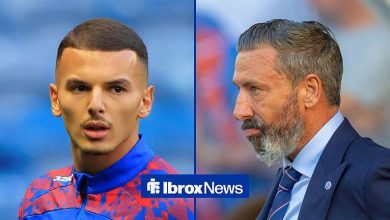
He Wants to Join: Inside Rangers’ Chase for as Derek McInnes Rebuilds His Midfield From the Ground Up

Rangers are closing in on a deal that, on paper, looks like a modest piece of transfer business — a £4 million-ish bid for a 20-year-old holding midfielder most British fans have never heard of. In practice, it is the clearest signal yet of how radically Derek McInnes intends to reshape Ibrox’s engine room this summer, and how much is riding on getting it right before the Scottish Premiership season kicks off in a matter of weeks.
Vanja Dragojevic, the captain of Partizan Belgrade, is understood to be edging towards Govan, with reports in Serbia and Scotland now suggesting an agreement could be struck within days. It would be Rangers’ sixth significant piece of summer business under their new head coach, and arguably the one that says the most about the identity McInnes wants to build into his team.
A Deal That Has Been Grinding Toward the Finish Line
The numbers tell their own story of a negotiation that has moved in increments rather than leaps. Rangers’ opening approach, somewhere in the £3.8 million to £4 million bracket, was knocked back by a Partizan hierarchy who value their captain considerably higher. Serbian outlet Mozzart Sport has suggested the Belgrade club want closer to £4.7 million, with some reports pushing the figure as high as £5.5 million once bonuses and add-ons are factored in. The gap between the two positions has narrowed steadily rather than dramatically, the kind of incremental movement that either collapses at the final hurdle or gets bridged in the last 48 hours of a window.
What makes Partizan’s resistance more than simple haggling is the contractual position they hold. Dragojevic signed an extension in May 2025 that ties him to the club until the summer of 2030 and carries a release clause reported at around €15 million — more than three times what Rangers have so far offered. Partizan’s sporting director, Radosav Petrovic, has all but confirmed the interest without naming the club involved, telling reporters that departures have been widely discussed and that concrete information should emerge in the coming days. That is about as close to an official nod as a selling club tends to give before a deal is actually signed.
There is also a human dimension to how seriously Partizan are treating the situation. According to Serbian outlet Telegraf, the club has placed Dragojevic on what amounts to a protective regime during training, deliberately managing his involvement in contact drills alongside teammate Ognjen Ugresic — who is subject to interest from Bologna — specifically to avoid any injury that could derail either move. It is an unusual step, but one that underlines how much both transfers matter to a club that, by its own admission, is leaning on this summer’s sales for financial stability.
Dragojevic’s representative, former goalkeeper Bojan Saranov, struck a note of caution when contacted directly. Asked about the state of negotiations, Saranov said he would confirm any agreement once it was close, but that as things stood, that point had not yet been reached. It is the kind of measured response typical of a deal that is advanced but not yet signed, sealed and delivered — consistent with reporting elsewhere that talks have accelerated significantly in the past week even if a final figure hasn’t been agreed.
Who Is Vanja Dragojevic?
For supporters who have followed midfield reinforcements linked to Ibrox purely by transfer fee and reputation, Dragojevic’s rise is a genuinely rapid one. Born on 11 January 2006 in Belgrade, he progressed through Partizan’s academy before spending time on loan with affiliate club Teleoptik during the 2024/25 campaign. He was recalled to the first team by then-manager Srdan Blagojevic in the second half of that season and made his senior debut in March 2025.
What followed was an unusually swift ascent. Within months of establishing himself as a regular starter, Dragojevic was handed the armband, becoming Partizan’s captain at an age when most of his peers are still fighting for a first-team squad number. Serbian media have described him as a “modern leader,” and in his own words, the responsibility of the captaincy at a club like Partizan leaves no room to hide. He has spoken about how the shirt demands players stand at the front and take the physical and emotional weight of matches, rather than lead quietly from the periphery — a mentality that, if it translates, would fit neatly into the confrontational rhythms of Scottish Premiership football.
On the pitch, Dragojevic operates as a defensive midfielder, standing around 184cm and playing predominantly with his right foot. His numbers last season were solid rather than spectacular for a holding player: 31 appearances in the Serbian SuperLiga, three goals and three assists, plus a broader tally of 41 appearances and four goals when cup and continental competition are included. He has already earned two senior caps for Serbia, making his international debut as a late substitute in a friendly defeat to Cape Verde. Transfermarkt currently rates his market value at around €8 million, which gives context to why Partizan feel Rangers’ opening offers represent a discount rather than a fair valuation — even accounting for the natural gap between market-value estimates and actual transfer fees agreed under time pressure.
There is also a competitive dimension pushing Partizan to hold firm. Both Manchester United and Borussia Dortmund have been credited with monitoring Dragojevic, along with interest from Besiktas, even if none of those links have yet developed into concrete offers. For a selling club, that kind of background interest is leverage in itself: it lets Partizan tell Rangers, implicitly or explicitly, that they are not the only suitor in the room, even if they are currently the most advanced.
The Bigger Picture: Why McInnes Needs a New Midfield Spine
Dragojevic’s pursuit cannot be understood in isolation. It sits inside a much larger reconstruction project at Ibrox, one born out of a genuinely difficult 2025/26 campaign that saw Rangers miss out on the Scottish Premiership title to Celtic once again. The appointment of Derek McInnes, arriving from Hearts to replace Danny Rohl, was the first major structural change of the summer, and the alterations to the playing squad have followed at a rapid clip ever since.
The rebuild has already delivered five new first-team additions before a ball has been kicked in anger. Lawrence Shankland arrived from Hearts as a proven Scottish Premiership goalscorer, giving McInnes an immediate focal point up front. Ross McCrorie returned to Ibrox from the Premier League to fill the void left by James Tavernier’s departure — a full-circle moment given McCrorie was previously signed for Aberdeen by McInnes himself, and one the defender described as fulfilling a boyhood ambition to represent Rangers rather than simply return to Scotland. Ben Godfrey has joined on loan to add Premier League experience at the back. Dan Neil has arrived on a free transfer from Sunderland, immediately strengthening the engine room. And goalkeeper Ivor Pandur has been brought in from Hull City, in a deal that also saw Jack Butland move in the opposite direction to the Tigers.
What is notable about this business is how it has been funded. Rangers have, by design, kept their outright spending relatively restrained, leaning instead on free transfers, loans and player sales — Butland’s departure being the clearest example — to create room for the bigger-ticket items still to come. That approach has been credited in part to the financial backing of owner Andrew Cavenagh and the 49ers Enterprises group, who are understood to be prepared to back McInnes significantly if the right targets present themselves. Dragojevic, and the second midfield pursuit running in parallel to him, represent exactly that kind of target.
The Parallel Chase: Jens Hjerto-Dahl and Tromso’s Resistance
While Dragojevic negotiations edge toward a conclusion, Rangers have simultaneously been pursuing a second midfield addition in Norway. Jens Hjerto-Dahl, the 20-year-old Tromso midfielder, has been persistently linked with Ibrox for the best part of eighteen months, and the interest has now escalated into a formal bid.
According to Norwegian outlet iTromso, Rangers tabled an offer worth 70 million Norwegian kroner — around £5.3 million — only for Tromso to reject it immediately and unambiguously. It is a firmer knockback than anything Partizan have delivered over Dragojevic, and it reflects a very different negotiating position: Tromso, unlike Partizan, appear to have no pressing need to sell and have made clear they intend to hold out for a fee closer to their original valuation, reported earlier this year at around £10 million.
Hjerto-Dahl’s numbers explain the reluctance to let him go cheaply. He has scored 12 goals in 96 appearances for Tromso and was in outstanding form heading into the current Eliteserien season, netting five goals and adding two assists in his opening 12 league appearances. He was, by some reports, unlucky to miss out on Norway’s World Cup squad given that form. An attacking-minded central midfielder rather than a pure defensive operator, he represents a different profile to Dragojevic — more of a like-for-like successor to Nicolas Raskin’s forward-driving instincts than a defensive midfield replacement.
This is not new territory for Hjerto-Dahl. Rangers were strongly linked with him in January 2026, an approach that ultimately went nowhere after the arrival of Tochi Chukwuani removed the practical need to force through a deal in the winter window. Hjerto-Dahl has since spoken candidly about how stressful he found that period of speculation, revealing he turned down interest from Turkish clubs at the time and describing the process as one he did not particularly enjoy, even as he insisted he never felt pressured by Tromso or his representatives. He signed a contract extension with Tromso in February, running to December 2029 — itself a sign that at the time, at least, he was not actively pushing for an exit. Whether a fresh approach from a club of Rangers’ stature during a breakout scoring run changes that calculus remains to be seen, but Tromso’s immediate rejection of the opening bid suggests this will be a longer and more expensive pursuit than the one for Dragojevic.
The Raskin Question: Funding the Rebuild
None of this midfield investment makes sense without understanding the departure that is quietly funding it. Nicolas Raskin, Rangers’ Belgian international and arguably their most influential midfielder over the past two seasons, looks set to leave Ibrox this summer, with Real Betis having opened concrete talks over a move to Seville.
Raskin’s situation has been transformed by his performances at the 2026 FIFA World Cup. Belgium’s dramatic 3-2 comeback win over Senegal in the round of 32 — a match in which Raskin came off the bench to replace Kevin De Bruyne and even had to intervene to break up an on-field flashpoint between teammates Youri Tielemans and Leandro Trossard — has only sharpened interest in a player who was already attracting serious attention before the tournament. Real Betis are understood to be exploring a deal below Rangers’ reported £20 million valuation, while at least two Serie A clubs, along with Hull City — who have already had a £14 million bid rejected — and Atalanta are said to be monitoring the situation closely.
Rangers’ negotiating position is a strong one. Raskin has two years left on his contract, meaning there is no obligation to sell at a discount, and the club’s stated valuation has reportedly climbed as high as £20 million, with some outlets suggesting a figure closer to €25 million depending on how far Belgium progress in the tournament. Given Raskin joined from Standard Liege for a modest initial fee, any sale in that region would represent an extremely profitable piece of business — precisely the kind of capital injection that allows McInnes to be aggressive in pursuit of both Dragojevic and Hjerto-Dahl without unbalancing the club’s finances.
The football logic is more complicated than the financial logic. Raskin has been one of the most consistently effective performers at Ibrox in recent seasons, and his ability to influence matches through personality as much as technical quality is not easily replicated. Rangers do have internal options — Mohammed Diomande, Chukwuani, Lyall Cameron, Conor Barron and now Dan Neil all provide central midfield depth — but none carry quite the same blend of composure, drive and leadership that Raskin has offered. That is part of the reasoning behind McInnes’s determination to have both Dragojevic and a more advanced profile like Hjerto-Dahl, or alternatively Bologna captain Lewis Ferguson, lined up before Raskin’s exit is finalised, rather than allowing a gap to open up in the middle of the park heading into a title challenge.
What This Means for Ibrox
Taken together, the picture emerging from Ibrox this summer is of a club trying to execute a coordinated midfield transformation rather than a series of disconnected signings. Dan Neil provides free-transfer stability and physicality. Dragojevic, if the deal is completed in the coming days as expected, would add a young, ball-winning captain with room to grow into a leadership role at Ibrox in the way he already has at Partizan. Hjerto-Dahl, should Rangers eventually meet Tromso’s valuation, would offer a more progressive, goal-scoring dimension further up the pitch. And the funds generated by Raskin’s near-certain departure to Real Betis or elsewhere are what makes the arithmetic of the whole operation work.
For a club that has watched Celtic retain dominance of Scottish football in recent seasons, the scale of this midfield rebuild under McInnes represents a genuine statement of intent. Whether it translates into results will depend on far more than transfer fees — integration, chemistry and the step up in physicality and tempo that Scottish Premiership football demands of new arrivals from Serbia and Norway are not guaranteed. But in terms of ambition, Rangers’ recruitment team appear determined to enter the new season with a midfield that looks structurally different, and considerably younger, than the one that finished runners-up to Celtic last term.
With the Scottish Premiership season now only a few weeks away, the coming days are likely to be decisive. If Dragojevic’s move over the line as expected, attention will turn quickly to whether Rangers can force Tromso’s hand over Hjerto-Dahl, and to exactly how much Real Betis, Hull City or one of the interested Serie A clubs are ultimately willing to pay to prise Raskin away from Ibrox. Derek McInnes’s first transfer window as Rangers head coach is shaping up to be one of the busiest, and most closely watched, in recent memory.