
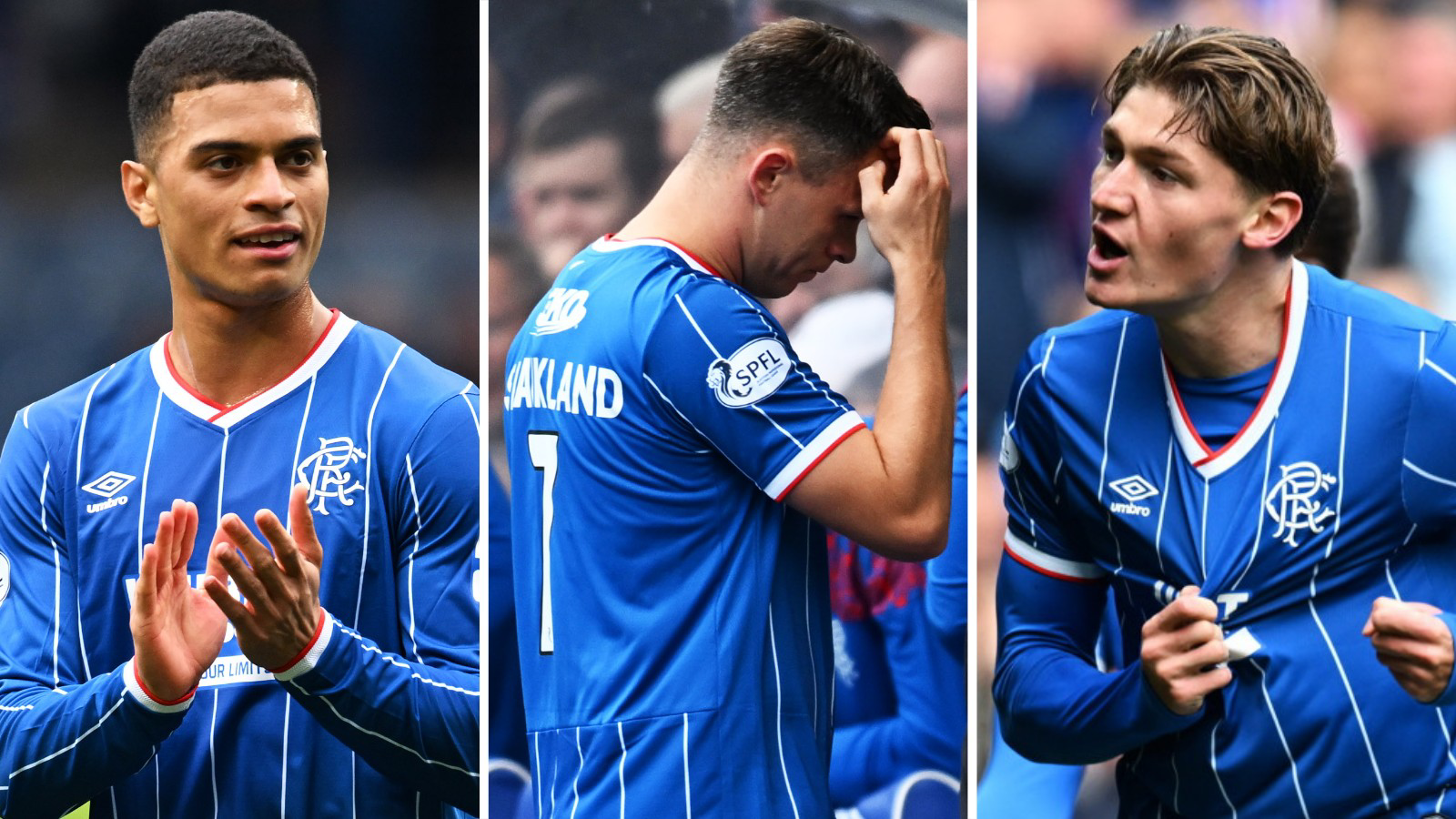
Every club has a player whose absence changes the mood around the place, and for Rangers that player is now Lawrence Shankland. The captain, signed in the summer from Hearts to lead the line under Derek McInnes, had barely begun his Ibrox career when a hamstring tear stopped it in its tracks. What followed was a slow drip of updates, each one confirming that the problem was bigger than first hoped, until the picture settled into its current form: surgery completed in London, a recovery that is going well, and a return that is not expected until the new year. For a team that has been winning regularly, it is a loss that is felt more as an absence of quality than as a crisis, but it has still changed the shape of the season.
The incident itself was almost unremarkable. Rangers were beating Motherwell 1-0 at Ibrox on 5 September when Shankland pulled up early in the game, clutching the back of his leg. Reports differ on the exact minute, with some saying five, some six and others eight, but all agree that he left the pitch very quickly and was replaced by Ryan Naderi. Naderi then scored the only goal of the match, which meant that the afternoon ended in victory, but the celebrations were muted by the sight of the captain walking away with his head down. He knew, as the manager later said, that it was significant, and the way he walked off made that obvious to everyone watching.
McInnes was quick to share his fears. In his post-match comments he said Shankland could be out for a while with a significant hamstring injury, and he pointed to a similarity with the problem the player suffered at Hearts the previous January. That earlier injury had kept the striker out for around three months, so the comparison immediately raised the prospect of a long absence. The manager added that the player had felt fine going into the game and could not identify anything he had done to cause it, although he had felt a little stiff and tight in training over the previous couple of days and after travelling.
One detail from the manager stood out because it showed how randomly these injuries can strike. According to McInnes, Shankland had been standing around for a couple of minutes at the start of the game while VAR checks interrupted play, and his first sprint after that pause was the moment the muscle went. It is the kind of ordinary sequence that happens in countless matches without consequence, and it illustrates why hamstring injuries are so frustrating for players and coaches. There is rarely a single tackle or awkward landing to blame, just a muscle that is asked to work at full power and fails.
The scan results confirmed the worst. McInnes said Shankland had suffered a grade 2c tear, which was described elsewhere as a tear of about two centimetres, in a spot very similar to the one he injured at Hearts. A grade 2 injury involves a partial tear of the muscle fibres, and the added letter indicates a more serious category within that group. It is serious enough to demand a long recovery and to raise the question of whether surgery should be considered. The manager noted that the player had come back smoothly from the last such injury and reached the World Cup, which offered a ray of hope, but it was clear that this time the decision would be more complicated.
The club arranged a follow-up scan with a specialist in London to decide between surgery and natural healing, and McInnes set out the trade-off with admirable clarity. Surgery would add time to the recovery but reduce the chance of a recurrence, while avoiding it might speed up the return but leave the muscle more vulnerable. He explained that the operation could add three to four weeks to the timetable, and that more would be known within a couple of days. It was a classic medical dilemma, with short-term convenience on one side and long-term protection on the other, and it was a decision that would shape not just the autumn but the whole season.
When the answer arrived, it pointed firmly towards surgery. McInnes confirmed that Shankland would have an operation in London on Thursday, on the same day that winger Daisuke Yokota was due to have surgery for a groin problem. The manager said the decision was the one he had expected the specialists to make, and that the player himself had been leaning in that direction. His reasoning was that, because this was effectively a recurrence of the earlier injury, surgery would minimise the risk of it happening again. For a 31-year-old striker whose game depends on sharp movement, protecting against another tear is arguably worth more than saving a few weeks.
The timeline has shifted as the details have emerged. The first estimate was about three months, and the manager’s early range was three to four months. With surgery now added, the latest reports, which cite Football Insider sources, say Shankland will be sidelined until 2027, though he is progressing well and Rangers are hopeful of having him back in the new year. That timing fits what one would expect from a four-month recovery that began in early September, with a margin for caution. It means the striker will miss the busy period leading up to Christmas, and he will return only when the season is well into its second half.
For a club with ambitions in every competition, that is a significant gap. One analysis has tried to quantify it by estimating that he could miss as many as twenty games in total. Among the fixtures on the list were the first Old Firm league meeting of the season, which has already come and gone, and a series of league matches against clubs including Dundee United, Hibernian, St Johnstone, Hearts, Kilmarnock and Dundee. Importantly, it also noted that he would miss a potential League Cup final in December. Cup finals are the sort of occasions where a seasoned goalscorer can be decisive, and not having him available for such a match would be a real disappointment.
The pundit Michael Stewart raised a different concern when he discussed the injury on a podcast. He said that the manager’s instant recognition of the problem as the same as the one in January was a major worry in itself, and he pointed out that Shankland is now 31. The point is that repeated injuries to the same area can signal that a body needs a different approach to training and recovery, and that the real challenge may come after the player returns. Stewart also expressed sympathy for the player, saying it was disappointing for him to be missing so many big games and for Rangers going forward. It is a balanced view, acknowledging both the immediate cost and the longer-term uncertainty.
Timing makes the loss feel sharper. Shankland had begun to find his rhythm at Rangers, with reports saying he had scored three goals in his first handful of Premiership games after the move from Hearts. A striker in that state of mind is dangerous, because confidence and form feed each other, and every goal makes the next one easier. A long layoff interrupts that process abruptly, and when the player returns, he will have to rebuild the sharpness that he had just started to acquire. It is one of the cruellest aspects of injuries, that they tend to strike when a player is most in need of momentum.
It is a measure of the club’s strength that the team has carried on winning. Rangers have strung together six victories in a row, including back-to-back wins over Celtic, and the win over Motherwell on the day of the injury was their fourth consecutive success and lifted them to second in the Premiership at the time. Naderi, who replaced the captain that day, has been one of the stars, scoring the winner against Celtic as well. The team has therefore shown that it can function without its main striker, which takes some of the pressure off the question of when he will be ready to return.
McInnes now has several options in attack. Kevin Kelsy, the £9 million signing from Portland Timbers, was identified as the player expected to take on the largest share of the burden, and he has already shown signs of settling, with a goal and an assist reported so far. Naderi has been a revelation since arriving from Hansa Rostock, and Bojan Miovski remains at the club after a proposed loan move did not go through. Each offers something different, and the manager can mix and match depending on the opponent. None of them is a direct replica of Shankland, but between them they provide enough variety to keep the team competitive.
The depth is further tested by the other injuries in the squad. Youssef Chermiti, the young striker, is out for the season with a knee ligament injury, and Yokota will be out for a couple of months after groin surgery. That leaves a thinner group than McInnes would like, and it raises the stakes for the players who remain. Any additional injury to the front line would stretch the squad uncomfortably, and the manager will be hoping for a period of good fortune. It is a reminder that depth is not just a luxury but a necessity in a long season with competitions on several fronts.
There has also been some more provocative commentary on the situation. One article argued that the injury might jeopardise Shankland’s Rangers career before it has properly begun, because the time out gives rivals a chance to establish themselves ahead of him. It noted that his only two non-penalty goals had come in a single match against Falkirk and suggested he had struggled in general play, and it even claimed that a young academy graduate was already targeting his number 7 shirt. That is a harsh reading, and it is worth treating with caution, since judging a striker on a handful of games is rarely fair. Still, it highlights an unavoidable truth: a player who returns from a long injury must earn his place back.
That challenge is real but not insurmountable. Shankland has a long record of scoring goals at previous clubs, and the qualities that made him a prolific striker in Scotland, such as intelligent movement, composure in front of goal and an ability to link play, do not disappear because of a tear. If he returns fit and sharp, he will be competing against players who have enjoyed a good run, but that is exactly the sort of competition that tends to bring out the best in an experienced striker. The manager will also appreciate having a proven option for the second half of the season, when the fixtures come thick and fast and the squad’s resources are tested.
The injury has cost him on the international front as well. Shankland was ruled out of Scotland’s upcoming Nations League fixtures, which marked the beginning of Sebastian Pocognoli’s tenure as head coach. A new manager is naturally interested in who is available and in form, and a player who misses the opening games of that reign has to work harder to establish his place afterwards. Scotland have other forwards who can fill the gap, and the national team will not stand still while the Rangers captain recovers. His next chance to impress will come only when he is back in the club’s first team and scoring again.
The medical programme he will follow is likely to be careful and gradual. After surgery, a player normally begins with basic mobility work and light strengthening, then progresses to walking and jogging, followed by controlled running and eventually sprinting. Only when those stages are complete does he return to contact training and match simulations. The final steps are the riskiest, because the hamstring is being exposed to the explosive efforts that caused the original injury, and the staff will want to make sure he can handle full-intensity sessions without discomfort before approving a return. Given the history, there is every reason to expect the club to be conservative.
McInnes has handled the communication well. He has been honest about the unknowns, explained the thinking behind the surgery decision and avoided making promises about specific return dates. That transparency helps supporters understand that the club is acting on professional advice rather than guesswork, and it also protects the player from the pressure of unrealistic expectations. The manager’s comment that Shankland himself favoured surgery suggests that the decision was shared, which should help the player feel confident in the plan. A player who trusts the treatment is more likely to commit fully to the rehabilitation.
For the fans, the situation calls for patience. It is natural to be disappointed that a new captain will miss so much of the season, but the team’s results have given reason for optimism, and the long-term view is that a properly healed striker will be more valuable than one rushed back too early. The history of the sport is full of players who returned prematurely and found themselves back on the treatment table. By choosing the cautious route, Rangers have given themselves the best chance of having Shankland at his best when it matters most, in the months when league and cup campaigns are decided.
The January transfer window will naturally enter the conversation. If injuries continue to affect the squad, the club may feel the need to strengthen the forward line, and the board has shown it is willing to spend when necessary, as the Kelsy deal demonstrated. On the other hand, with Shankland expected to return around the same time, the manager might feel that he already has enough options. The decision will depend on how the team is performing, how many players are fit and whether any new problems arise. It is one of those situations where the right answer can only be seen close to the moment.
There is also a leadership question that deserves attention. Shankland was appointed captain partly because of his experience and his standing in the squad, and his absence leaves a gap in the dressing room as well as in the attack. Other senior players will need to take on more responsibility, and McInnes will have to decide who wears the armband in his place. Leadership often emerges in difficult spells, and it is possible that the group will grow stronger as a result. Nevertheless, it is not easy to replace someone who commands respect, and the captain’s influence will be missed even when he is not on the pitch.
From a wider perspective, the episode illustrates how quickly football can change. A striker who joins in the summer with high hopes and a handful of goals to his name can find himself on the sidelines for months, while others take his place and the team moves on. The best clubs adapt to such changes without losing their rhythm, and Rangers have so far done that well. They have kept winning, introduced new players successfully and stayed competitive in every game. If they can maintain that approach, the absence of their captain will be seen as a setback rather than a disaster.
Looking ahead, the key dates are likely to arrive in the new year. If the recovery stays on track, Shankland could be back in training around the turn of the year and could begin to feature in matches soon afterwards. The first appearances may come from the bench, as the manager eases him back, and his full return to the starting line-up could take several weeks more. That would give him a few months to make an impact before the end of the season, and a striker who is hungry after a long absence can be a potent weapon in the closing stages.
The final verdict on the whole saga must wait until he is back on the pitch. For now, the facts are that he has a grade 2c hamstring tear, has had surgery in London, is progressing well and is expected to return in the new year. Rangers have the depth to cope, the form to stay at the top of the league and the patience to wait for the right moment. The story of Shankland’s season is unlikely to be a happy one so far, but it is far from over, and the chapter that matters most may still be waiting to be written once he is fit again










