Liverpool Banned From Facing Real Madrid In Champions League Fixture By UEFA

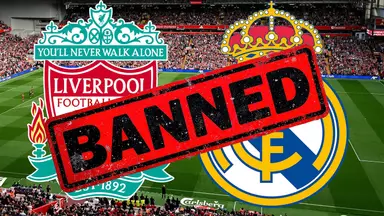
Liverpool fans were left in shock after news broke that UEFA has officially banned the Reds from facing Real Madrid at Anfield in the Champions League group stage next season. It sounds unbelievable, but it is true. A new UEFA regulation introduced before the 2025/26 campaign has changed how fixtures are drawn, and it directly affects Liverpool’s historic rivalry with the Spanish giants.
Arne Slot’s side, who are trying to rebuild their confidence after a rough few weeks, were preparing to face Real Madrid again at Anfield on Tuesday night. But UEFA’s latest rule means that it will be the last time Liverpool can host the Spanish champions in a Champions League group stage match for at least the next two years. It’s a rule many fans didn’t even know existed until now, and it has immediately caused debate across Europe.
Liverpool’s record in recent weeks has been shaky. They have lost six of their last eight matches in all competitions, a run that has raised questions about the squad’s depth and form. But a 2-0 victory over Aston Villa in the Premier League gave the team a small boost before their next European test. In the Champions League, Liverpool have been solid but not perfect. They defeated Atletico Madrid and Frankfurt but fell to a shock defeat against Galatasaray in the second matchweek.
Meanwhile, Real Madrid, led by Carlo Ancelotti, have been flying. They have won every single game in their Champions League group so far and sit comfortably at the top of the league phase. Tuesday’s clash between both sides at Anfield was meant to be another fiery encounter in a rivalry that has become one of Europe’s biggest. But behind the football excitement lies a regulation that will soon make such fixtures impossible to happen again—at least not at Anfield.
According to UEFA, the new rule was introduced to bring more balance and variety to the Champions League’s league-phase format. The rule states that if two teams have faced each other twice in two consecutive seasons with the same home team, they cannot face each other again with that same home team for a third season in a row. In simple terms, it’s UEFA’s way of saying “enough repetition.” They want fans across Europe to enjoy fresh matchups and not see the same home-and-away combinations every year.
For Liverpool and Real Madrid, this means that their upcoming clash at Anfield will be the last group-stage meeting at that venue until at least the 2027/28 season. If both teams are drawn together again next season, the fixture will automatically have to be played at the Santiago Bernabéu in Spain instead. This would then cause one of Liverpool’s away games to be switched to Anfield to maintain the rule that every team must play four home and four away matches in the group stage.
It’s a logistical rule, but it has deep footballing consequences. Liverpool’s Anfield atmosphere is famous across Europe. Over the years, it has broken even the biggest teams—Barcelona, PSG, Manchester City, and others have all suffered under the roar of the Kop. Real Madrid, who have a strong history against Liverpool, including their Champions League final victories, have often seen Anfield as one of the toughest grounds to play in. That’s why this ban feels so big.
UEFA’s full rule reads: “If any teams that already played against each other in the league phase of the UEFA Champions League in the 2024/25 season are again drawn against each other, with the same home team, in the league phase of the UEFA Champions League in this 2025/26 season, those teams will not be able to be drawn against each other with the same home team in the 2026/27 season (although, for the sake of clarity, those teams could still be drawn against each other at the venue of the other team).”
The new system aims to make fixtures more balanced and unpredictable. UEFA wants to prevent fans from complaining that the same fixtures are repeated every year, as often happens with clubs like Liverpool, Real Madrid, Bayern Munich, and PSG who always make it to the Champions League. However, for Liverpool fans, this change feels more like a punishment than a fresh start. Many fans believe UEFA is taking away the magic that comes with Anfield nights.
In Liverpool, European nights are more than football matches. They are spiritual moments. When the Champions League anthem rings around the stadium and the crowd sings “You’ll Never Walk Alone,” it’s not just a song—it’s a declaration of pride, of history, of belonging. Taking Real Madrid away from that setting feels like removing a piece of football theatre. The rivalry between Liverpool and Real Madrid is one of the most emotional in recent European history. The two clubs have clashed in several Champions League finals, most notably in 2018 and 2022, both of which went the way of the Spanish giants.
Liverpool fans still remember the heartbreak in Kyiv and Paris, where Mohamed Salah’s dreams were crushed twice by the same opponents. But when Liverpool defeated Real Madrid 2-0 at Anfield in last season’s group stage, it felt like revenge. It was a statement that the Reds could still rise and fight the same giants that once broke them. Now, hearing that UEFA’s new rule will stop that from happening again so soon feels bitter.
Inside the club, there is understanding but also disappointment. Sources close to Liverpool’s management have said that the club respects UEFA’s decision but believes more flexibility should be allowed in scheduling. Arne Slot, when asked about the rule, reportedly smiled and said, “Well, if they don’t come to Anfield, we’ll just go there and make the Bernabéu shake.” The Dutch manager has built his reputation on courage and calmness, and he seems ready for any challenge.
For Real Madrid, the rule doesn’t hurt as much. The Spanish side have won four of their last five meetings against Liverpool in the Champions League. They might even see this as a small advantage, as Anfield has always been a difficult place for them. Playing at home instead might make their path smoother.
Football experts, however, have mixed feelings about UEFA’s new rule. Some believe it’s a fair step towards equality in competition. Others think it’s unnecessary and takes away from the traditions that make European football special. Journalist Ryan Smart, who broke the story, explained that the rule only applies to the group stage and not to the knockout rounds. So, if fate brings Liverpool and Real Madrid together again in a quarterfinal or semifinal, they can still face each other at Anfield.
Fans on social media were quick to react. “UEFA just can’t stop interfering,” one fan wrote. Another said, “They’re scared of Anfield. They know what happens here when the lights come on.” On X (formerly Twitter), Liverpool supporters posted photos of their famous comebacks, reminding the world why Anfield is sacred.
The timing of this announcement has also raised eyebrows. It came just before the match against Real Madrid, adding more tension to an already emotional fixture. Some fans believe UEFA deliberately chose this time to make it public, while others see it as coincidence. Either way, the match now carries even more meaning—it could be the last time the Kop sees Real Madrid for a long time in a group game.
Anfield is expected to be packed to its limits. Every chant, every song, and every scream will echo with the awareness that this could be goodbye—for now. The players know it too. Mohamed Salah, Darwin Núñez, Trent Alexander-Arnold, and Virgil van Dijk are all ready to give everything. Slot’s men want to make this final Anfield showdown one to remember.
It’s strange how football rules can change emotions. What UEFA sees as a fair technical adjustment, fans see as an attack on tradition. The beauty of football has always been its unpredictability, but not in the sense of who you play—it’s about how you play, where you play, and the stories that come with each match. Anfield and Real Madrid are part of football’s storytelling.
For now, the focus remains on Tuesday’s game. Liverpool need a result. Real Madrid want to continue their perfect run. Beyond the scoreline, though, lies a piece of history being written—one that says goodbye, at least temporarily, to one of football’s most intense modern rivalries at one of its most legendary grounds.
When the final whistle blows, and fans sing “You’ll Never Walk Alone,” it won’t just be about the game. It will be a farewell. A promise that even if UEFA bans this fixture, the spirit of Anfield will always remain. Rules can change fixtures, but they can never silence the magic that happens when Liverpool play under those lights.