Man Utd’s Surprise Move for Nicolas Raskin Solves One Problem – But Creates Another for Rangers

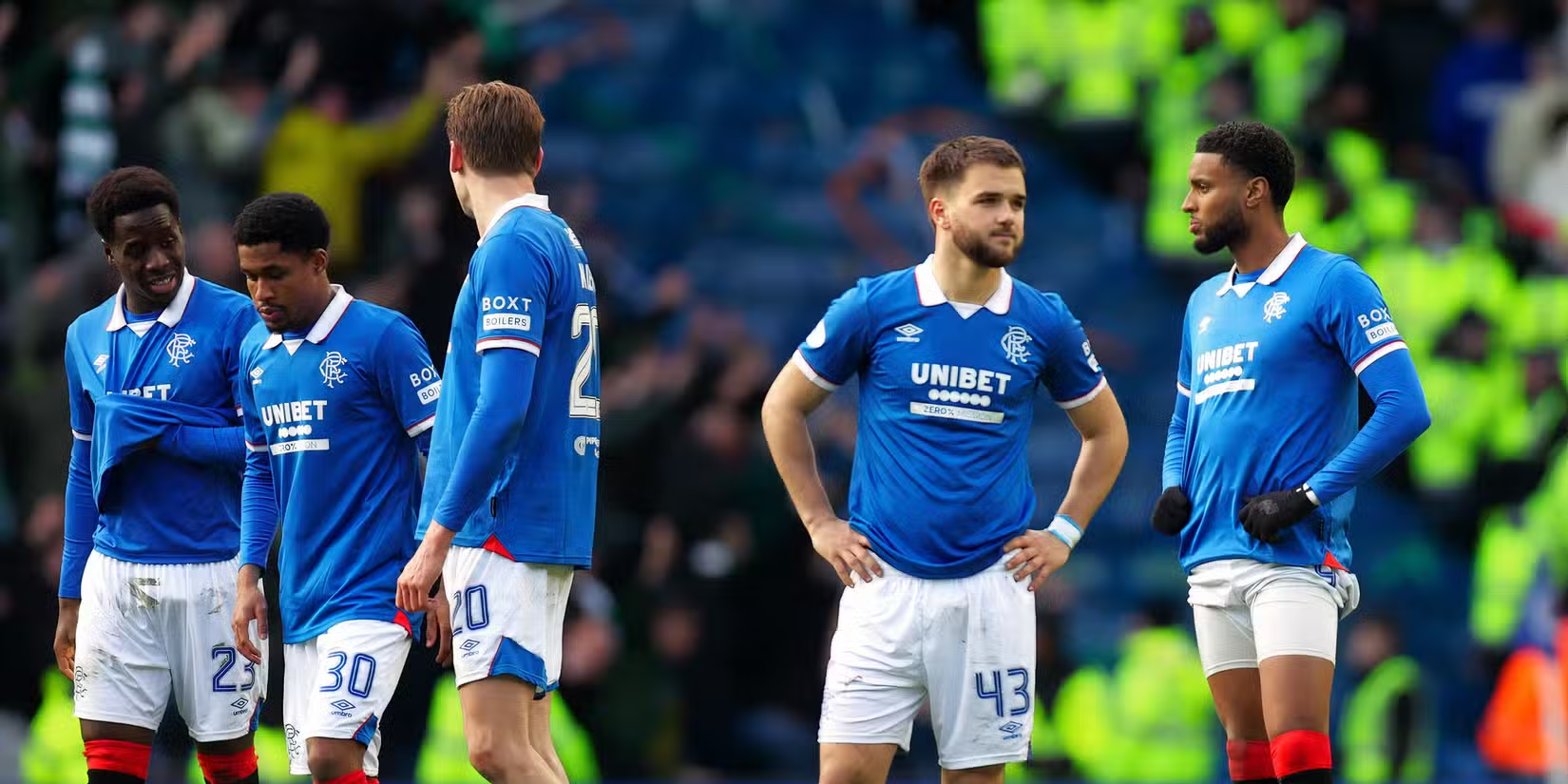
Nicolas Raskin’s summer was supposed to be about celebration. A first World Cup, six appearances for Belgium on the biggest stage in football, and a return to Ibrox as a genuine international performer rather than simply a promising Scottish Premiership midfielder. Instead, he has come home to find his club in the middle of the most consequential transfer saga of Rangers’ summer, with Manchester United the latest and most eye-catching name to enter the race for his signature.
For Rangers, the situation carries a familiar, slightly uncomfortable shape. A homegrown talent, developed and improved inside Ibrox, is now attracting interest from one of the biggest clubs in world football on the back of a standout tournament. It is the position every ambitious selling club both dreams of and dreads in equal measure — vindication of the coaching and recruitment work that turned a £1.5 million arrival from Standard Liege into a player United are reportedly willing to pay upwards of £20 million for, and simultaneously the prospect of losing the engine room of Derek McInnes’ midfield just as pre-season gets underway.
## From Standard Liege to the World Cup Stage
Raskin’s rise at Ibrox has been one of the more understated success stories of Rangers’ recent transfer business. Signed from Standard Liege in January 2023 for a fee in the region of €1.5 million, he has gone on to make close to 150 first-team appearances for the club, establishing himself as a near-ever-present in central midfield across three seasons. His numbers last term were particularly eye-catching, with reports crediting him with involvement in 13 goals in the Scottish Premiership — a return bettered in Manchester United’s own midfield only by Bruno Fernandes, a comparison that has done plenty to fuel the growing interest from Old Trafford.
It has not, however, been an entirely smooth ride. Raskin was notably dropped by manager Russell Martin at the start of last season following a run of performances where his use of the ball came in for criticism, a spell that led some supporters to question whether his long-term future lay elsewhere even before this summer’s interest materialised. That dip makes his subsequent recovery, and the manner in which he forced his way both back into the Rangers side and into the Belgium squad, all the more notable. He made his international debut in March 2025, coming on as a second-half substitute in a Nations League relegation play-off defeat to Ukraine, hardly the most glamorous of starts, but one that opened the door to a rapid rise through the ranks of Rein Vos’s squad.
That rise culminated this summer in South Korea and North America, that international breakthrough hit its high point. Raskin featured in all six of Belgium’s matches at the World Cup as they were eventually eliminated in the quarter-finals, losing 2-1 to eventual finalists Spain after what was, by most accounts, a spirited and competitive campaign. It was exactly the kind of tournament exposure that turns a solidly performing domestic midfielder into a continent-wide transfer target, and clubs have reacted accordingly.
## The Old Trafford Connection
Manchester United’s interest, first reported by Belgian outlet Voetbalkrant and picked up widely across the UK press, stems from a specific and fairly pressing need in Michael Carrick’s midfield. United have already been busy in the position this summer, completing moves for Andrey Santos from Chelsea and triggering Youri Tielemans’ release clause at Aston Villa, alongside the free-transfer arrival of goalkeeper Karl Darlow. Those signings, alongside academy graduate Kobbie Mainoo and the ever-present Bruno Fernandes, have given Carrick a reshaped midfield department — but not, according to most reporting, the specific profile he still wants.
What United are said to be missing is mobility: a midfielder capable of covering ground relentlessly, offering the kind of ball-winning energy that neither Tielemans nor Santos are specifically renowned for, and which even Mainoo, for all his technical gifts, has at times lacked the physicality to provide consistently. That gap in the squad has been exposed at various points since Carrick replaced Ruben Amorim, and with first-choice options Casemiro departing as a free agent and Manuel Ugarte sidelined by a serious injury, the need for a defensively-minded, high-energy presence in the middle of the park has only grown more urgent.
It is that specific requirement that has pushed Raskin onto United’s radar, alongside more established names such as Carlos Baleba, Manu Kone, Eduardo Camavinga and Ayyoub Bouaddi, with the club previously priced out of moves for both Sandro Tonali and Elliot Anderson. United’s director of football, Jason Wilcox, is understood to have been drawn to Raskin specifically because of his World Cup performances, with the Belgian’s willingness to press, cover ground and disrupt opposition attacks fitting neatly into the profile Carrick has been chasing all summer. Fulham’s Sander Berge has also been mentioned as a lower-cost alternative, a sign that United may be exploring value options after already committing close to £85 million to their previous two midfield signings this summer.
There is a reasonable football logic to the interest. Raskin is, by most reasonable accounts, accustomed to the physical demands of a division that shares plenty in common stylistically with the Premier League, and his combination of technical composure and defensive work rate has been on full display both for Rangers and for Belgium over the past twelve months. Whether he represents the finished article United need for a Champions League campaign is a different question entirely, and one that has divided opinion even among those covering the story closely.
## Not the Only Suitors
What has made Rangers’ summer around Raskin so complicated is the sheer breadth of interest the midfielder has attracted, rather than any single dominant suitor. Real Betis and Villarreal held discussions with the club before the World Cup even began, while reports throughout the tournament and in its immediate aftermath have added Aston Villa, Inter Milan, Atalanta, Bologna and Hull City to the list of admirers, with Hull’s opening bid of around £14 million already reported as having been rejected by Rangers as insufficient.
The picture has shifted rapidly and, at times, contradictorily in the days since Raskin’s return from international duty. Some reporting has suggested Villarreal are now the frontrunners, with Rangers said to have reached an agreement in principle for a fee in the region of £17 million, potentially rising given the club’s history of negotiating upward once a deal is close to being finalised. Other outlets have continued to insist that no concrete offers have yet been formally tabled, with Raskin’s representative, Nordin Hendrick, confirming only that the midfielder “would like to take the next step in his club career this summer” while stopping short of confirming any advanced negotiations.
That uncertainty is not unusual for a transfer saga involving a player of Raskin’s profile at this stage of the window, but it does leave Rangers in a delicate position. The club have reportedly settled on an asking price in the region of £20 million, or roughly €23.5 million, a figure some reports suggest could climb as high as £25-30 million given the scale of interest from across three of Europe’s top five leagues. That represents an extraordinary uplift on the €1.5 million fee Rangers paid Standard Liege back in January 2023, and would rank among the most lucrative sales in the club’s recent history if a deal at the top end of that range were to be completed.
## A Deliberate Waiting Game
Raskin himself appears to be taking his time. Having not yet returned for Rangers’ pre-season training, he has instead been enjoying a period of rest following Belgium’s World Cup exit, using part of that break for a sentimental visit back to his footballing roots. He returned to RS Waremmien FC, the club where he first played as a five-year-old before later moving on to Standard Liege, to spend time with 30 children attending a summer camp organised by his brother, Maxime. The family’s ties to the club remain deep, with his father, Thierry, currently the manager of the Stade Waremmien first team in Belgium’s fifth division.
It was a low-key, grounded moment amid the noise of a transfer saga that has, by contrast, been anything but quiet — and it underlines something worth remembering about Raskin as this saga plays out. For all the swirl of continental interest and increasingly large numbers being reported in the press, this remains a player who, by his agent’s own account, has not yet received a concrete offer he considers worth acting on. Decisions of this magnitude, for a player only recently establishing himself at international level, are rarely made in haste, and Raskin’s holiday appears to be as much about clearing his head before a defining choice as it is genuine downtime.
There is also the matter of what Raskin himself wants. He has previously spoken about the Premier League as his long-term ambition, reportedly naming Chelsea as a boyhood dream destination in past interviews — a detail that adds another layer of intrigue to United’s interest, even if Old Trafford was likely never the specific club he had in mind. Whatever the destination, the substance of those comments suggests his priority, when a genuine opportunity arrives, will lean towards English football over a return to continental Europe, which could yet work in Manchester United’s favour relative to their Spanish, Italian and Belgian competition, assuming their interest translates into a concrete bid rather than remaining background monitoring.
## The Case Against the Move — And the Rangers Angle
Not everyone is convinced a move to Old Trafford makes obvious sense for either party, and it is worth engaging honestly with that scepticism rather than assuming United’s interest guarantees a smooth transition. Raskin’s World Cup form has undeniably been the catalyst for this fresh wave of attention, but tournament performances have a well-documented habit of inflating valuations and reputations beyond what proves sustainable at a higher level. Data analytics firm SciSports rates Raskin’s current SciSkill score at 65.8, with potential to grow to 80.9 — a level that, even accounting for room to develop, sits below every specific first-team midfield option United already have in Bruno Fernandes, Tielemans, Mainoo, Mount and Santos. His performances domestically last season were also described as patchy at times, a period that included being dropped from the Rangers side entirely before his international breakthrough arrived.
None of that necessarily disqualifies him from a step up. Plenty of players have used a similarly uneven domestic campaign as a springboard, once the specific tactical fit and coaching environment around them changes for the better. But it is a reminder that Rangers, in weighing up any offer that arrives, are negotiating from a position that reflects three weeks of standout form on the biggest stage in the sport, layered on top of twelve months of otherwise solid, occasionally inconsistent Scottish Premiership performances. That combination is exactly the kind of moment a selling club looks to capitalise on, and it goes a long way toward explaining why Rangers have held their asking price firm even in the face of a rejected £14 million bid from Hull City.
For Rangers, the situation is layered with more than just recruitment logic. Raskin has become one of the club’s most important midfield players over the past two seasons, and any departure — whether to Manchester United, Villarreal, or elsewhere — leaves a obvious gap that Derek McInnes will need to address before the new season gets underway. The club’s approach to previous high-profile sales suggests they will not simply accept the first offer that meets a nominal valuation; the pattern with Raskin, much like with other recent departures, points toward Rangers using genuine interest from multiple directions to drive the price as high as realistically possible, banking the proceeds to reinvest elsewhere in the squad.
## What Comes Next
As things stand, nothing about Raskin’s next destination is settled. Manchester United remain, by most accounts, an interested party rather than an advanced suitor, still weighing him alongside more expensive, more proven alternatives like Carlos Baleba and Manu Kone, and reportedly viewing him as a fallback option rather than a first-choice target should their other pursuits fall through. Villarreal’s reported willingness to agree a fee in the region of £17 million suggests they may currently be the most advanced in actual negotiations, even if Rangers’ stated ambitions for a higher overall fee suggest the final number, if a deal is reached, could climb beyond that opening figure.
What is clear is that Rangers are unlikely to be pushed into a quick decision. With Raskin still on holiday and no concrete bid yet confirmed by the club itself, the situation has all the hallmarks of a saga that will run for weeks rather than days, with reported figures fluctuating as different suitors test the water and Rangers hold out for the valuation their asking price reflects. Whether that ends with Raskin at Old Trafford, in Spain with Villarreal or Real Betis, or ultimately staying at Ibrox for at least one more season remains genuinely uncertain.
For a club that has built its recent transfer strategy around developing players and selling them on for significant profit, Raskin represents about as clean an example of that model working as Rangers could hope for. A little over three years after arriving from Standard Liege for a fraction of his current valuation, he now finds himself the subject of interest from one of the biggest clubs in the Premier League, with a fee in excess of £20 million realistically on the table. Whatever happens next, it is a reminder that Ibrox remains a stage capable of producing players good enough to attract that level of attention — even if, for Derek McInnes, it also means preparing for the very real possibility that his midfield will look rather different come the start of the new Scottish Premiership season.