Raskin to man united done deal, do you think he will start for man united ??

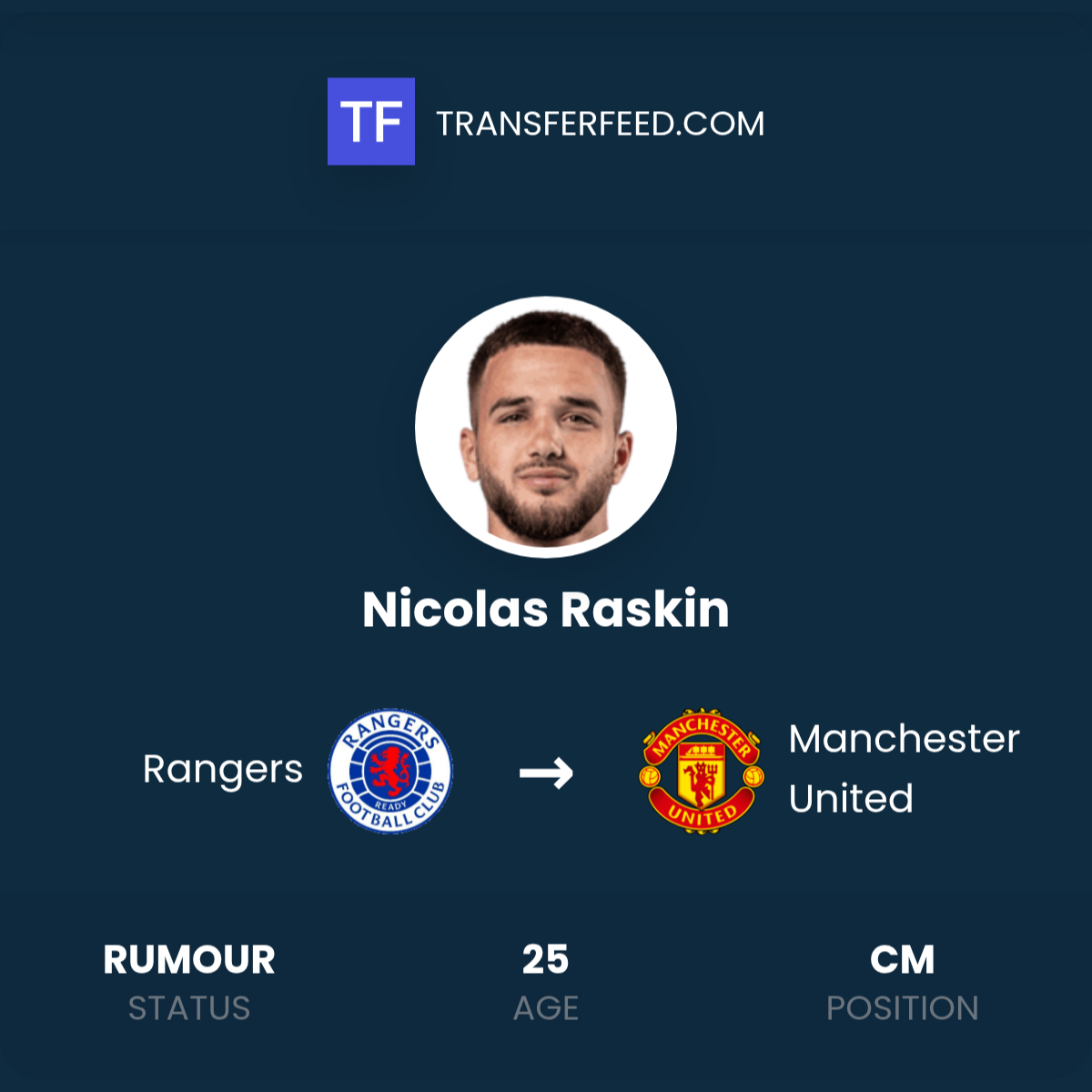
The roots of this go back to last September, when Raskin was still playing under previous Rangers manager Russell Martin. At that point, Raskin’s future had already become a live issue inside the club, not because of transfer interest from elsewhere but because of a breakdown in his standing with Martin himself. Reports from that period described Raskin as having been “unsettled” by transfer approaches during an earlier window, to the point where Martin left him out of a Champions League qualifier against Viktoria Plzen and, more strikingly, out of an Old Firm match against Celtic. Martin was quoted at the time saying Raskin had “a duty to make sure he earns the trust of all his other teammates and all the coaching staff,” language that made clear this wasn’t a tactical decision but something closer to a discipline or trust issue. Raskin was also left out of a matchday squad to face Hearts that same September, and pundits covering the club at the time speculated he could push for a January exit if he couldn’t work his way back into Martin’s plans. That dispute, notably, resolved itself in Raskin’s favor rather than in an exit. Martin left the club, Rangers appointed German manager Danny Röhl, and under Röhl, Raskin’s career at Ibrox was reportedly revived, with Röhl “taking his game to the next level” and making him one of his first names on the team sheet. By the time Röhl himself departed Rangers in June, having accepted the RB Salzburg head coach role after Rangers reached a compensation agreement with the Austrian club, Raskin had gone from a player on the fringe of the squad to genuinely one of Rangers’ most important performers.
That turnaround is worth dwelling on because it directly shapes the situation Rangers face now. A player who nearly left under a cloud of dysfunction less than a year ago has instead become arguably the club’s most valuable asset, elevated further by a strong World Cup campaign with Belgium this summer that put him on the radar of an unusually wide array of clubs. Derek McInnes was brought in as Röhl’s replacement over the summer specifically to guide Rangers into the new season, and one of the first major swirling questions he inherited, alongside rebuilding large parts of the first-team squad, was what to do about a homegrown academy-turned-first-team success story who now had suitors across four countries and two years still left on his contract.
The breadth of interest in Raskin this summer really is unusual, and tracing how it developed shows just how quickly a strong tournament performance can transform a player’s market. Rangers’ own valuation of him has moved substantially over just the past several months, itself a signal of how quickly the number kept needing to be revised upward as more clubs entered the conversation. Back in January, when interest in Raskin was still relatively contained, Rangers reportedly wanted at least thirteen million pounds for him, a figure roughly equivalent to fifteen million euros. By June, once Hull City had emerged as the first Premier League club to make a concrete approach, an offer in the region of fourteen million pounds was submitted and rejected outright, with Rangers viewing that bid as insufficient even before the World Cup boost to his value had taken effect. Through July, as talks reportedly progressed with Villarreal toward what was described as a positive, ongoing negotiation, Rangers’ valuation was widely cited in the region of twenty million pounds, equivalent to about twenty three and a half million euros. Then, once his World Cup performances for Belgium had registered fully across the football world, that valuation climbed again, with some reports placing it as high as twenty five million pounds, or close to thirty million euros, reflecting both his rising individual profile and the simple fact that he still had two full years left on his contract, giving Rangers genuine leverage to hold out rather than negotiate from a position of urgency.
That leverage, though, worked in tension with the calendar the entire time, and as the deadline approached, reporting suggested Rangers’ asking price was drifting back down rather than continuing to climb. Reports from August indicated Fenerbahce’s interest specifically centered around a fee closer to seventeen million euros, notably below where Rangers’ valuation had peaked, and other reporting suggested the club might be willing to accept offers nearer twenty million pounds again in the closing days of the window, a recognition that insisting on a premium figure risked losing him for less value entirely if no deal materialized and his contract ticked down toward its final year. That kind of price recalibration under deadline pressure is common in football negotiations generally, but the scale of the swing here, from a peak valuation near thirty million euros down to offers being discussed in the seventeen to twenty million range within the space of a few weeks, underlines just how much of this summer’s Raskin coverage was driven by shifting expectations rather than any fixed, agreed number both sides were working toward.
The list of interested clubs, when assembled in full, is genuinely one of the widest geographic spreads I’ve seen reported for a single Scottish Premiership player in one window. In England, Hull City remained the most consistently cited and the only club confirmed to have submitted a formal, rejected bid, though Leeds United, Tottenham, Brentford, and even Everton were all mentioned at various points as clubs monitoring his situation without formalizing interest. In Spain, Villarreal’s talks were the furthest along by most accounts, described as “positive and ongoing” through mid-July with a fee near twenty million euros discussed, while Real Betis was also linked without ever producing a concrete bid in the reporting. Italy produced the longest roster of interested clubs without any of them appearing to move decisively: Roma, Atalanta, Bologna, Inter Milan, and Fiorentina were all named across different reports, alongside an approach later attributed to French side Olympique Marseille and Germany’s Borussia Mönchengladbach, both of which were described as monitoring the situation rather than actively negotiating. Turkey produced arguably the most concretely engaged suitor outside of Hull City, with Fenerbahce reportedly making early contact specifically to establish financial terms, and Beşiktaş resurfacing with renewed interest of their own later in the window. Denmark’s Copenhagen even made a loan offer ahead of their own domestic deadline, which Raskin reportedly turned down, a detail that suggests his camp was holding out for a permanent move to a bigger league rather than entertaining a short-term loan arrangement regardless of the destination.
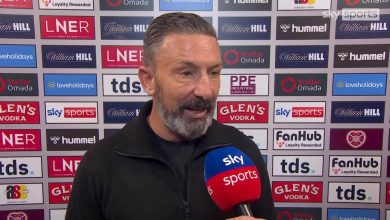
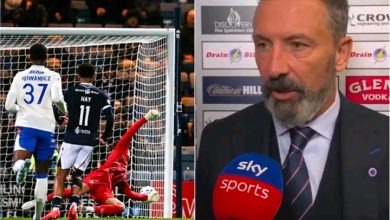
Amid all of that circling interest, the person whose public statements carry the most actual weight, because he’s the only one with direct knowledge of what offers have or haven’t arrived, has been remarkably consistent in his messaging throughout. Derek McInnes has been asked about Raskin’s situation repeatedly over the closing weeks of the window, and in every instance, his answer has amounted to the same thing: no formal bid has been submitted that Rangers can actually evaluate. After Rangers were eliminated from the Conference League by Czech side Jablonec, with Raskin left out of the squad entirely, McInnes confirmed there had been no offers despite the growing perception that his omission signaled an imminent departure. Days later, following a league win over Aberdeen, he repeated that message almost word for word, stating there had “certainly not been any offers for Nico,” and adding that transfer business at a club like Rangers tends to intensify only in the final couple of days of a window, meaning the club needs to be prepared for that late surge rather than assume anything is settled beforehand. Even in the very latest reporting available, following Rangers’ one-nil league win at Pittodrie, McInnes was still describing the club as “no further along” with selling Raskin, with pundit voices around the club acknowledging that while everyone expects bids to eventually come in, none had arrived as of that point.
This consistent gap between “widely expected to happen” and “no formal offer received” is the single most important thing to understand about how this story has actually unfolded, because it explains why so much of the coverage has felt repetitive without technically being wrong. Reporters and pundits close to the situation, including former Manchester United chief scout Mick Brown, have offered a fairly convincing explanation for why that gap exists and why it might persist right up until the closing hours of deadline day itself. Brown’s argument, repeated across multiple interviews with Football Insider, is that clubs which have been quietly monitoring a player for weeks or months without submitting anything formal often do so deliberately, waiting for the pressure of an approaching deadline to either force a selling club into accepting a discounted fee or to catch a target while other suitors are still deciding whether to commit. If that dynamic holds true here, and Raskin’s saga certainly fits the pattern Brown describes, then the absence of a confirmed bid through nearly the entire window doesn’t actually tell you much about whether a deal will ultimately happen. It may simply mean the real negotiating has been reserved for the final hours, a dynamic that would make today, the actual deadline for the Premier League and most of continental Europe, the moment where the entire summer’s worth of speculation either resolves into an actual transfer or quietly dissolves into Raskin staying at Ibrox for at least another season.
Rangers’ own conduct throughout the summer strongly suggests the club has treated a Raskin departure as a serious, actively planned scenario rather than an abstract possibility, and that preparation offers a useful lens for judging how seriously to take the speculation even without a confirmed bid attached to it. McInnes brought in three central midfielders during the window, Dan Neil, Vanja Dragojevic, and Cammy Devlin, well before any Raskin exit was close to materializing, a level of proactive squad-building in that exact position that would be a striking coincidence if the club weren’t at least partly building a contingency plan around his potential sale. Beyond that, a source close to the club told Belgian newspaper Le Soir that selling Raskin would instantly trigger a dedicated recruitment drive to bring in a direct successor, describing an internal plan that had already been finalized in case a sufficient offer landed in the closing stretch of the window. Pundit Scott McDermott, discussing the situation on Daily Record’s Hotline Live, went further still, framing Raskin’s likely departure within a much broader wave of expected outgoing transfers at Ibrox, naming Lyall Cameron, Ross McCausland, Clinton Nsiala, John Souttar, and Bojan Miovski as other players who could realistically leave before the window shuts, and suggesting Rangers could complete six or more outgoing deals in total. That scale of squad turnover, layered on top of McInnes’s own incoming business including South Korean winger Kim Min-su’s £8.5 million move from Girona and Venezuelan striker Kevin Kelsy’s roughly £9.5 million arrival from Portland Timbers, paints a picture of a genuinely comprehensive rebuild at Ibrox this summer, one in which Raskin’s situation is a significant piece but far from the only moving part.
There’s also a specific complicating factor tied to Rangers’ current squad that makes the timing of any Raskin sale riskier than it might otherwise be. Striker Youssef Chermiti is currently out injured, and several reports have flagged Raskin as arguably the club’s single most valuable and important remaining player given that absence, meaning his departure right now would coincide with an already-thinned attacking group rather than landing at a moment of squad strength. That context helps explain the emphasis, repeated by multiple sources, on Rangers requiring an immediate midfield replacement the moment any sale is completed, since losing Raskin without a ready alternative would leave a genuine tactical hole for McInnes to manage through the run-in to a season that’s already started slowly, with Rangers eliminated from both the Europa League and Conference League and sitting five points behind Celtic after just three league games.
For anyone trying to actually track how this resolves rather than continuing to read pre-deadline speculation, the calendar itself is the most useful piece of information available. The Premier League’s registration deadline falls today, September the first, at seven in the evening, earlier than the Scottish Premiership’s own cutoff of September the third, meaning any deal specifically involving a Premier League club, most plausibly Hull City or Brentford given their history of reported interest, would need to be fully agreed and registered before that Tuesday evening cutoff regardless of how much longer Rangers themselves have to conduct business domestically. If nothing materializes with an English club by then, an English Premier League destination for Raskin becomes moot for this specific window, even if informal talks with an English side continue past that point, since the paperwork window will have technically closed. Clubs elsewhere in Europe, including Villarreal, Fenerbahce, or Beşiktaş, generally operate under slightly different domestic deadlines, meaning the door for a deal with one of those clubs could, in principle, remain open a short while longer even after any Premier League possibility has formally expired for this window.
Taken as a whole, the honest and complete picture of the Raskin situation, as of the most recent confirmed reporting available, is one where near-universal expectation that he will leave Rangers this summer has still not translated into an actual, confirmed transfer. Every voice with genuine insight into the situation, from the manager himself to independent pundits tracking the club closely, describes his departure as effectively a matter of timing rather than a live question of whether it happens at all, driven by the combination of his rising post-World Cup value, the sheer number of clubs across England, Spain, Italy, and Turkey monitoring him, and Rangers’ own extensive preparation for life without him. And yet, as of Derek McInnes’s most recent on-record comments, no offer had actually been formally submitted, no fee had been agreed, and no single club had separated itself definitively as the most likely destination. Whether today’s deadline finally produces the resolution that months of speculation have been building toward, or whether Raskin instead ends up staying at Ibrox into the final stretch of a very different kind of season than anyone expected back in June, is something that genuinely cannot be determined from anything reported up to this point, and I’d treat any claim of a completed deal that surfaces in the next few hours with real scrutiny until it’s confirmed by the club itself or a reporter with a demonstrated track record on this exact story, rather than by another vague, hype-driven post with no name, no number, and no source attached to it.