Why Findlay Curtis, Not a Forward, Could One Day Take Lawrence Shankland’s Shirt

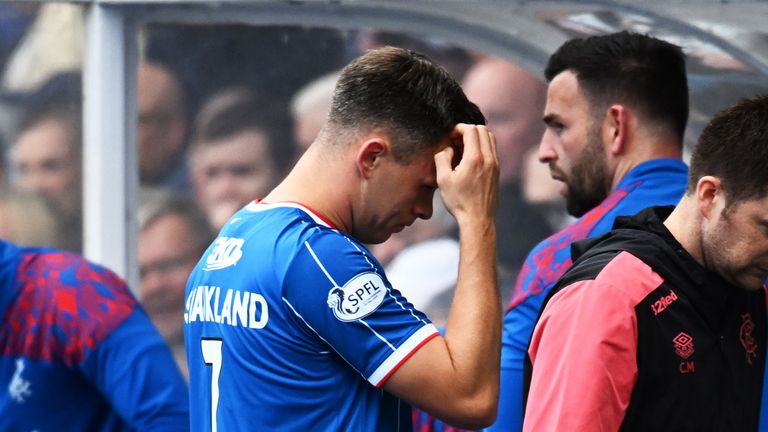
Squad numbers in football are supposed to be a bit of harmless tradition, a way of telling the supporters who is who. At Rangers, as at most big clubs, they are a little more than that. Certain shirts carry weight, and the number seven is one of them. It has a history of being worn by wide players and creative attackers, by men who run at defenders and make things happen on the right-hand side. So when Lawrence Shankland, a centre-forward by trade, was handed the shirt after arriving from Hearts, it raised a few eyebrows. Now, with Shankland sidelined and the squad evolving around him, an old question is being asked in a new way: who is the natural number seven at Ibrox, and is he already in the building?
The answer, in my view, is a player who is not a forward at all. Findlay Curtis, the academy graduate who has become a regular fixture in Derek McInnes’s first team this season, currently wears the number 52. That number tells you everything about where he started, as a young player from the Rangers youth system given a high squad number in the manner of an academy prospect. But the way he has played this season suggests he may not stay on that number for long. If Shankland’s Ibrox career fails to take root, or even if it simply runs its natural course over the next few years, the shirt could find its way to Curtis.
This is an opinion piece, so let me be clear about what I am and am not saying. I am not claiming that Shankland has failed or that a swap is imminent. I am saying that the number seven has a particular meaning, that Curtis fits that meaning more naturally than Shankland does, and that the circumstances of this season have made the possibility of a handover more realistic than it looked a few months ago.
Start with Shankland himself. He arrived at Rangers in May on a free transfer from Hearts, where he had been captain and one of the most prolific strikers in the Scottish game. Taking the number seven shirt, which had previously belonged to Rasmus Skov Olsen, was a notable detail, not least because the club marked it with a social media post describing him as joining an illustrious group of number sevens. The reaction from supporters was mixed in a good-natured way. Some were excited, others were surprised that a striker was being given a number so closely associated with wingers, and one or two were already joking about the weight of expectation that comes with it.
His start at Ibrox was, by most measures, encouraging. In his first five Premiership appearances he scored three goals, which is a strong return for a player settling into a new environment and a very different tactical role from the one he had at Tynecastle. He is 31 now, having turned that age in August, and he brings a level of experience and composure in front of goal that every squad needs. Nobody should underestimate how valuable a reliable finisher is, particularly in a league where chances are often scarce against deep defences.
But the picture quickly became more complicated. A hamstring problem has ruled him out, and reports suggest that he is on course to return in the new year rather than in the coming weeks. That absence has coincided with a separate crisis in the forward line, because Youssef Chermiti is out with an anterior cruciate ligament injury and is not expected back until very late in the season, if at all. Rangers have had to adapt, and the adaptation has revealed something about how McInnes wants his team to play.
The manager has leaned on Ryan Naderi, Kevin Kelsy and Bojan Miovski to lead the line, and each of them offers something different from Shankland. Naderi is a physical, mobile striker who has been scoring important goals, including the winner at Pittodrie. Kelsy is a versatile forward who can operate across the front line. Miovski brings experience and a different type of presence. Between them, they have given McInnes options, and some supporters have started to wonder where exactly Shankland fits in a team that appears to prize pace, power and movement in its forwards.
That is not a criticism of Shankland as a player. It is an observation about role. For Hearts he operated in a very specific way, dropping into pockets, linking play and finishing chances created by the system around him. At Rangers, the role he has been asked to play has not always matched that profile, and some supporters on fan forums have been vocal about it, questioning how well he suits the more demanding, mobile style that McInnes seems to want. Those views are opinions rather than facts, and it is early days, but they are part of the context in which the number seven question has arisen.
Which brings us to Curtis. The academy graduate has emerged as a regular first-team player for McInnes this season, and the numbers on his senior record are encouraging for someone so young: three goals and three assists at senior level. More important than the statistics, though, is the way he plays. Reports describe him as a player who began the season in a right-sided number ten role, running the show with his play in possession. That description is revealing, because it places him in the part of the pitch traditionally associated with the number seven, and it suggests a player who is comfortable receiving the ball between the lines and doing something creative with it.
His international form has reinforced that impression. While away with the Scotland Under-21s, he provided four assists in a single match, all of them from the right wing, a return that stands out in any age group. Scotland finished third in their qualifying group, behind Portugal, so they will not be at the Under-21 finals next summer, but the performance suggested a player whose natural habitat is wide on the right with licence to create. Put that alongside his club form, and you have a profile that fits the traditional meaning of the shirt much better than a penalty-box striker does.
That is the heart of the argument. Football’s squad number conventions are not rules, and plenty of strikers wear seven, but the number has a cultural association with wingers and attacking midfielders, particularly in British football. It stands for a certain kind of player: quick, inventive, comfortable in space and capable of producing a moment of quality. If you asked a group of Rangers supporters to describe a number seven, few of them would describe a centre-forward. They would describe someone like Curtis.
There is also a sentimental dimension, and it should not be dismissed. Rangers supporters have always taken particular pleasure in academy players who make it, who come through the system and establish themselves at the top level. The idea of a homegrown player taking one of the club’s symbolic shirt numbers has an appeal that goes beyond tactics. It says something about the pathway from the youth system to the first team, and it would be a powerful message to the next generation of young players watching from the academy.
Of course, there are reasons for caution. Curtis is still young, and a regular place in the team does not guarantee a long-term career at the top. He will have bad games and spells of poor form, and he will face competition from other players for the right-sided and advanced midfield positions. The squad contains plenty of attacking options, including Minsu Kim, who wears the number ten, Djeidi Gassama, Badredine Bouanani and others. Any one of them could force their way into the reckoning for a role on the right, and Curtis will need to keep improving to hold his place.
It is also worth remembering that Shankland’s situation is not as bleak as some of the more heated online commentary suggests. He is a proven goalscorer who has already contributed in his short time at the club, and he is expected back in the new year with a point to prove. Strikers often find their rhythm as the season goes on, and a fit Shankland who hits form in the winter months could easily change the narrative. McInnes has been cautious about rushing him back, which makes sense, and the club’s attacking depth gives them the luxury of patience.
So when I talk about Curtis taking the shirt, I am talking about the medium term rather than the immediate future. The article that sparked this discussion framed it in terms of what might happen if Shankland slips down the pecking order or finds his Rangers career over already, and that is a hypothetical rather than a prediction. What I find more interesting is the structural point: that the number seven at Rangers is currently on the back of a player for whom it is not a natural fit, and that there is a younger player in the squad who is.
There is a practical consideration too. Squad numbers are assigned at the start of each season, and any change would typically happen over the summer. That means there is no urgency, and no need for anyone to force the issue. If Curtis continues to develop and Shankland’s role at the club evolves, the conversation can take place naturally when the time comes. A player does not need to ask for a shirt; he earns the right to be considered for it through performances, and the club can decide accordingly.
What matters most in the short term is performance, not numerology. Rangers are in the middle of a strong run, with six consecutive wins and a place in the Premier Sports Cup semi-finals, and McInnes has made it clear that he wants his players focused on the next game rather than on what happens in the summer. Curtis, in particular, will be well served by keeping his attention on his own development. A player who produces consistently in the number 52 shirt will not need to worry about the numbers on his back.
There is also something to be said for the way the club has handled its number allocations. The decision to give Shankland the seven was a statement of respect, a signal that the club saw him as a major signing. It does not need to be undone or reversed, and nobody at Ibrox is likely to be thinking about the shirt in a way that undermines him. The beauty of football’s long history is that shirts get passed on, from one generation to the next, and that process is part of how clubs tell their story.
Looking across the squad, the picture is of a team in transition, with a manager who is still shaping his group and a number of players who are finding their level. Naderi has become a regular contributor, Kelsy is settling in, Chermiti is recovering from a serious injury, and Shankland is working his way back. In the middle of all that, Curtis has emerged as a bright spot, a young player from the academy who is performing well and showing the kind of qualities that make supporters believe. It is no surprise that people are beginning to talk about his future.
Is it fair to speculate? I think so, as long as it is done with respect for everyone involved. Opinion pieces exist to explore possibilities, and the idea that a talented academy graduate might one day inherit one of the club’s traditional shirts is a legitimate and interesting one. It does not diminish Shankland, and it does not presume that Curtis will succeed. It simply recognises that football is a game of cycles, and that every established player is, in a sense, keeping a shirt warm for the next.
If I had to put a timeline on it, I would say that the summer of 2027 is the earliest realistic moment for a conversation, and even then only if Curtis has had an excellent season and Shankland’s role has diminished. More likely, the situation will take a couple of years to resolve, and it may never come to a head at all. Players leave, shirts change hands, and the plans of clubs shift in ways that nobody can predict. But the possibility is there, and it is worth noting.
For now, the sensible position is simple. Shankland is the number seven, and he deserves the chance to prove he can be a success at Rangers. Curtis is the number 52, and he deserves the chance to keep developing at his own pace. If the two paths cross at some point in the future, then the club will have a good problem to solve. And if they do not, then both players will have contributed to a squad that is trying to bring success back to Ibrox.
What I would say to anyone tempted to dismiss the idea as fanciful is to watch Curtis play. Watch how he receives the ball on the right, how he turns, how he picks out a pass or drives at a defender. Then ask yourself whether that is the kind of player who belongs in the number seven shirt. I think the answer is obvious, and I think the club’s coaches probably agree. The only question is when, not if.
It is worth thinking about how Curtis might actually fit into McInnes’s team over a longer horizon. A right-sided attacker who starts wide but drifts inside can solve several problems at once. He gives the side a creative outlet against deep defences, he allows a full-back to overlap and stretch the pitch, and he provides a different kind of threat from the physical, mobile strikers through the middle. Against opponents who sit in a low block, which Rangers will face often in the Premiership, that type of player can be the difference between a frustrating draw and a comfortable win. If his assist return for Scotland Under-21s is anything to go by, he already has the vision to do it.
The contrast with Shankland is instructive rather than unflattering. A striker’s job is to be in the right place at the right time, and Shankland has built a career on doing exactly that. His strengths are in and around the penalty area, in timing a run, finding a yard of space and finishing a chance with composure. Those qualities do not disappear with age, and in fact they often become more valuable as a player learns to conserve energy for the moments that matter. A fit Shankland is the kind of forward who can win a tight game from a single opportunity, and there will be plenty of those over the course of a long season.
The point is that the two players are not really competing for the same job. Curtis would be the creator, Shankland the finisher, and a well-balanced team needs both. The number seven conversation only becomes relevant if the club decides that the shirt should reflect the position of the player wearing it, which is a matter of tradition and taste rather than necessity. Plenty of clubs are relaxed about that, and nobody would blame Rangers for leaving things as they are. But if supporters ever do want to see the seven restored to a wide player, Curtis is the obvious candidate.
There is a wider lesson here about how Rangers approach their squad. The club has often been criticised in the past for buying expensive players who failed to settle, while ignoring talent that was already available through the academy. A manager who is willing to give a young player regular minutes, and who has been rewarded with performances like Curtis’s, is doing something that supporters will respect. It saves money, it builds a connection between the stands and the pitch, and it creates a pathway that encourages the next group of academy players to believe they can follow.
That is perhaps the most important thing about the whole discussion. Whether or not Curtis ever wears the number seven, the fact that people are talking about it at all is a sign that he has arrived. A few months ago, an academy graduate in a high squad number would not have been the subject of speculation about a famous shirt. Now he is, and that tells you something about the progress he has made and the confidence McInnes has shown in him.
In the end, a squad number is only a number. What matters is what a player does while wearing it, and how supporters feel about him when he does. Shankland has the chance to make the seven his own, and I hope he does. But if the shirt ever does become available, there is a young man from the academy who has already shown he has the talent, the temperament and the sense of occasion to wear it. That is a good thing for Rangers, and it is worth keeping an eye on.








