🔵🇻🇪 SHANKLAND RELISHES KELSY ARRIVAL AS RANGERS BOLSTER FORWARD LINE WITH £9.2M DEAL ⚽


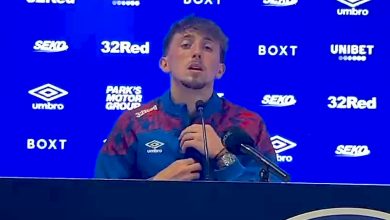
Lawrence Shankland has never been the sort of player to shy away from competition, and he made that clear in typically direct fashion after Rangers confirmed the signing of Kevin Kelsy from Portland Timbers in a deal worth £9.2million, becoming the club’s second most expensive signing in its history behind only Tore André Flo’s move a full twenty-six years ago. Speaking fresh from a brace of his own in Rangers’ two-one win over Falkirk on Wednesday night, the Ibrox captain gave the newest addition to McInnes’s forward line an emphatic welcome, framing the arrival of a nine-million-pound-plus centre-forward not as a threat to his own place in the team but as exactly the kind of healthy internal competition a club of Rangers’ size and ambition should expect to generate.
“There’s always got to be healthy competition at football clubs like this,” Shankland said, addressing the fee directly rather than dodging the obvious subtext of a club captain being asked to react to his own position being strengthened against. “You know that coming in. You’re obviously talking about the transfer fee. It’s obviously an important one, but that’s the way football is going. If you want good players, you need to pay money now.” It is a refreshingly matter-of-fact response from a player who, on the face of it, has every reason to view Kelsy’s arrival with at least a flicker of professional wariness, and it speaks to the kind of dressing-room culture McInnes has been trying to build at Ibrox since taking charge, one in which internal competition for places is treated as a strength to be embraced rather than a threat to be managed carefully around egos.
Kelsy’s arrival addresses a specific and pressing need in McInnes’s squad, one that emerged in painful circumstances. Youssef Chermiti, signed to provide competition and cover in the number nine role, suffered an anterior cruciate ligament injury in the defeat to Hibernian, an injury serious enough to require surgery in London and rule the Portuguese forward out for a significant stretch of the season. That left McInnes with a genuine gap at centre-forward heading into the closing weeks of the transfer window, and the pursuit of Kelsy, a twenty-two-year-old Venezuelan international who had been in prolific form for Portland Timbers in Major League Soccer this year, was Rangers’ direct response to that setback. The Rangers Review had reported an agreed fee of around nine million pounds for Kelsy the week before the move was finalised, and while there was some uncertainty in the days that followed, with one report citing a source close to the club denying the deal was fully done at that exact figure, all parties involved remained “confident” the move would ultimately be completed before the window closed, and so it proved.
The final structure of the deal, once confirmed, saw Rangers commit to an initial fee of £9.6million with additional add-ons layered on top, along with a sell-on clause included as part of the arrangement, a detail that gives Portland Timbers a stake in any future transfer premium should Kelsy go on to thrive and eventually move on again eventually. Kelsy has signed a four-year contract at Ibrox, with the option of a further twelve months attached, tying him to the club through what should represent the core years of his development as a striker, and giving Rangers long-term control over an asset they clearly believe carries considerable upside. The scale of that commitment, both financially and in terms of contract length, underlines just how seriously McInnes and his recruitment staff rate Kelsy’s potential, treating this very much as a marquee, statement signing rather than a straightforward stopgap addition brought in purely to plug the Chermiti-shaped hole in the squad.
Kelsy himself did not hide his excitement at completing the move, having travelled to Europe to undergo his medical examination on the Monday before the deal was finalised, saying his goodbyes at Providence Park in Portland before arriving in Scotland on the Wednesday. “I’ve heard a lot about the club,” Kelsy said upon completing his move. “Even when I was younger, I saw the team in Europe. I know what the club means to the fans. I would love to bring some joy to the fans and the club, and score goals to bring amazing moments to the team. I know we have to win all the games and play well, and I’ll be ready for this with my teammates. I’m ready for this new chapter in my life.” It is the kind of statement that, while inevitably following the familiar script of a newly unveiled signing, nonetheless carries genuine weight given the scale of the fee involved and the pedigree of the club he is joining, a young forward openly acknowledging he grew up watching Rangers compete on the European stage and now finds himself walking through the door as one of the most significant investments in the club’s transfer history.
McInnes was similarly warm in his own reaction to landing his man, telling the club’s official channels: “We’re really pleased to welcome Kevin to the club. Kevin has a great attitude and a real desire to improve, and we’re looking forward to seeing what he can bring at Rangers.” It is worth noting the specific language McInnes chose there, emphasising attitude and a desire to improve rather than simply reeling off Kelsy’s goalscoring statistics from MLS, a framing that suggests the Rangers head coach sees this as much as a long-term development project as an immediate, ready-made goalscoring fix for a squad that has occasionally struggled for firepower this season. Kelsy’s route to Portland Timbers itself tells its own story of a player who has already accumulated a fair amount of senior football at a relatively young age, having come through the Shakhtar Donetsk system before gaining MLS experience with both FC Cincinnati and Portland across the last two seasons, a path that has exposed him to different footballing cultures and levels of competition even before this latest, most significant step of his career.
Kelsy’s arrival lands him thirteenth on the list of Rangers’ summer signings, a genuinely striking figure that underlines just how comprehensively McInnes has reshaped his squad since taking charge at Ibrox, and it followed hot on the heels of another significant piece of incoming business, with midfielder-forward Min-su Kim having arrived in an £8.5million move from Girona earlier in the same window. Taken together, the fees committed to Kelsy and Kim alone, before even factoring in the rest of McInnes’s thirteen summer arrivals, paint a picture of a Rangers hierarchy backing their new head coach with genuinely significant financial resources as he works to build a squad capable of competing domestically this season, particularly given the club find themselves without European football entirely this campaign following their qualifying exits over the summer.
The context around Shankland’s own start to life as Rangers captain makes his gracious reaction to Kelsy’s arrival all the more notable. Having joined from Hearts and been handed the captaincy over the summer, Shankland did not enjoy the smoothest of opening chapters at Ibrox, scoring just a single penalty across his first seven appearances in all competitions, a underwhelming return for a forward signed specifically for his proven goalscoring pedigree in the Scottish game. Statistical analysis circulating before the Kelsy deal was finalised had highlighted a specific area of concern in Shankland’s own game too, with the Scotland international having lost eighty per cent of his aerial duels in the Premiership this term, a marked contrast to Kelsy’s own record of winning sixty-one per cent of his aerial contests in MLS this year, a discrepancy that had led some observers to suggest Kelsy’s arrival could represent more of a genuine threat to Shankland’s starting spot than the captain himself was letting on publicly.
Whatever the numbers suggested in the build-up to the move being completed, Shankland answered any doubts about his own form in the most emphatic way possible, scoring twice in Rangers’ two-one victory over Falkirk on the very night before Kelsy’s arrival was confirmed, a timely reminder to McInnes, to the watching Ibrox support, and perhaps most pointedly to Kelsy himself, of exactly what the Rangers captain remains capable of when his own form clicks into gear. That brace against Falkirk followed an earlier winning goal against Aberdeen the previous Sunday, giving Shankland a run of significant contributions in the days immediately preceding Kelsy’s unveiling that will have done plenty to settle any nerves around Ibrox regarding the captain’s place in the side, even with a nine-million-pound rival for his starting berth now formally part of the squad. It is that context, a captain finding his scoring touch at precisely the moment a direct competitor for his position arrives through the door, that gives Shankland’s comments about healthy competition rather more substance than they might otherwise have carried had he been struggling for form and goals at the same moment.
Tactically, Kelsy’s arrival also needs to be read against the backdrop of a formation shift McInnes has made in recent weeks. Rather than deploying two out-and-out number nines in tandem, as many had expected given the club’s recent recruitment pattern in the striker department, McInnes has instead settled on a 4-2-3-1 system following a difficult start to the season, with Findlay Curtis, Min-su Kim and Djeidi Gassama operating as the attacking three behind a single central striker, a role Shankland has occupied throughout that period. That structural detail matters considerably when assessing exactly how Kelsy is likely to be integrated into the side: rather than simply representing a like-for-like alternative to slot in alongside Shankland, his arrival more plausibly sets up a straightforward, old-fashioned battle for the single central striker’s berth, with McInnes able to rotate between his captain and his new record signing depending on form, fitness and the specific demands of each fixture, rather than needing to find a way to accommodate both simultaneously within his preferred system.
There is also a broader depth chart to consider in Rangers’ centre-forward department beyond just Shankland and Kelsy. Ryan Naderi, the young German forward who joined on deadline day during the previous winter window, has contributed two goals from seven appearances this season, a modest but not insignificant return that keeps him firmly in the conversation as a rotation option even with Kelsy’s considerably higher-profile arrival. Bojan Miovski, meanwhile, has fallen further down the pecking order amid his own struggles for regular game time and has been the subject of external interest from clubs in Europe throughout the summer, a situation that could yet see further movement in that department before the story of Rangers’ forward line for this season is fully written. McInnes now finds himself with a genuinely crowded, competitive centre-forward department, spanning an established Scotland international captain in Shankland, a marquee record signing in Kelsy, a developing young option in Naderi, and a fringe figure in Miovski whose long-term future at the club remains genuinely uncertain, a level of strength in depth up front that few Rangers squads in recent years have been able to boast simultaneously.
For a club that has endured a genuinely turbulent twelve months, encompassing a managerial change, a first season without European football since 2017, and no shortage of noise around individual player futures throughout this transfer window, the confirmation of Kelsy’s signing represents a concrete, tangible statement of intent as the domestic season gathers pace. Nine million pounds, rising with add-ons, for a twenty-two-year-old with genuine MLS pedigree and evident hunger to prove himself on a bigger stage is precisely the kind of ambitious, forward-looking business Rangers supporters will want to see from a club still working to reassert itself after a difficult period, and Shankland’s own willingness to publicly frame the arrival as healthy rather than threatening competition speaks well of the environment McInnes appears to be cultivating within his squad. Whether Kelsy can hit the ground running quickly enough to force his way into McInnes’s starting eleven ahead of a captain who has just answered his early-season critics with a brace of his own remains to be seen, but Rangers, for the first time in some time, find themselves with a genuine, high-quality selection headache up front rather than a gap that urgently needed filling, and that alone represents real progress after a summer that began with considerably more uncertainty than it is now ending with