Manchester City, one of the biggest football clubs in the world, have found themselves in a moment many fans never expected. After years of winning trophies and dominating both in England and Europe, City’s season has taken a dramatic turn. Their hopes in the UEFA Champions League — a competition they cherish above all — have been devastated by a shocking defeat that has left players, managers, fans and critics asking the same question: What is going wrong?
It all came to a head with a stunning 3‑1 defeat away to Bodø/Glimt a Norwegian side who had never won a match at this level before. City’s loss wasn’t just another bad result — it was a symbolic moment, an upset so complete that it felt like a signal that something deeper was broken. In that Arctic Circle night, City didn’t just lose a game — they lost momentum, belief, and control of their season.
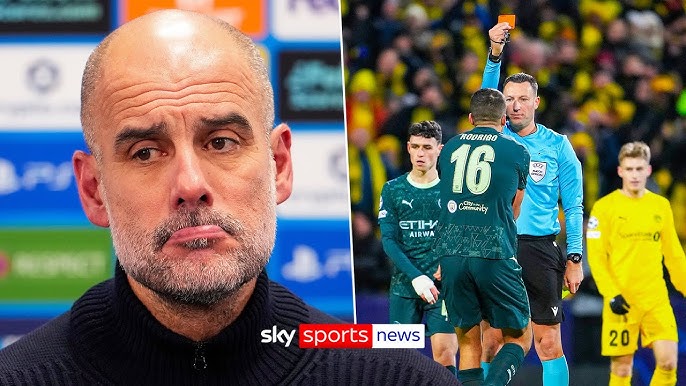
City now sit outside the automatic qualifying places for the knockout stages of the Champions League and must fight just to stay alive in the competition. Manager Pep Guardiola, one of the most successful coaches in modern football, admitted afterward that “everything is going wrong.” For a club built on precision, control, rhythm and confidence, that was a rare
In Norway, City were undone by two quick goals from Kasper Høgh and another strike from Jens Petter Hauge. City managed only one goal through Rayan Cherki, and then their captain Rodri was sent off after two yellow cards in just over a minute — a moment that shocked observers and weakened their ability to fight back. That red card was a microcosm of the night: unexpected, chaotic, and costly.
This was not a simple defeat. It was a game where City looked vulnerable in almost every department: defensively fragile, devoid of rhythm, and psychologically shaken. The opponent was not some global giant — they were an underdog enjoying the night of their lives. Yet the visitors were unable to cope. That benching of key players, injuries and an inability to adapt compounded the collapse.
Guardiola himself said that it felt like “everything that could go wrong was going wrong… in many, many details.” That kind of phrasing shows just how deep the problem feels to people inside the club — not simply a few mistakes, but a sense that the tide has turned against them
To understand how bad things have become, you must look at the run of form* around this shock loss.
Before Bodø/Glimt, City suffered a painful derby defeat to Manchester United. Then there have been other disappointing results — draws, draws that should have been wins, and losses that seemed unthinkable a year ago. In fact, at the time of their Champions League defeat, City had won just two of their last seven matches in all competitions, and one of those wins was against a third‑tier team in the FA Cup.
This is not the same team that used to dominate seasons with seemingly effortless consistency. For years, when City led games, they *kept the lead*. This season, they haven’t been able to do that. They’ve given up leads more than once — against top teams and lesser opponents alike. Competitive spirit and tactical discipline feel thinner than in previous years.
The overall statistics show a team struggling for form on both ends of the pitch: struggling to score when they create chances, and conceding more easily than expected when opponents
Pep Guardiola is known for his confidence and control. He rarely suggests his team is unlucky or that random elements are to blame. But in the aftermath of this latest crisis, even he seemed unsettled.
He spoke unguardedly about the team’s misfortunes — saying that “everything is going against us” and that they have had many things working against them, including injuries and loss of key players.That marks a change from his usual steely public demeanor.
City midfielder Bernardo Silvaclllllllllllllalso admitted the team is in a *“dark place.”* It wasn’t the usual, polished spokesperson analysis — it was a raw statement about confidence and morale. Silva spoke of the side conceding too easily and failing to take chances even when they played well. For a top‑level squad, that’s a damning
Even Erling Haaland, normally a source of power and goals, called the performance “embarrassing” and acknowledged he was in a poor patch of form. For a striker who has been dominant in years past, that admission is significant.
In Norway, Guardiola was without **11 senior players** due to injury, illness, suspension, or eligibility rules. Losing that many first‑team players at once is a blow no matter who you are — but for a team that relies heavily on tactical fluidity and cohesion, it was crippling.
This has been a recurring issue throughout the season. Key players like Rodri — whose presence in midfield often anchored City’s game — have been absent at critical times due to injury. Others have been returning slowly from long layoffs, meaning the team has not been able to find its best shape.
It’s not just injuries. Squad rotation — changing lineups for different competitions — has sometimes backfired. In one Champions League game against Bayer Leverkusen Guardiola made 10 changes and later said he felt some players didn’t try and were too cautious. That kind of remark from a manager of his caliber suggests frustration and lack of trust in the squad depth.
Football isn’t just tactics and fitness. It’s also psychology — belief, timing, momentum, rhythm. And this Manchester City side seems to have lost all three.
Formerly, City could grind results out even on poor days because of confidence. This season, that resilience isn’t there. When mistakes happen, they compound. When goals are conceded early, panic and disarray follow. Small errors turn into big problems. Former players and pundits have noted that the team now seems *mentally fragile*, unable to handle pressure moments with the calm it once had.
City used to create an atmosphere around them — a belief that the second half would always bring answers, that the pressure would eventually tell on the opponent. Now the opposite feels true. There’s a real sense that the team doubts itself more easily. That shift has deeper causes than any one bad resul
Part of City’s success for the last decade has been Guardiola’s innovative tactics: possession, positional play, pressing, quick transitions. But in recent months, some of those tactical traits have looked less sharp.
Opposition teams have started to identify ways to disrupt City’s rhythm. Pressing them aggressively, forcing turnovers in midfield, and exploiting space behind their defenders. Even sides with less overall quality than City have found ways to make the game uncomfortable for them.
That doesn’t mean City suddenly became a bad team overnight. But it suggests that others have adapted, while City’s evolution has stalled. When you add in injuries and mental fragility, tactical rigidity can become a weakness rather than a streng
First, Champions League elimination — or struggling to qualify — means less revenue, lower morale and financial consequences. Prize money and matchday income from progressing deep in Europe would have been significant. An early exit hits the club’s finances, as well as its prestige.
Second, the Premier League title race is now more difficult. Arsenal and other rivals have pulled away while City drop points. The club that once seemed almost untouchable domestically now finds itself scrambling for every point. That’s a major shift for a team used to leading the charge week after week.
And third, internal confidence — the belief that this era can continue at its peak — has been shaken. Players who used to take their success for granted now question their own form, and that doubt can spread quickly if not checked.
Fans and pundits have reacted strongly. Some are realistic — saying every long‑running great team goes through cycles and dips. Others are harsher, saying Guardiola has lost his magic touch after nearly ten years at the top. TalkSPORT even published opinion that he should consider resigning if the decline continues.
But not all reactions are negative. Many supporters continue to back the team and the manager, pointing to injuries and the extraordinary consistency City have shown over the years. This isn’t a collapse from greatness to failure; it’s a rough patch for one of football’s most successful clubs.
In an emotional gesture, City’s players even pledged to refund fans who travelled to the Bodø/Glimt match, acknowledging their own disappointment and showing solidarity with supporters. That speaks to a humanity within the team even in dark moments.
Despite the gloom, there are reasons to hope.
City are still competitive in the Premier League, even if they aren’t leading it. They still have Champions League football on the line — it isn’t over yet. And Guardiola is a manager known for turning adversity into fuel. He has rebuilt teams before, changed styles mid‑season, and found solutions in difficult times.
Younger players are gaining experience. New signings are integrating. Injured stars are returning. And when this City team clicks, they still have world‑class talent all over the pitch.
What’s going wrong for Manchester City? It is not one single cause — it is a mixture of injuries, loss of form, tactical challenges, psychological fragility, and a string of bad results that feed on each other.
A shock Champions League defeat to Bodø/Glimt was the flashpoint, but the underlying issues have built up over time. Guardiola’s midfield is sometimes stretched too thin; the team’s confidence has taken hits; and rivals have caught up in areas City once dominated.
Yet this does not spell the end of the City project. It’s a litmus test, a moment of truth for everyone connected to the club. How they respond will define this season far more than the loss itself.
If City can regroup — regain confidence, adjust tactics, restore fitness and mental strength — they could still rescue their season. But what will not be forgotten is how a club so dominant could find itself on the back foot so suddenly — a story of sport’s uncertainty, where confidence and momentum matter as much as skill and trophies.