Football finance expert Kieran Maguire has warned Man City could face a 40-60 point decision if the 115 charges verdict doesn’t go their way

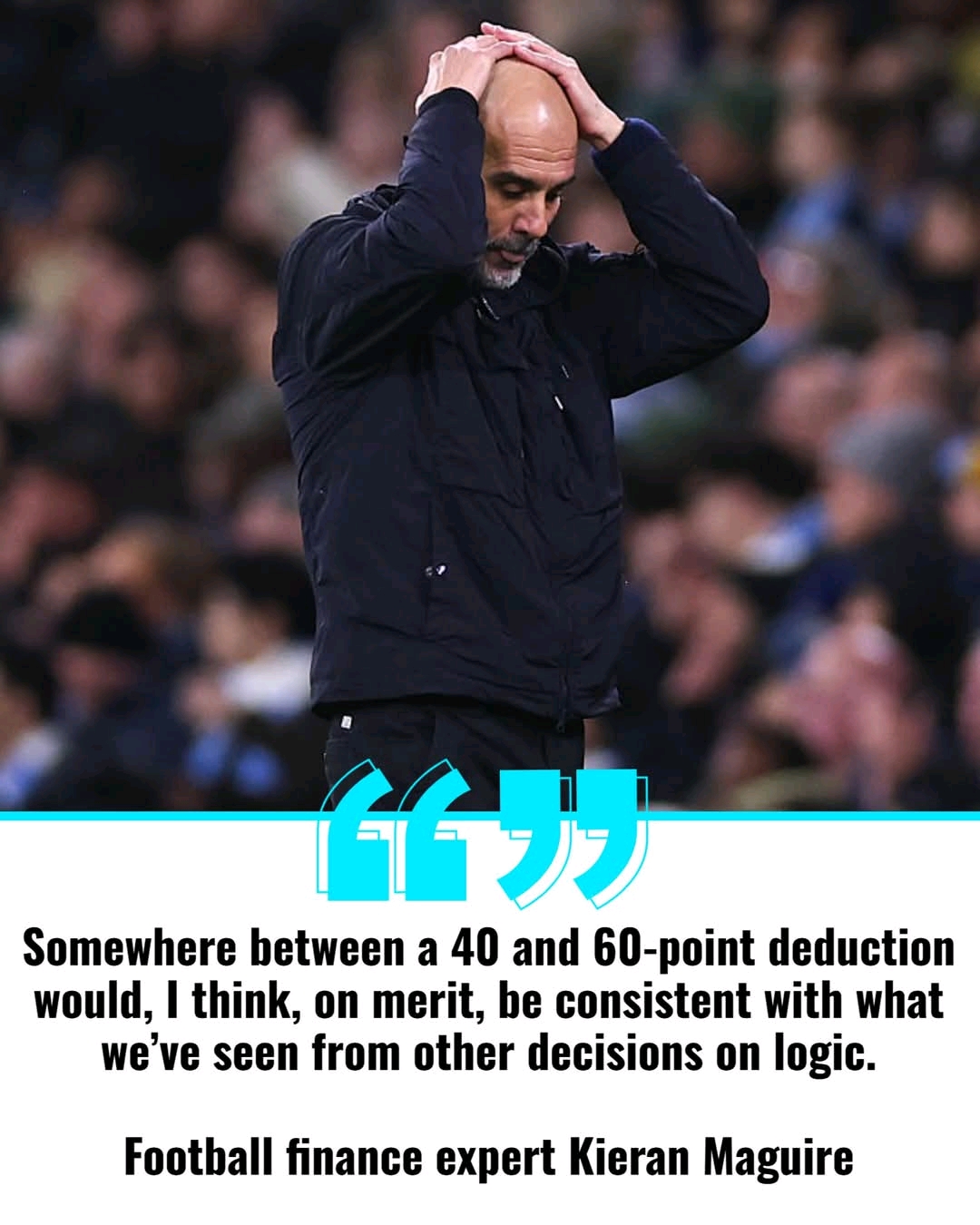
Kieran Maguire, a football finance expert widely respected for his detailed understanding of club accounts, regulations, and Premier League operations, has delivered a stark warning to Manchester City as the outcome of the ongoing 115 financial charges case approaches. The situation is tense and unprecedented, not just for City, but for English football as a whole, because the verdict has the potential to reshape the very foundations of how clubs operate both on and off the pitch. Maguire’s analysis suggests that if the verdict does not go in Manchester City’s favor, the consequences could be severe enough to cost the club between forty and sixty points in the Premier League, a scenario that would completely alter the trajectory of their current and future seasons.
Manchester City’s current position in the league and their ongoing campaigns in domestic and European competitions mean that any reduction of points would not simply affect this season’s standings, but also have far-reaching implications for their finances, reputation, player morale, and transfer plans. The six-time Premier League winners, managed by Pep Guardiola, have built a squad and a legacy on consistent performance and financial investment that adheres to the rules of the game, at least publicly, and now all of that could be called into question depending on the legal and regulatory decisions forthcoming.
Maguire, known for breaking down the often complex intersection between club accounts, UEFA financial fair play rules, and Premier League regulations, has explained that the charges against Manchester City are serious. The 115 allegations reportedly cover multiple seasons and include accusations of financial misconduct, possible breaches of fair play regulations, and irregularities in sponsorship and revenue declarations. While City has consistently denied wrongdoing and positioned themselves as fully compliant with all regulations, Maguire warns that the severity of the case means the Premier League or associated regulatory bodies could impose exceptionally heavy penalties if they rule against the club.
In his commentary, Maguire pointed out that a deduction of 40 to 60 points is not just theoretical. The Premier League has the authority to impose sanctions of such magnitude in cases of gross violations, particularly when multiple infractions are proven over a period of time. To contextualize the scale, a points deduction in that range would move Manchester City from title contention to a relegation battle overnight, something the club, its supporters, and the league itself has never truly seen in modern English football. Such a penalty would not only erase the hard-earned points from matches on the pitch, but it would also cast a shadow over every previous title or cup won during the period under investigation, raising questions about the legitimacy of past achievements.
The timing of this verdict adds another layer of complexity. Manchester City currently sit in a highly competitive Premier League season, battling with Arsenal and other challengers for the top spot. With European competitions ongoing, a points deduction would impact their standing in the Champions League indirectly, affecting seedings and potentially the club’s ability to attract top talent in the next transfer windows. Players and staff would have to manage uncertainty while maintaining performance on the field, and Guardiola, known for his meticulous planning and focus, would face one of the greatest managerial challenges of his career, having to motivate a squad while knowing that points on the pitch might be stripped away due to administrative and financial rulings.
Maguire’s warning also highlights the financial implications of such a scenario. A deduction of forty to sixty points would likely see Manchester City drop out of qualification spots for the Champions League, resulting in significant revenue loss from UEFA distributions, matchday income, and global broadcasting rights. Sponsorship deals, many of which are performance and participation-dependent, could be renegotiated or reduced, creating a ripple effect across all commercial operations of the club. Beyond the immediate financial losses, the reputational damage of a verdict against City would likely impact their global brand, reducing the club’s commercial appeal and potentially affecting player recruitment. The club has invested heavily over the past decade to establish itself as one of the world’s most attractive destinations for football talent, and any hint of scandal could undermine that perception.
Maguire also emphasized that the regulatory process itself is incredibly meticulous. Investigations of this scale involve detailed audits of contracts, sponsorship deals, and internal communications. The Premier League and other football governing bodies would examine every piece of evidence, from sponsorship arrangements to accounting practices, in order to determine whether breaches occurred and the severity of each. The 115 charges reportedly span several seasons, meaning that if wrongdoing is found, the authorities may feel compelled to impose maximum penalties to set a precedent, not just for Manchester City but for all Premier League clubs. The potential for a 40 to 60-point deduction is indicative of the gravity of repeated or systemic breaches, and Maguire has made it clear that this is not a situation where a minor fine or slap on the wrist would suffice in the eyes of the regulators.
City’s management and board have maintained a defensive posture publicly, insisting on compliance and cooperation with authorities while continuing to focus on football operations. Guardiola has publicly dismissed distractions as secondary to on-pitch performance, insisting that his players must remain focused and deliver results regardless of off-field issues. Yet Maguire notes that while leadership can maintain calm publicly, the psychological effect on players and staff cannot be ignored. Knowing that victories could be nullified retroactively puts pressure on motivation, team morale, and mental focus. Even the most disciplined professionals can find their performance affected by external uncertainty, and the scale of the potential point deduction magnifies this effect.
The media has followed the case closely, providing constant updates on procedural developments, internal statements from the club, and expert opinions from financial analysts like Maguire. Public perception, influenced by the coverage, could either amplify pressure on the Premier League to act decisively or on Manchester City to settle disputes or present additional evidence to mitigate sanctions. Maguire has argued that transparency and cooperation are crucial in such situations. Clubs that demonstrate a willingness to engage fully with regulatory authorities often receive more favorable treatment, but he cautions that the size and complexity of the charges mean that leniency cannot be guaranteed.
Historical precedents in English football, while limited, show that points deductions have been used to punish clubs for severe breaches of regulations. From financial irregularities to administrative misconduct, previous cases illustrate that the Premier League is prepared to impose harsh measures when violations are clear, particularly if multiple or repeated offenses are involved. A 40 to 60-point deduction would be unprecedented in modern Premier League history, but Maguire warns that this could be exactly what happens if the 115 charges are upheld fully. He has repeatedly emphasized that clubs cannot underestimate the severity, and even a club of Manchester City’s stature and resources could find itself dramatically affected.
The broader implications for the sport are equally significant. Should Manchester City face a major points deduction, it would signal to every Premier League club that financial compliance is not negotiable and that the authorities are willing to enforce the rules rigorously. This could lead to more cautious approaches in contract negotiations, sponsorship deals, and accounting practices across the league, potentially reshaping how clubs operate in the transfer market and commercial sectors. Maguire has suggested that the verdict could set a legal and regulatory benchmark, influencing decisions for years to come and demonstrating that even elite clubs are accountable under the rules.
Fans have also become deeply invested in the potential outcomes. Manchester City supporters, accustomed to success and dominance in English football, face the anxiety of seeing their club potentially punished in a manner that could erase months of work on the pitch. Rival supporters see an opportunity to capitalize on City’s vulnerability, but the uncertainty also adds tension across the league, as every club’s position could shift dramatically if points are deducted retroactively. Maguire has noted that fan reactions, while emotional, may have indirect influence on the broader footballing conversation, affecting narratives in media, negotiations in sponsorship, and pressure on regulators.
In the meantime, Manchester City must continue to perform under the shadow of uncertainty. Every match carries additional weight, as victories on the field could be rendered irrelevant if a points deduction is imposed. Guardiola faces the dual challenge of keeping his squad focused on results while managing the mental strain that comes with off-field controversies of this magnitude. Maguire points out that this balancing act requires exceptional leadership, resilience, and clarity of communication within the club, and that failure to maintain composure could exacerbate the impact of the legal proceedings.
Maguire’s warning also underlines the interconnected nature of football finances and competition. A points deduction is not just a sporting penalty; it has cascading effects on finances, player contracts, transfer budgets, and sponsorship agreements. If City were to lose forty to sixty points, they would likely drop out of European qualification spots, impacting future revenue streams and the ability to attract elite players. The club’s long-term strategic plans could be thrown into disarray, forcing management to reassess priorities and rebuild trust with investors, sponsors, and supporters.
Experts have debated possible outcomes and mitigation strategies, including partial deductions, fines, or negotiated settlements, but Maguire stresses that nothing can be taken for granted given the scale and scope of the 115 charges. Each point deducted represents not just a match result, but the culmination of strategic planning, player effort, and management execution, highlighting the gravity of potential consequences.
In conclusion, Kieran Maguire’s assessment paints a sobering picture for Manchester City. The 115 charges case is unprecedented in modern Premier League history in terms of scale, complexity, and potential penalties. A 40 to 60-point deduction, while extreme, is within the realm of possibility if regulators rule against the club fully. The impact would reverberate across the sport, affecting on-pitch performance, finances, squad morale, fan sentiment, and the broader footballing ecosystem. For Manchester City, the verdict represents a crossroads. How the club navigates this challenge, communicates with stakeholders, and maintains performance on the field will define not only the current season but also the club’s reputation and legacy for years to come. Maguire’s warning is clear, detailed, and unambiguous: the stakes could not be higher, and the consequences of an adverse decision could reshape the Premier League in ways no one has seen before.